Adolf Hitler - Hitler’s Second Book
Здесь есть возможность читать онлайн «Adolf Hitler - Hitler’s Second Book» весь текст электронной книги совершенно бесплатно (целиком полную версию без сокращений). В некоторых случаях можно слушать аудио, скачать через торрент в формате fb2 и присутствует краткое содержание. Город: New York, Год выпуска: 2003, ISBN: 2003, Издательство: Enigma Books, Жанр: Публицистика, на английском языке. Описание произведения, (предисловие) а так же отзывы посетителей доступны на портале библиотеки ЛибКат.
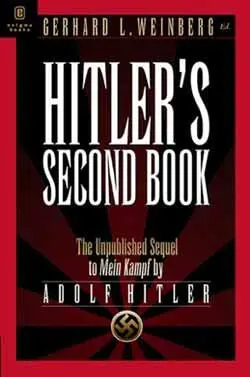
- Название:Hitler’s Second Book
- Автор:
- Издательство:Enigma Books
- Жанр:
- Год:2003
- Город:New York
- ISBN:978-1929631162
- Рейтинг книги:4 / 5. Голосов: 1
-
Избранное:Добавить в избранное
- Отзывы:
-
Ваша оценка:
Hitler’s Second Book: краткое содержание, описание и аннотация
Предлагаем к чтению аннотацию, описание, краткое содержание или предисловие (зависит от того, что написал сам автор книги «Hitler’s Second Book»). Если вы не нашли необходимую информацию о книге — напишите в комментариях, мы постараемся отыскать её.
* * * In 1958, while directing the microfilming and organization of a trove of archives that the U.S. forces had taken from the Nazis at the end of WWII, historian Weinberg (
) discovered the manuscript of a second book that Hitler had written but never published. The manuscript was published in German in 1961, accompanied by Weinberg’s annotations, but this is the first authoritative English version (a pirated and poor translation appeared in the 1960s). The text bears all of Hitler's hallmarks: rambling thoughts, half-baked ideas, pedantic writing-along with a terrifying, sustained belief in war and violence as the means to ensure that Germans would flourish. Compared to
, there are fewer pages devoted to Jews. Nonetheless, what comes across most strongly is Hitler’s abiding commitment to the principle of race and his identification of Jews as the enemy that threatened to undo all that Germans had created. Hitler dwells at length on foreign policy, and outlines a strategy of alliance with Fascist Italy and Great Britain. (He actually believed that Britain would accept a German-dominated European continent so long as Germany did not challenge the overseas British empire.) He also foresees an inevitable clash with the United States. This provides solid historical background on Hitler's thinking in the late 1920s, when his party was nothing more than a tiny, radical sect. Weinberg provides helpful notes and a very informative introduction.
Copyright 2003 Reed Business Information, Inc. “Politics is history in the making.”
Such were the words of Adolf Hitler in his untitled, unpublished, and long suppressed second work written only a few years after the publication of
.
Only two copies of the 200 page manuscript were originally made, and only one of these has ever been made public. Kept strictly secret under Hitler’s orders, the document was placed in an air raid shelter in 1935 where it remained until it’s discovery by an American officer in 1945.
Written in 1928, the authenticity of the book has been verified by Josef Berg (former employee of the Nazi publishing house Eher Verlag), and Telford Taylor (former Brigadier General U.S.A.R., and Chief Counsel at the Nuremburg war-crimes trials) who, after an analysis made in 1961, comments:
*as quoted by http://www.pharo.com/lost&found.htm
“If Hitler’s book of 1928 is read against the background of the intervening years, it should interest not scholars only, but the general reader.”*
Hitler’s Second Book — читать онлайн бесплатно полную книгу (весь текст) целиком
Ниже представлен текст книги, разбитый по страницам. Система сохранения места последней прочитанной страницы, позволяет с удобством читать онлайн бесплатно книгу «Hitler’s Second Book», без необходимости каждый раз заново искать на чём Вы остановились. Поставьте закладку, и сможете в любой момент перейти на страницу, на которой закончили чтение.
Интервал:
Закладка:
As a matter of fact, such a foreign policy aim also cannot stand up to a real critical examination. Hence attempts are made to motivate it less on logical grounds than on grounds of national honour.
National honour requires that we restore the borders of the year 1914. This is the tenor of the discussions at the beer evenings which the representatives of national honour hold on all sides.
First of all, national honour has nothing to do with the obligation to conduct a stupid and impossible foreign policy. For the result of a bad foreign policy can be the loss of a Folk’s freedom, whose consequence is slavery, and which certainly cannot be viewed as a condition of national honour. To be sure a certain degree of national dignity and honour can still be preserved under oppression, but then this is not a question of shouting or national phrases, and so on, but, on the contrary, the expression which is to be found in the decorum with which a Folk bears its fate.
Let there be no talk in presentday Germany, above all, of national honour, let no one try to make himself conspicuous, as though one could preserve the national honour outwardly by any kind of rhetorical barking. No, this cannot be done, and for the reason that it is no longer there. And by no means is it no longer there because we lost the War, or because the French occupied Alsace-Lorraine, or the Poles stole Upper Silesia, or the Italians took the Southern Tyrol. No, the national honour is no longer there because the German Folk, in the most difficult time of its struggle for existence, exposed to the light of day a lack of character, an unabashed servility, a dog like crawling fawning that can only be called shameless. For the reason that we subjected ourselves miserably without being forced to do so, indeed because the leaders of this Folk, against eternal historical truth and our own knowledge, themselves assumed the war guilt, and indeed burdened our whole Folk with it, because there was no oppression by the enemy which would have not found thousands of creatures as willing helpers among our Folk. Because, conversely, there were those who shamelessly reviled the time of the great deeds of our Folk, spat upon the most glorious flag of all times, indeed defiled it with dirt, tore the cockades from home coming soldiers before whom the world had trembled, pelted the flag with mud balls, ripped off ribbons and badges of honour, and degraded a thousandfold even the memory of Germany’s greatest period. No enemy had so reviled the German Army as it was defiled by the representatives of the November crime. No enemy had disputed the greatness of the Commanders of the German Army as much as they were calumniated by the scoundrelly representatives of the new idea of government. And which was more certain dishonour for our Folk: the occupation of German areas by the enemy, or the cowardice with which our bourgeoisie surrendered the German Reich to an organisation of pimps, pickpockets, deserters, black marketeers and hack journalists? Let not the gentlemen prattle now about German honour, as long as they bow under the rule of dishonour. They have no right to want to conduct a foreign policy in the name of national honour, if the domestic policy is one characterised by the most antinationalist shamelessness which has ever afflicted a great nation.
Whoever wants to act in the name of German honour today must first launch a merciless war against the infernal defilers of German honour. They are not the enemies of yore, but they are the representatives of the November crime. That collection of Marxist, democratic pacifistic, destructive traitors of our country who pushed our Folk into its present state of powerlessness.
To revile former enemies in the name of national honour and recognise the shameless allies of this enemy as the rulers within their own country — that suits the national dignity of this presentday so called national bourgeoisie.
I frankly confess that I could reconcile myself to any of the former enemy, but that my hatred against the betrayers of our own Folk in our ranks is and remains irreconcilable.
What the enemy inflicted on us is grievous and deeply humiliating to us, but the wrong committed by the men of the November crime is the most dishonourable, the basest crime of all times. I am helping to make amends for German honour by striving to bring about a situation in which these creatures will some day be called to account.
I must, however, reject the idea that any other grounds could be a standard for the ordering of foreign policy save that of the responsibility of securing the freedom and the future of the life of our Folk.
The whole senselessness of the patriotic national bourgeois border policy shows itself on the basis of the following consideration:
If the avowal of German as the mother tongue is used as a basis, the German nation numbers ……… Folk.
Of this figure, ……… millions are in the mother country.
In which …… Consequently, of all the Germans in the world, there are only ……… millions within the present Reich territory, who represent ……… percent of the total number of our Folk altogether.
Chapter 9
HOPELESSNESS OF AN ECONOMIC SOLUTION
Of the Germans not united with the motherland, in consequence of the slow loss of dedicated racial comrades, the following must be regarded, that is, a total number of approximately ……… million Germans find themselves in a situation which, in all human probability, will one day cause their de-Germanisation. In no case, however, will they be able to take further part in the motherland’s fateful struggle in any kind of decisive form, and just as little, too, in the cultural development of their Folk. Whatever the German element individually accomplishes in North America, it will not be reckoned to the benefit of the German Folk as such, but adds to the cultural aggregate of the American Union. Here the Germans are really only the cultural fertilisers for other Folks. Indeed, in reality, the greatness of these nations is, in general, not seldom to be ascribed to the high percentage of German contributions and accomplishments.
Once we keep the size of this constant loss of people in view, we will immediately be able to estimate the slight importance of the border policy sponsored by the bourgeois world.
Even if a German foreign policy were to restore the borders of the year 1914, the percentage of Germans living within the Reich territory, that is, belonging to our nation, would rise despite this only, from ……… percent to ……… percent. Thus the possibility of enlarging this percentage considerably could hardly be in question any more.
If, notwithstanding, the German element abroad wants to remain true to the nation, this can at the outset be only a question of a language and cultural loyalty, in that the more it rises to a consciously manifested feeling of belongingness, the more does the motherland of the German nation honour the German name in the dignity of her representatives.
Thus the more Germany as a Reich transmits a mark of the greatness of the German Folk to the world, the more will the German element conclusively lost to the State receive a stimulus at least to take pride in belonging spiritually to this Folk. On the other hand, the more wretchedly the motherland herself attends to her interests, and accordingly transmits a bad impression abroad, the weaker will the inner inducement be felt to belong to such a Folk.
Since the German Folk does not consist of Jews, the German element, especially in Anglosaxon countries, nevertheless and unfortunately will increasingly be anglicised and presumably likewise be lost to our Folk, spiritually and ideologically as well. Just as its practical work accomplishments are already lost to them.
Insofar, however, as it is a matter of the fate of those Germans who were broken off from the German Nation by the events of the World War and the peace treaty, it must be said that their fate and future is a question of regaining the motherland’s political power.
Читать дальшеИнтервал:
Закладка:
Похожие книги на «Hitler’s Second Book»
Представляем Вашему вниманию похожие книги на «Hitler’s Second Book» списком для выбора. Мы отобрали схожую по названию и смыслу литературу в надежде предоставить читателям больше вариантов отыскать новые, интересные, ещё непрочитанные произведения.




Обсуждение, отзывы о книге «Hitler’s Second Book» и просто собственные мнения читателей. Оставьте ваши комментарии, напишите, что Вы думаете о произведении, его смысле или главных героях. Укажите что конкретно понравилось, а что нет, и почему Вы так считаете.