Adolf Hitler - Hitler’s Second Book
Здесь есть возможность читать онлайн «Adolf Hitler - Hitler’s Second Book» весь текст электронной книги совершенно бесплатно (целиком полную версию без сокращений). В некоторых случаях можно слушать аудио, скачать через торрент в формате fb2 и присутствует краткое содержание. Город: New York, Год выпуска: 2003, ISBN: 2003, Издательство: Enigma Books, Жанр: Публицистика, на английском языке. Описание произведения, (предисловие) а так же отзывы посетителей доступны на портале библиотеки ЛибКат.
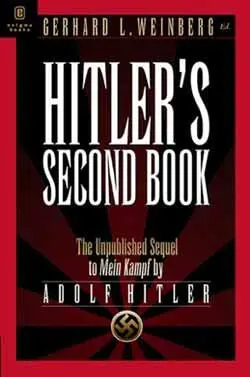
- Название:Hitler’s Second Book
- Автор:
- Издательство:Enigma Books
- Жанр:
- Год:2003
- Город:New York
- ISBN:978-1929631162
- Рейтинг книги:4 / 5. Голосов: 1
-
Избранное:Добавить в избранное
- Отзывы:
-
Ваша оценка:
Hitler’s Second Book: краткое содержание, описание и аннотация
Предлагаем к чтению аннотацию, описание, краткое содержание или предисловие (зависит от того, что написал сам автор книги «Hitler’s Second Book»). Если вы не нашли необходимую информацию о книге — напишите в комментариях, мы постараемся отыскать её.
* * * In 1958, while directing the microfilming and organization of a trove of archives that the U.S. forces had taken from the Nazis at the end of WWII, historian Weinberg (
) discovered the manuscript of a second book that Hitler had written but never published. The manuscript was published in German in 1961, accompanied by Weinberg’s annotations, but this is the first authoritative English version (a pirated and poor translation appeared in the 1960s). The text bears all of Hitler's hallmarks: rambling thoughts, half-baked ideas, pedantic writing-along with a terrifying, sustained belief in war and violence as the means to ensure that Germans would flourish. Compared to
, there are fewer pages devoted to Jews. Nonetheless, what comes across most strongly is Hitler’s abiding commitment to the principle of race and his identification of Jews as the enemy that threatened to undo all that Germans had created. Hitler dwells at length on foreign policy, and outlines a strategy of alliance with Fascist Italy and Great Britain. (He actually believed that Britain would accept a German-dominated European continent so long as Germany did not challenge the overseas British empire.) He also foresees an inevitable clash with the United States. This provides solid historical background on Hitler's thinking in the late 1920s, when his party was nothing more than a tiny, radical sect. Weinberg provides helpful notes and a very informative introduction.
Copyright 2003 Reed Business Information, Inc. “Politics is history in the making.”
Such were the words of Adolf Hitler in his untitled, unpublished, and long suppressed second work written only a few years after the publication of
.
Only two copies of the 200 page manuscript were originally made, and only one of these has ever been made public. Kept strictly secret under Hitler’s orders, the document was placed in an air raid shelter in 1935 where it remained until it’s discovery by an American officer in 1945.
Written in 1928, the authenticity of the book has been verified by Josef Berg (former employee of the Nazi publishing house Eher Verlag), and Telford Taylor (former Brigadier General U.S.A.R., and Chief Counsel at the Nuremburg war-crimes trials) who, after an analysis made in 1961, comments:
*as quoted by http://www.pharo.com/lost&found.htm
“If Hitler’s book of 1928 is read against the background of the intervening years, it should interest not scholars only, but the general reader.”*
Hitler’s Second Book — читать онлайн бесплатно полную книгу (весь текст) целиком
Ниже представлен текст книги, разбитый по страницам. Система сохранения места последней прочитанной страницы, позволяет с удобством читать онлайн бесплатно книгу «Hitler’s Second Book», без необходимости каждый раз заново искать на чём Вы остановились. Поставьте закладку, и сможете в любой момент перейти на страницу, на которой закончили чтение.
Интервал:
Закладка:
This then offers the possibility of regulating mutual relations in a permanent way, either in the sense of an intended resistance against the known operation of such a power, or a reasonable awareness of it, or also in the sense of an understanding, since, perhaps, one’s own interests can be achieved along a common path.
This stability in foreign policy can be established with a whole series of European States. For long periods of her existence, Russia exhibited definite foreign policy aims which dominated her whole activity. In the course of the centuries, France has always represented the same foreign policy aims regardless who embodied political power in Paris at the moment. We may speak of England not only as a State with a traditional diplomacy, but above all as a State with a foreign policy idea become a tradition. With Germany, such an idea could be discerned only periodically in the Prussian State. We see Prussia fulfil her German mission in the short period of the Bismarckian statecraft, but thereafter any foreign policy aim staked out far in advance came to an end. The new German Reich, especially after Bismarck’s retirement, no longer had such an aim since the slogan of preserving peace, that is, of maintaining a given situation, does not possess any kind of stable content or character. Just as any passive slogan is doomed in reality to be the plaything of an aggressive will. Only he who himself wants to act can also determine his action according to his will. Hence the Triple Entente, which wanted to act, also had all the advantages which lie in the self determination of action, whereas the Triple Alliance through its contemplative tendency to preserve world peace was at a disadvantage to the same degree. Thus the timing and opening of a war was established by nations with a definite foreign policy aim, whereas, conversely, the Triple Alliance powers were surprised by it at an hour that was everything but favourable. If we in Germany ourselves had had even the slightest bellicose intention, it would have been possible through a number of measures, which could have been carried out without effort, to have given another face to the start of the War. But Germany never had a definite foreign policy aim in view, she never thought of any kind of aggressive steps for the realisation of this aim, and consequently events caught her by surprise.
From Austria-Hungary we could hope for no other foreign policy aim as such, save that of wriggling through the hazards of European politics, so that the rotten State structure as much as possible nowhere bumps into anything, in order thus to conceal from the world the real inner character of this monstrous corpse of a State.
The German national bourgeoisie, which alone is under discussion here — since international Marxism as such has no other aim but Germany’s destruction — even today has learned nothing from the past. Even today it does not feel the necessity of setting for the nation a foreign policy aim that may be regarded as satisfactory, and thereby give our foreign policy endeavours a certain stability for a more or less long time. For only if such a possible foreign policy goal appears fundamentally staked out can we discuss in detail the possibilities that can lead to success. Only then does politics enter the stage of the art of the possible. As long, however, as this whole political life is not dominated by any leading idea, individual actions will not have the character of utilising all possibilities for the achievement of a certain success as such. Instead, they are but individual stations along the way of an aimless and planless muddling through from today to tomorrow. Above all is lost that certain persistence which the execution of great aims always requires; that is: one will try this today and that tomorrow, and the day after one will have this foreign policy possibility in view, and suddenly pay homage to a wholly opposite intention — insofar, that is, as this visible confusion as confusion is not actually in keeping with the wish of that power which rules Germany today, and in truth does not wish for a resurgence of our Folk ever.
Only international Jewry can possess a lively interest in a German foreign policy which by its continual, seemingly irrational, sudden transitions, lacks that clear plan, and which, as its only justification, at best asserts: Indeed, we too naturally don’t know what should be done, but we do something precisely because something must be done. Yes, not seldom can we actually hear that these men are so little convinced of the inner sense of their foreign policy actions that, as highest motivation, they can only inquire whether somebody else may know a better one. This is the foundation on which the statecraft of a Gustav Stresemann rests.
In contrast, precisely today more than ever is it necessary for the German Folk to set itself a foreign policy goal which meets its real inner needs and, conversely, guarantees an unconditional stability to its foreign policy activity for the humanly predictable proximate period of time. For only if our Folk fundamentally determines and persistently fights for its interests in such a way, can it hope to induce this or that State whose interests are not opposed to ours, now at last established, and which indeed may even be parallel, to enter into a closer union with Germany. For the idea of wanting to solve our Folk’s distress through the League Of Nations is exactly as unjustified as it was to let the German question be decided by the Frankfurt Federal Parliament.
The satisfied nations dominate the League Of Nations. Indeed, it is their instrument. To a large measure they have no interest in allowing a change in the territorial distribution of the globe, unless it again appeals to their interests. And while they talk about the rights of small nations, in reality it is only the interests of the largest they have in view.
If Germany again wants to achieve a real freedom so that, under its blessing, she can give the German Folk its daily bread, she must take the measures thereto outside the Parliament Of The League Of Nations in Geneva. But then, for the lack of sufficient strength, it will be necessary that she find allies who can believe that they may also serve their own interests by going along with Germany. Such a situation, however, will never arise if Germany’s real foreign policy aim has not become fully clear to these nations. And, above all, Germany by herself will never acquire the strength and inner force for that persistence necessary, alas, to sweep away the obstacles of world history. For then one will never learn how to have patience in particulars, and also to renounce them if necessary, in order finally to be able to achieve the vitally necessary aim on a large scale. For even among allies, relations will never be completely frictionless. Disturbances of reciprocal relations can arise over and over again to assume threateningly dangerous forms if the strength to overcome these petty unpleasantnesses and obstacles does not lie in the very dimensions of the foreign policy aim ultimately staked out. Here the French national leadership of the pre War decades may serve as an exemplary model. How it lightly passed over small matters, indeed, even remained silent before the most bitter events, so as not to lose the possibility of organising a war of revenge against Germany, in such contrast to our eternally bawling hurrah! — patriots, and, consequently, their frequent barking at the moon.
The staking out of a clear foreign policy aim appears as important, furthermore, for the reason that, otherwise, the representatives of other interests among one’s own Folk will always find it possible to confuse public opinion, and to make, and in part even provoke, petty incidents into a cause for the radical change of opinion on foreign policy. Thus, out of the petty disputes which result from conditions themselves or which are artificially fabricated, France will again and again try to bring about ill feeling, indeed estrangement, among nations which, by the whole nature of their real vital interests, would be dependent upon each other, and which perforce would have to take a stand against France in concert. Such attempts, however, will be successful only if in consequence of the lack of an unshakeable political aim, one’s own political actions do not possess a true stability, and above all, because persistence in the preparation of measures serviceable to the fulfilment of one’s own political aim is also lacking.
Читать дальшеИнтервал:
Закладка:
Похожие книги на «Hitler’s Second Book»
Представляем Вашему вниманию похожие книги на «Hitler’s Second Book» списком для выбора. Мы отобрали схожую по названию и смыслу литературу в надежде предоставить читателям больше вариантов отыскать новые, интересные, ещё непрочитанные произведения.







Обсуждение, отзывы о книге «Hitler’s Second Book» и просто собственные мнения читателей. Оставьте ваши комментарии, напишите, что Вы думаете о произведении, его смысле или главных героях. Укажите что конкретно понравилось, а что нет, и почему Вы так считаете.