Robert Kaplan - Imperial Grunts
Здесь есть возможность читать онлайн «Robert Kaplan - Imperial Grunts» весь текст электронной книги совершенно бесплатно (целиком полную версию без сокращений). В некоторых случаях можно слушать аудио, скачать через торрент в формате fb2 и присутствует краткое содержание. Город: New York, Год выпуска: 2005, ISBN: 2005, Издательство: Random House, Жанр: Публицистика, nonf_military, на английском языке. Описание произведения, (предисловие) а так же отзывы посетителей доступны на портале библиотеки ЛибКат.
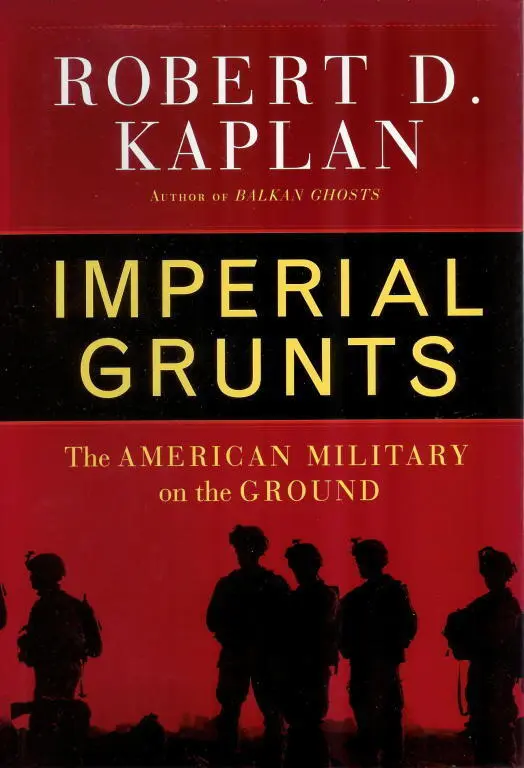
- Название:Imperial Grunts
- Автор:
- Издательство:Random House
- Жанр:
- Год:2005
- Город:New York
- ISBN:978-0-307-27850-0
- Рейтинг книги:5 / 5. Голосов: 1
-
Избранное:Добавить в избранное
- Отзывы:
-
Ваша оценка:
Imperial Grunts: краткое содержание, описание и аннотация
Предлагаем к чтению аннотацию, описание, краткое содержание или предисловие (зависит от того, что написал сам автор книги «Imperial Grunts»). Если вы не нашли необходимую информацию о книге — напишите в комментариях, мы постараемся отыскать её.
Imperial Grunts — читать онлайн бесплатно полную книгу (весь текст) целиком
Ниже представлен текст книги, разбитый по страницам. Система сохранения места последней прочитанной страницы, позволяет с удобством читать онлайн бесплатно книгу «Imperial Grunts», без необходимости каждый раз заново искать на чём Вы остановились. Поставьте закладку, и сможете в любой момент перейти на страницу, на которой закончили чтение.
Интервал:
Закладка:
For the next few days, Lt. Cols. Hagen and Byrne and their staffs were to become inseparable, as the Army unloaded a virtual data dump about the area on the Marines. Intel briefings about such items as the trajectories of incoming mortars and attempts to identify their points of origin would last up to three hours at a time. Hostility between the services, while it still existed, was less noxious now than at any point in American military history—a legacy of the Goldwater-Nichols Act of 1986 that created unified area commands and enlarged the joint staff at the Pentagon in order to force the services to work together. [78] Senator Barry Goldwater, Republican, of Arizona; Representative Bill Nichols, Democrat, of Alabama.
The first stop on Lt. Col. Hagen’s tour for Lt. Col. Byrne was the West Baghdad City Council meeting, which took place every Saturday in the Mansour district of Baghdad. The council included sheikhs and other leaders of the towns immediately to the west of the Iraqi capital. The route from FOB Mercury to Baghdad took us onto a six-lane highway, past one of the palaces of Saddam’s younger son, Qusai, now occupied by several Army Special Forces A-teams. After the palace came the former Saddam International Airport, now a sprawling conglomeration of separate coalition military bases—“Camp Victory” for the Combined Joint Task Force, “Camp Blackjack” for the Army’s 1st Cavalry Division, and so on. The whole area was referred to as BIAP (Baghdad International Airport). Just as the convoy from Kuwait had represented perhaps the last industrial age caravan, BIAP represented the epicenter of perhaps the last great mass infantry invasion.
A few minutes away lay the western edge of downtown Baghdad: decrepit-looking compared to the late 1980s when I had last seen it, the result of more than a decade of economic sanctions. Inside the art gallery where the council meeting was about to begin, I was stunned by the sight of Iraqis chatting loudly in little groups, with cell phones going off all the time. There were men and women in traditional keffiyahs and abayas (headscarves), and also in well-tailored suits; unlike the frumpy Eastern European attire of the 1980s when Iraq had been under the security tutelage of the East Germans. The creepy-looking Hollywood uglies—morose-looking security types I remembered from two decades before—were gone. The air of freedom was everywhere in the room, or so it seemed.
Two decades before, council members would have stood apart from each other in nervous silence, waiting to salute the senior official as soon as he entered the room. Now, the moment the council chairman sat down he was peppered with accusations. “We have seen nothing from you…. When are we going to see results?” The meeting quickly descended into backbiting.
During a short break, my initial romance with the new Iraq was shattered when a member of the council in a well-tailored suit, Sheikh Dhari al-Dhari, told me:
“People live in fear. There are robberies all the time, carjackings, kidnappings of the members of well-to-do families. The rich families are beginning to move to Amman [Jordan], to escape from the chaos. People don’t go out after dark.”
Sheikh al-Dhari described a situation reminiscent of Russia and South Africa following the collapse of their authoritarian regimes. As bad as those regimes were, because of their longevity they had made life predictable and people had found ingenious ways to adapt. Because the rules, albeit oppressive, were known, people sometimes found ways around them. But then came liberation and an interregnum of no rules, when nothing was predictable, fostering a new kind of oppression, tied to soaring crime rates.
Actually, Russia and the rest of the communist bloc—much more than South Africa—was the appropriate comparison for Iraq. The ruling Baath (Renewal) party here had been like the Soviet Communist party, its avowed utopian ideology receding deeper into the past as it evolved into a criminal organization. And when that crumbled, smaller mafias and protection rackets came into being that attached themselves to other criminal and terrorist enterprises. The much-trumpeted prisoner release announced by Saddam just prior to the American-led invasion in March 2003 had had a specific purpose: to let common criminals loose all over the country, to prepare the ground for post-invasion ungovernability.
Whereas the Americans were most concerned with terrorism, average Iraqis were just as concerned with common crime. One of the worst areas in the country was the town of Abu Ghraib, just west of Baghdad, where an infamous prison and torture facility was located. Responsibility for the town of Abu Ghraib was split between the 1st Cavalry Division and the 82nd Airborne, the latter of which was handing over its section of Abu Ghraib to the Marines.
Lt. Col. John Ryan of the 1st Cavalry Division got up to address the Iraqis on the council.
“You people can’t have security if you can’t police your own,” Lt. Col. Ryan barked. “You know who the criminals and terrorists are. They’re mainly not foreign terrorists. They’re your own sons and cousins. You want jobs. Well, there will be no jobs without security. You have to take responsibility for your own neighborhoods. The coalition will be left with no choice but to spend more money in the countryside, where people are more law-abiding and friendly to us, than in Abu Ghraib. We will not feed the mouth that bites us,” he went on. “I don’t want to search your homes at three in the morning, but you people leave me no choice. Either help us find the criminals or stop complaining about it.”
Lt. Col. Byrne hid his head in his hands out of embarrassment. He did not like the insulting tone of the Army lieutenant colonel, who hadn’t even removed his flak jacket as the marines and Lt. Col. Hagen had done, and had spoken to the council like a drill instructor to recruits.
“You overthrew the system,” one council member shot back, “so it is your job to provide security.”
“If you want jobs,” Lt. Col. Ryan replied evenly, “help us more with security.”
Lt. Col. Byrne addressed the group. His tone was subdued: “I am an American marine. We have a different tradition than the Army. I am honored to be here to serve you. Like you, I am a believer. Before coming here, I met with my chaplain and prayed with him to bless our mission.”
But the Army lieutenant colonel turned out to be no less culturally aware than his Marine counterpart. As I found out, Lt. Col. Ryan had tried the soft approach for weeks and had gotten nowhere, even as intelligence mounted about active links between several council members and violent criminals. Lt. Col. Ryan’s tough manner was an experiment, he told me later. It was targeted at certain members of the council. Meanwhile, he was meeting privately with other council members.
After the meeting ended, Sheikh al-Dhari told Lt. Col. Byrne that “we need visual examples of progress. The more time that you Americans spend on your own security, the less effort you put into rebuilding, and the less respect the average Iraqi has for you.” The sheikh had gotten to the root of the American military dilemma in Iraq, as I’ll explain.
In fact, repression had not been the only tool used by Saddam Hussein. He had also bribed the paramount sheikhs of the Sunni Triangle with cash, fancy cars, tracts of land, and other tangible gifts. But the American-led invasion dismantled that entire system. And what had the Americans brought in return to assuage such notables, who for millennia had affected the thinking of their extended clans? The promise of elections? What was that? An abstraction that meant little to many here. In a part of the world where blood was thicker than ideas, it was a difficult step for one Muslim to dime out another Muslim, especially for something as intangible as elections.
Читать дальшеИнтервал:
Закладка:
Похожие книги на «Imperial Grunts»
Представляем Вашему вниманию похожие книги на «Imperial Grunts» списком для выбора. Мы отобрали схожую по названию и смыслу литературу в надежде предоставить читателям больше вариантов отыскать новые, интересные, ещё непрочитанные произведения.








Обсуждение, отзывы о книге «Imperial Grunts» и просто собственные мнения читателей. Оставьте ваши комментарии, напишите, что Вы думаете о произведении, его смысле или главных героях. Укажите что конкретно понравилось, а что нет, и почему Вы так считаете.