Robert Kaplan - Imperial Grunts
Здесь есть возможность читать онлайн «Robert Kaplan - Imperial Grunts» весь текст электронной книги совершенно бесплатно (целиком полную версию без сокращений). В некоторых случаях можно слушать аудио, скачать через торрент в формате fb2 и присутствует краткое содержание. Город: New York, Год выпуска: 2005, ISBN: 2005, Издательство: Random House, Жанр: Публицистика, nonf_military, на английском языке. Описание произведения, (предисловие) а так же отзывы посетителей доступны на портале библиотеки ЛибКат.
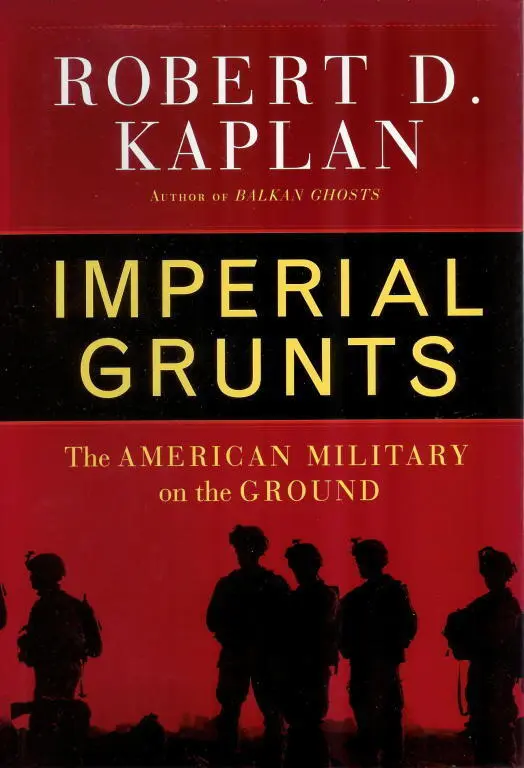
- Название:Imperial Grunts
- Автор:
- Издательство:Random House
- Жанр:
- Год:2005
- Город:New York
- ISBN:978-0-307-27850-0
- Рейтинг книги:5 / 5. Голосов: 1
-
Избранное:Добавить в избранное
- Отзывы:
-
Ваша оценка:
Imperial Grunts: краткое содержание, описание и аннотация
Предлагаем к чтению аннотацию, описание, краткое содержание или предисловие (зависит от того, что написал сам автор книги «Imperial Grunts»). Если вы не нашли необходимую информацию о книге — напишите в комментариях, мы постараемся отыскать её.
Imperial Grunts — читать онлайн бесплатно полную книгу (весь текст) целиком
Ниже представлен текст книги, разбитый по страницам. Система сохранения места последней прочитанной страницы, позволяет с удобством читать онлайн бесплатно книгу «Imperial Grunts», без необходимости каждый раз заново искать на чём Вы остановились. Поставьте закладку, и сможете в любой момент перейти на страницу, на которой закончили чтение.
Интервал:
Закладка:
Though the ancient Greek historians called the region Mesopotamia, meaning “the land between the [two] rivers,” Roux notes that the inhabitants of Mesopotamia themselves “had no name covering the totality of the country in which they lived.” The terms they used were either too vague (“the Land”) or too precise (“Sumer,” “Akkad,” and so on). 11Thus, the current division of Iraq between Indo-European Kurds in the northern mountains, Sunni Arabs in central Mesopotamia, and Shiite Arabs in southern Mesopotamia was—like the divisions that I had seen in Yemen, Colombia, the Philippines, and Afghanistan—a formidable legacy of both history and geography.
I reached into an MRE bag and grabbed a fudge brownie for lunch. It had the consistency of drying cement. During another piss break a growly senior noncom took a back seat in our Humvee after the alternator had gone bust on his command car. “Fuck this… un-fuck that… un-ass that… Corporal, you’re as fucked up as a football bat,” he went on. After gouging on MREs he fell into a deep sleep, for which I was grateful.
I kept up a running conversation with Gunner David Bednarcik. The gunner was a stocky, matter-of-fact regular Joe with a shrewd and likable temperament, the kind of guy I’d trust on anything from setting up presence patrols in an unpacified area to presidential politics. There were rare moments when he reminded me of the late comic John Candy, of course without the obesity (in fact, Bednarcik was a long-distance runner). He was a lifer in the corps, set on doing thirty years, though he would only half admit it. More than a decade older than Cpl. Pena and Lance Cpl. Neal, he had a mild, avuncular disposition toward them and the other “knuckleheads” in the platoon, as he called them.
“I’m from Allentown, Pennsylvania, a place where people are real patriotic,” he told me with distinct pride. His family boasted World War II, Korean War, and Vietnam War veterans. Grenada and Beirut had affected him deeply, so he joined the Marines. A former drill instructor at Parris Island, South Carolina, and later a gunnery sergeant, he was the ultimate iron grunt. Yet he also harbored a mellowness that made him a delight to be around. [76] Just as this book was going to press, Gunner Bednarcik—back in Iraq for the third time in the spring of 2005—was badly wounded and recovering at Bethesda Naval Hospital.
“Parris Island is a machine,” Gunner Bednarcik explained, in a reference to Marine Corps basic training. “Drill instructors there are rough because of all the pressure on them to produce competent recruits in a finite period of time. Every minute of the day is micro-managed for the recruits. You can’t talk nice to grunts,” he intoned in a knowing, authoritative manner, as though confiding a secret to me. “Make no mistake, these are tough kids around you, really tough kids. Unless you’re tough with them, they don’t respond. The Army wants to train you in order to teach you skills. Fuck that. Marine Corps training seeks to break you down in order to remake you as a better person.”
I asked him about one officer in particular, who had seemed a bit distant. “Yeah, I know,” Gunner Bednarcik said. “He’s a real East Coast marine. You see, Camp Lejeune is close to the flagpole at Quantico [Virginia] and II MEF now has less to do in terms of deployments. The combination makes East Coast marines sticklers for details and regulations”—exactly what I had noticed in Djibouti.
“Camp Lejeune. Jacksonville, N.C.,” the Gunner went on, shaking his head with disapproval, “jack shacks, strip joints, the Business of Immorality in other words. Wherever you see the Business of Immorality you know there is a low ratio of available women to young men. Truth be told, Pendleton marines have more fun. The young marines there are right by the interstate, close to Hollywood and San Diego. The best deal for a lance corporal is to do basic at Parris Island and then be posted to Camp Pendleton.”
It was after midday. Dried mud oases with whited-out date palm jungles and mud-walled villages appeared under a broad and pasty sky. Women in billowing black robes were walking on berms beside irrigation ditches, with water jugs on their heads. There were donkeys and cattle but no camels. Then came more alkaline desert.
In the late afternoon, exactly thirteen hours after leaving NAVISTAR, we pulled into “Scania,” another U.S. military fuel and resupply depot, located two hours south of Baghdad near Al-Hillah. The Jersey barriers, HESCO baskets, and Porta-Johns created the instant sensation of having left Iraq. After refueling, the convoy lined up in eight yawning columns, divided by narrow gravel lanes, where we were told to lay out sleeping bags.
Darkness fell as we stumbled back from chow. Lance Cpl. Neal showed me how to arrange the rifle plates in my flak jacket as a more comfortable surface for sleeping atop the gravel. Using a flashlight in the dark, he showed me a World War I compass that his Marine grandfather had given him, inscribed “Semper Fi, Love Grandpa.”
One marine, cursing the sharp gravel, simply laid his sleeping bag on the hood of a truck and fell asleep. Under the stars, we all fell silent as the bagpiper played the “Marine Hymn.” Then the loud noises and other chaos of this latter-day caravanserai resumed.
While I was lying in my sleeping bag, one of the Renegades, Cpl. Michael Pinckney of South Kingstown, Rhode Island, came up to me and began to talk: “I’m twenty-three. My generation sucks. They’re all soft. They don’t care about their identity as Americans. We live in some bad-ass country, and they’re not even proud of it. My family flies the flag, but other families don’t. Nobody knows what it means to be American anymore, to be tough. I like being home and yet I don’t. People at home are not proud of us being in Iraq, because they’ve lost the meaning of sacrifice. They expect things to be perfect and easy. They don’t know that when things go wrong you persevere; you don’t second-guess. During OIF-I, we all slept in the rain and got dysentery in Ad-Diwaniyah. But back home, everyone is going to shrinks and suing each other. That’s why I like the Marine Corps. If you fuck up, your sergeant makes you suck it up. I don’t want to be anywhere else but Iraq. OIF-I and OIF-II, this is what manhood is all about. And I don’t mean macho shit either. I mean moral character.”
Despite news reports of low morale in the armed services because of overdeployment, with Army Special Forces and the Marines I had met only two kinds of troops: those who were serving in Iraq and Afghanistan, and those who were jealous of those who were.
Reveille was at 5 a.m. After packing our sleeping bags and chowing down, the Gunner gave the platoon a brief on IEDs (improvised explosive devices, including car bombs), which the insurgents often placed on the highway to Baghdad. “All right you knuckleheads, the latest intel mentions Volkswagens, sedans, BMWs, Opels, and red Toyotas as particularly suspicious. I know, I know, that’s half the cars on the road. All’s I mean is, as Bugs Bunny would say, be wery, wery aware.”
The next brief came from Sgt. Christian Driotez of Los Angeles. Sgt. D, as he was called, was from a Salvadoran immigrant family. Powerfully built with a hands-on, Charles Bronson–type expression, he was, nevertheless, the mildest, most considerate sergeant I would meet in the Marine Corps, as well as a true leader of men. He had joined the corps, he claimed, because he wanted to make “a fucking difference”—after having seen kids dragged off to fight against their will by left-wing rebels in his family’s native country.
“Remember the battalion motto for OIF-II,” Sgt. D told the platoon: “ Make Peace or Die. And make sure you got your fucking ACOG [advanced combat optical gunsight] on your rifles. This is where Iraq really starts. There will be no head calls. So bring empty water and Gatorade bottles to piss in. We’re tight, but we’re gonna get a lot tighter as the weeks go on. I’m already proud of you guys.”
Читать дальшеИнтервал:
Закладка:
Похожие книги на «Imperial Grunts»
Представляем Вашему вниманию похожие книги на «Imperial Grunts» списком для выбора. Мы отобрали схожую по названию и смыслу литературу в надежде предоставить читателям больше вариантов отыскать новые, интересные, ещё непрочитанные произведения.








Обсуждение, отзывы о книге «Imperial Grunts» и просто собственные мнения читателей. Оставьте ваши комментарии, напишите, что Вы думаете о произведении, его смысле или главных героях. Укажите что конкретно понравилось, а что нет, и почему Вы так считаете.