Robert Kaplan - Imperial Grunts
Здесь есть возможность читать онлайн «Robert Kaplan - Imperial Grunts» весь текст электронной книги совершенно бесплатно (целиком полную версию без сокращений). В некоторых случаях можно слушать аудио, скачать через торрент в формате fb2 и присутствует краткое содержание. Город: New York, Год выпуска: 2005, ISBN: 2005, Издательство: Random House, Жанр: Публицистика, nonf_military, на английском языке. Описание произведения, (предисловие) а так же отзывы посетителей доступны на портале библиотеки ЛибКат.
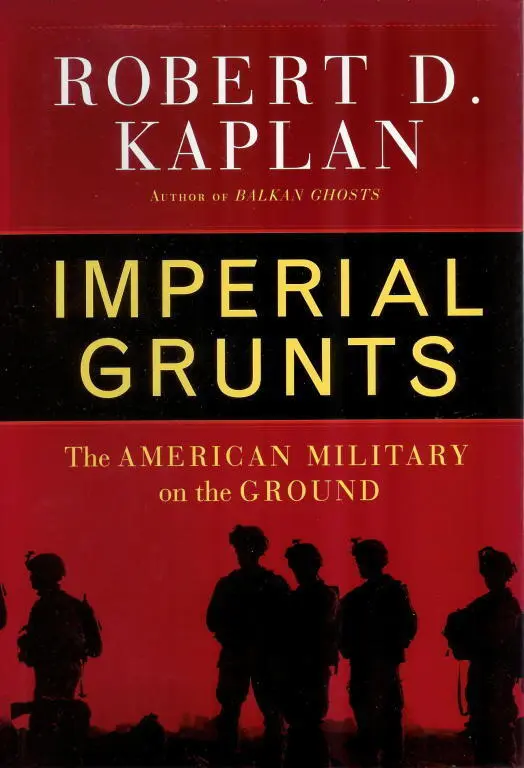
- Название:Imperial Grunts
- Автор:
- Издательство:Random House
- Жанр:
- Год:2005
- Город:New York
- ISBN:978-0-307-27850-0
- Рейтинг книги:5 / 5. Голосов: 1
-
Избранное:Добавить в избранное
- Отзывы:
-
Ваша оценка:
Imperial Grunts: краткое содержание, описание и аннотация
Предлагаем к чтению аннотацию, описание, краткое содержание или предисловие (зависит от того, что написал сам автор книги «Imperial Grunts»). Если вы не нашли необходимую информацию о книге — напишите в комментариях, мы постараемся отыскать её.
Imperial Grunts — читать онлайн бесплатно полную книгу (весь текст) целиком
Ниже представлен текст книги, разбитый по страницам. Система сохранения места последней прочитанной страницы, позволяет с удобством читать онлайн бесплатно книгу «Imperial Grunts», без необходимости каждый раз заново искать на чём Вы остановились. Поставьте закладку, и сможете в любой момент перейти на страницу, на которой закончили чтение.
Интервал:
Закладка:
Neal’s subject now was the nine-hour fight to secure Saddam’s palace at the bend of the Tigris in central Baghdad. “It was like the movie Black Hawk Down without the rioters. I was RPGed so often I gradually stopped ducking. During one of the lulls I was relaxed enough to eat an MRE and fall asleep for a few minutes. I was so tired and hungry. You get used to anything if it goes on long enough.”
NAVISTAR was a vast gravel maze of Jersey barriers that smelled of oil and gasoline. We did a fast-paced quarter-mile march in formation to the chow hall. There was no time to piss even—or you would lose your platoon and never find them again in the dark, as masses of marines and soldiers were being processed through in different directions. The chow hall was airless and overcrowded, with low ceilings and putrefying smells. “This ain’t no fuckin’ Denny’s,” a sergeant major screamed over the confusion. “Eat fast, don’t talk, and get the fuck out. There are more people waiting to chow down.”
The immensity of the redeployment was visually staggering. Outside, engines and generators whined in the dark, as long lines of trucks partially blocked out the stars.
In the order of the convoy, the Renegades led by Gunner Bednarcik were part of the Charlie “stick” of Alpha Company. We were provided a narrow patch of sand between two lines of vehicles to lay our sleeping bags. Reveille would be at 2:30 a.m. There was no place to wash; no heads or Porta-Johns either. By 2:45 a.m. we had packed our gear and marines were fiddling with straps and lubricants, loudly cursing at broken doors and transmission problems.
Iraq was heralded by the lights of burning petrol fires. We rode for hours on the hardball road in the dark. My teeth chattered and my thighs shook from the freezing cold air pouring through the roof hatch where Lance Cpl. Neal sat behind his machine gun. “I’m so cold that my face has frozen into a permanent grin,” he shouted down through the hatch.
Dawn brought a landscape of cindery desert and short grass the greenish gray color of mold. As we continued north the desert became increasingly alkaline, with knife-sharp depressions of salt mixed with dried mud. A five-minute piss break was announced through the handheld ICOMs, or intra-squad radios. Hundreds of marines lined up along the road to water the desert. Marines looked at each other and laughed. I ate a cold MRE of Thai chicken for breakfast.
We passed long armored convoys of Turkish trucks bearing fuel and consumer items out of and into Iraq. The construction of the hardball road was the quality of an American interstate, a legacy of Iraq’s oil wealth from the 1970s and 1980s before Saddam invaded Kuwait and sanctions were imposed. As the morning wore on, Iraqi civilians appeared along the sides of the highway and in battered minivans, and waved at us. We crossed the Euphrates River between An-Nasiriyah and An-Najaf, entering the heart of southern Shiite Mesopotamia. Here and there were small green areas bordered by irrigation ditches. Iraqis in soiled yet dignified robes and keffiyahs stood beside sheep and cattle, and waved. But for the most part, the dreary moonscape did not cease.
Of all the landscapes and geographical situations across the earth, according to the French orientalist Georges Roux, Iraq’s is among the least changed throughout history. Roux’s book Ancient Iraq neatly bridges the gap between the romantic vision of Mesopotamia, based on the first chapters of Genesis, and the rather grim landscape I found there on this and previous visits. 5
Adam and Eve, it turned out, did not live in a garden paradise but in a turgid mud swamp. The Tigris and Euphrates “flow with such a low gradient that they meander considerably and throw numerous side branches,” creating many “lakes and swamps,” interspersed with “dreary wastes strewn with dry wadis and salt lakes.” 6The ancient Mesopotamian towns, Roux continues, “were built of nothing but mud.”
There is also the early-twentieth-century English traveler Robert Byron’s description of Iraq: “It is a mud plain…. From this plain rise villages of mud and cities of mud. The rivers flow with liquid mud.” 7
Keep in mind that Iraq has the bone-dry climate of a desert, which is constantly cracking the mud and blowing it into fine dust. Roux notes that temperatures in Mesopotamia, from prehistory onward, reach 120 degrees in summer, and the average annual rainfall is under ten inches, most of which comes in the early spring, causing floods. But since all the land to the west until the Mediterranean and to the east until the Indian subcontinent is riverless and rainless desert, this dreary artery of mud was where ancient civilization developed.
But it did not exactly prosper. Contrary to popular belief, fed by biblical clichés, the valley of the Tigris and the Euphrates did not make Iraq an old and unified land in the way that the Nile Valley made Egypt. Both river valleys may have been the mothers of history and of civilization, narrow lines of life amid desert nothingness, but that is where the similarities ended.
Roux explains that since antiquity the Nile had an annual flood of almost constant volume, with the great lakes of East Africa acting as regulators. Because the Nile “freely inundates the valley for a time and then withdraws,” it required only the “cheap and easy ‘basin type’ of irrigation,” in which canal slits were dug and men waited for them to fill up. But the Tigris and the Euphrates had no great lakes at their source to regulate floods. They were two rivers instead of one, with the Tigris born of the snows of Kurdistan and the Euphrates flowing down from the mountains of Armenia. Moreover, their annual flooding occurred too late for the winter crops and too soon for the summer ones. Thus, irrigation in Mesopotamia was a never-ending drudgery involving reservoirs, dikes, and regulator sluices. Even then, unlike Egypt, little was guaranteed. Low waters over a few years meant drought and consequently famine, whereas high waters swept away mud houses as if they had never existed. Roux states that “this double threat and uncertainty” bred a “fundamental pessimism” among Mesopotamia’s inhabitants. 8
That pessimism grew not only out of the perennial struggle against nature, but also out of the struggle of man against man—another thing that did not exist in Egypt. Freya Stark explains: “While Egypt lies parallel and peaceful to the routes of human traffic, Iraq is from earliest times a frontier province, right-angled and obnoxious to the predestined paths of man.” 9
In other words, the Nile has always been a natural migration route. People didn’t need to cross it, but to go up or down it. The Nile brought ivory and spices from Africa. The Tigris and the Euphrates brought nothing except their waters. The times that foreign invaders violated Egypt by sea, or by land across the Sinai Peninsula, were few enough to be well remembered—the aggressions of Alexander the Great and Napoleon, for example, which brought learning and economic progress.
But Iraq was never left alone. The valley of the Tigris and Euphrates, as Freya Stark indicates, ran at a right angle to one of history’s bloodiest routes of migration. From the Syrian desert in the west came the Amorites, the Hittites, and the medieval Arab armies of the Umayyad caliphs in Damascus: a threat that in modern times has been represented by the rival Baathist regime in Syria. To the east loomed the high plateau of Elam, “the great mountain that strikes terror,” from where invaders, including Aryan Kassites, Persians under Darius and Xerxes, Mongol hordes, and Ayatollah Khomeini’s Iranians, all marched down into Mesopotamia. 10
Yet the most important difference between the Nile Valley and Mesopotamia was that while the former was always a demographically cohesive unit, the latter was a nebulous border region where various groups clashed and overlapped. Outsiders have occasionally been inclined to interpret Iraq as a modern outgrowth of an age-old polity, known variously by such names as Sumer, Akkad, Assyria, Babylonia, and the Baghdad caliphate. In truth, as Roux painstakingly documents, each of these civilizations encompassed only a part of present-day Iraq, a part that was often at war with the other parts. The Sumerians, who lived in southern Mesopotamia, fought the Akkadians of central Mesopotamia, and both of them fought the Assyrians, who inhabited northern Mesopotamia. The Assyrians, in turn, fought the Babylonians, who occupied the border region between what had been, in a previous millennium, Sumer and Akkad. This is to say nothing of the many islands of Persians who lived amidst the native Mesopotamians, forming another source of strife.
Читать дальшеИнтервал:
Закладка:
Похожие книги на «Imperial Grunts»
Представляем Вашему вниманию похожие книги на «Imperial Grunts» списком для выбора. Мы отобрали схожую по названию и смыслу литературу в надежде предоставить читателям больше вариантов отыскать новые, интересные, ещё непрочитанные произведения.







Обсуждение, отзывы о книге «Imperial Grunts» и просто собственные мнения читателей. Оставьте ваши комментарии, напишите, что Вы думаете о произведении, его смысле или главных героях. Укажите что конкретно понравилось, а что нет, и почему Вы так считаете.