Robert Kaplan - Imperial Grunts
Здесь есть возможность читать онлайн «Robert Kaplan - Imperial Grunts» весь текст электронной книги совершенно бесплатно (целиком полную версию без сокращений). В некоторых случаях можно слушать аудио, скачать через торрент в формате fb2 и присутствует краткое содержание. Город: New York, Год выпуска: 2005, ISBN: 2005, Издательство: Random House, Жанр: Публицистика, nonf_military, на английском языке. Описание произведения, (предисловие) а так же отзывы посетителей доступны на портале библиотеки ЛибКат.
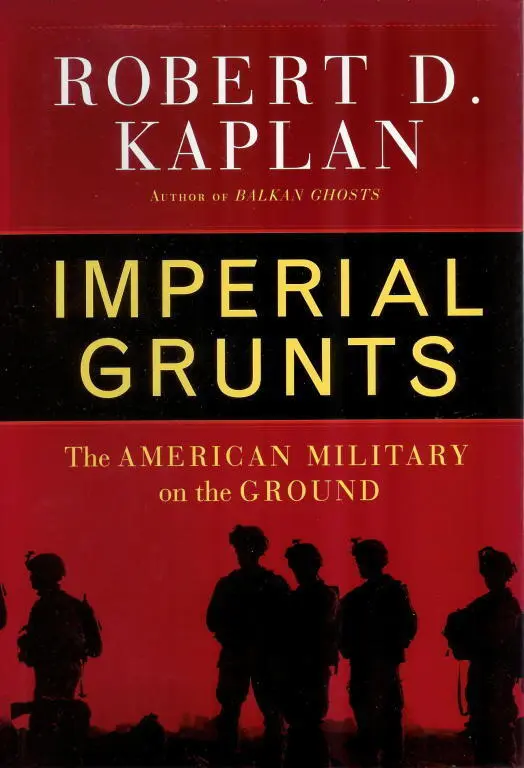
- Название:Imperial Grunts
- Автор:
- Издательство:Random House
- Жанр:
- Год:2005
- Город:New York
- ISBN:978-0-307-27850-0
- Рейтинг книги:5 / 5. Голосов: 1
-
Избранное:Добавить в избранное
- Отзывы:
-
Ваша оценка:
Imperial Grunts: краткое содержание, описание и аннотация
Предлагаем к чтению аннотацию, описание, краткое содержание или предисловие (зависит от того, что написал сам автор книги «Imperial Grunts»). Если вы не нашли необходимую информацию о книге — напишите в комментариях, мы постараемся отыскать её.
Imperial Grunts — читать онлайн бесплатно полную книгу (весь текст) целиком
Ниже представлен текст книги, разбитый по страницам. Система сохранения места последней прочитанной страницы, позволяет с удобством читать онлайн бесплатно книгу «Imperial Grunts», без необходимости каждый раз заново искать на чём Вы остановились. Поставьте закладку, и сможете в любой момент перейти на страницу, на которой закончили чтение.
Интервал:
Закладка:
Washington and New York heralded the world of ideas; places like Oceanside the application of them. Because ideas can be tested only through application, Oceanside was sometimes the more intellectually stimulating.
To deploy from Camp Pendleton or Camp Lejeune in significant numbers overseas, which was the case with Iraq, the Marines assembled a MAGTF (pronounced “magtaf”): a Marine Air-Ground Task Force. MAGTFs came in different sizes, depending upon the need. But the key feature of all MAGTFs was their self-sufficiency, with ground combat, aviation, support service, and command components. The largest MAGTFs were the three Marine Expeditionary Forces, or MEFs as they were called, consisting of forty thousand to forty-five thousand marines each.
The First Marine Expeditionary Force (I MEF), based out of Camp Pendleton, covered the Pacific. The Second Marine Expeditionary Force (II MEF), based out of Camp Lejeune, covered the Atlantic. The Third Marine Expeditionary Force (III MEF) was forward deployed in Okinawa, Japan. Smaller than the other MEFs, III MEF had only seventeen thousand marines and was focused on the Korean Peninsula. But all these areas of responsibility were fluid and overlapped. For example, both I and II MEF had seen action in Operation Iraqi Freedom the year before.
Below the MEFs were the MEBs, Marine Expeditionary Brigades of 8,000 to 10,000 marines each. Below them were the MEUs, Marine Expeditionary Units. The MEUs, with about 2,200 marines each, were the real workhorses of Marine deployments in the unconventional post–Cold War world, able to react fast to overseas emergencies with their six-hour Rapid Response Planning Process. The Marines’ smallest element was their special purpose MAGTFs, custom fit for just about every situation.
Iraq obviously rated a MEF, the largest kind of MAGTF.
A year earlier, I MEF had been tasked to capture Baghdad. Its ground combat element, the 1st Marine Division, “marched up” from Kuwait to the Iraqi capital, a feat that recalled the ten thousand Greek hoplites under Xenophon who had marched north from Mesopotamia and across Asia Minor in 400 B.C., and “hacked their way through every army that challenged them.” 1The marines advanced on Baghdad under the symbol of the Blue Diamond—the five stars of the Southern Cross against the blue of the evening sky—which commemorated the 1st Division’s landing in 1942 at Guadalcanal in the Solomon Islands. The 1st Division also retook Seoul in 1950 during the Korean War, Hue City in 1968 during the Vietnam War, and Kuwait City in 1991 during Desert Storm.
In 2003 during Operation Iraqi Freedom (OIF, in U.S. military parlance), the 1st Marine Division, along with the Army’s 3rd Infantry Division, did most of the fighting. Following the ouster of Saddam Hussein, the 1st Division assumed responsibility for stabilizing heavily Shiite south-central Iraq. During that deployment, unlike the experience of the Army in the Sunni Triangle, not one marine was killed. The Marines ascribed their success partly to lessons learned from their Small Wars Manual. 2
The Small Wars Manual, it was at least hoped, would guide the division’s latest assignment. In the early weeks of 2004, I MEF, with the 1st Division as its ground combat element, was preparing to deploy to western Iraq, an area the size of North Carolina stretching from the Euphrates River to the Syrian border, including part of the Sunni Triangle. This area of responsibility contained 2.8 million people, 80 percent of whom were Sunni and 20 percent Shiite.
While I was at Camp Pendleton, Maj. Gen. James N. Mattis, the 1st Division’s commander, delivered his pre-deployment brief to thousands of marines. [72] Whereas Maj. Gen. Mattis, a two-star general, commanded the ground combat ele-ment of I MEF, the MEF itself was commanded by Lt. Gen. James T. Conway, a three-star general.
He made it clear that not only were the Marines returning to Iraq, they were also returning to their roots as unconventional warriors: a tradition forged long ago in the Philippines and in the Central American “Banana Wars” of the early twentieth century, when the Marines were referred to as the “State Department’s troops.”
Old black-and-white photos of U.S. Marines in Nicaragua accompanied the brief. Noting Iraq’s “confusing, challenging” environment, Maj. Gen. Mattis told his marines that “Chesty Puller faced a similar situation in Nicaragua in 1929 and learned how to be a warrior. He learned on hundreds of patrols over years of fighting where he and his men destroyed the enemy and won the trust of the people.”
That history might have been obscure to people in Washington, but it was fresh and relevant to those at Camp Pendleton—perhaps more relevant than the two world wars. Lewis Burwell “Chesty” Puller, born in rural Virginia, grew up worshipping Confederate generals like Robert E. Lee and Stonewall Jackson. 3He developed a chest “like a pouter pigeon” (hence the nickname). In Haiti, beginning in 1919, Marine Pvt. Chesty Puller led bush patrols composed of native Creole-speaking troops in the struggle against the cacos —outlaw gangs opposed to the U.S. occupation. In 1924 he became a second lieutenant, and between 1929 and 1933 he served two tours in Nicaragua, fighting against Augusto César Sandino, the leftist guerrilla leader after whom the Sandinistas were named.
A bandit to the Marines and a hero to radicals throughout Latin America, Sandino threatened Nicaragua’s stability, which was crucial to the protection of the Panama Canal. Puller and his gunnery sergeant, William A. Lee, commanded a company of three dozen locally recruited Indians in the fight against Sandino. They marched thirty miles a day, living off the land. “Whenever a chow line formed, Puller and Lee made sure they were at the back; their men got fed first,” writes Max Boot in The Savage Wars of Peace.
Men wounded or killed were evacuated from the battlefield. Applying the Marine ethos to his native troops, Puller never left an indig behind. In 1931, after an earthquake and fire had devastated the capital of Managua, Puller and other marines took the lead in salvage, rescue, and recovery operations. It was just one aspect of the humanitarian side of Marine operations in Nicaragua.
While the political outcome to that early U.S. intervention in Nicaragua was messy, the Marines took pride in it, just as they and the Green Berets took pride in their performance in Vietnam. Though many Americans categorized such interventions as failures and moral disgraces, the Marines knew that the history of those interventions was complex: there were tactics that worked, as well as those that didn’t; actions of positive moral consequence, and of negative consequence.
Invoking Nicaragua, Gen. Mattis said he needed “self-disciplined young sailors and marines who can smile to children, [73] The Marines were a naval force; the medics in each Marine platoon were not marines but “Navy corpsmen,” hence the reference to sailors.
wave to Iraqis who flip you the bird… who are tough enough to be kind to the innocent, no matter what the enemy does to us or our buddies…. We must win the hearts and minds of the Iraqi people,” he went on, repeating a Vietnam War phrase. “Satellites don’t give us intel in a counterinsurgency—as you win their trust, the people will give you intel.”
Nevertheless, aware of the gritty realities bedeviling the Army in western Iraq at that moment—realities with which the Marines would soon have to deal—Mattis said that in the eyes of Iraqis, Marines had to be seen as No Better Friend, No Worse Enemy. He added, “Wave at them, but have a plan to kill them.”
Gen. Mattis ended on a religious note. Marines should use the solitude and hardships of the Iraqi desert to strengthen their faith in God: “We, like the people who’ve gone to the desert before, will know ourselves better and come to have a greater appreciation for each other.”
Читать дальшеИнтервал:
Закладка:
Похожие книги на «Imperial Grunts»
Представляем Вашему вниманию похожие книги на «Imperial Grunts» списком для выбора. Мы отобрали схожую по названию и смыслу литературу в надежде предоставить читателям больше вариантов отыскать новые, интересные, ещё непрочитанные произведения.




Обсуждение, отзывы о книге «Imperial Grunts» и просто собственные мнения читателей. Оставьте ваши комментарии, напишите, что Вы думаете о произведении, его смысле или главных героях. Укажите что конкретно понравилось, а что нет, и почему Вы так считаете.