Robert Kaplan - Imperial Grunts
Здесь есть возможность читать онлайн «Robert Kaplan - Imperial Grunts» весь текст электронной книги совершенно бесплатно (целиком полную версию без сокращений). В некоторых случаях можно слушать аудио, скачать через торрент в формате fb2 и присутствует краткое содержание. Город: New York, Год выпуска: 2005, ISBN: 2005, Издательство: Random House, Жанр: Публицистика, nonf_military, на английском языке. Описание произведения, (предисловие) а так же отзывы посетителей доступны на портале библиотеки ЛибКат.
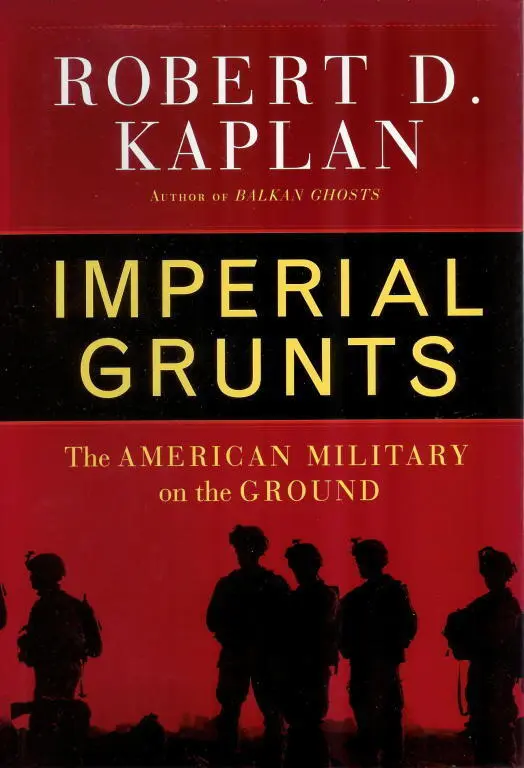
- Название:Imperial Grunts
- Автор:
- Издательство:Random House
- Жанр:
- Год:2005
- Город:New York
- ISBN:978-0-307-27850-0
- Рейтинг книги:5 / 5. Голосов: 1
-
Избранное:Добавить в избранное
- Отзывы:
-
Ваша оценка:
Imperial Grunts: краткое содержание, описание и аннотация
Предлагаем к чтению аннотацию, описание, краткое содержание или предисловие (зависит от того, что написал сам автор книги «Imperial Grunts»). Если вы не нашли необходимую информацию о книге — напишите в комментариях, мы постараемся отыскать её.
Imperial Grunts — читать онлайн бесплатно полную книгу (весь текст) целиком
Ниже представлен текст книги, разбитый по страницам. Система сохранения места последней прочитанной страницы, позволяет с удобством читать онлайн бесплатно книгу «Imperial Grunts», без необходимости каждый раз заново искать на чём Вы остановились. Поставьте закладку, и сможете в любой момент перейти на страницу, на которой закончили чтение.
Интервал:
Закладка:
Capt. Stacy was a pro. He realized fast, as I had, that most of his white bread, standard-issue Army team was out of place in this Bob Marley, everything-is-cool, hakuna matata Afro-Islamic environment spiced by the decadent lifestyle of the royal family of Monaco. He knew that they would all, especially Sgt. McCoy, have to adapt fast, to loosen up or be typecast as ugly Americans. He also realized that in the end they could only be themselves.
Later, back at Camp Lemonier, I asked an Army officer about how people were selected to go to a place like Lamu. He replied: “Select? Do you think we have the luxury to select? The Reserve is so overstretched because of Iraq that we’re just grabbing bodies to fill slots.”
Capt. Stacy’s team did come with some advantages, however. For example, Staff Sgt. Glenn Elenga, an avid reader of the tabloids, briefed us on the various marriages of Princesses Caroline and Stephanie, and the colorful reputation of Prince Ernst of Hanover, Caroline’s third husband, who spent more time in Lamu than the other royals.
For the members of both these teams, Lamu was merely the most recent in a string of deployments that had brought them all over the globe, to places both known and obscure, violent and potentially so. The marines of India Company could almost have been the sons of these guys, such was the age difference. But even the teenagers back in Djibouti had great stories to tell me, not only about Iraq, but also about Portugal, Kuwait, Bahrain, and other places they had been.
Lying awake as Indian Ocean breezes raced through my mosquito net and the lovely white stucco work, I thought that if you were a male of a certain age during World War II and had not served in some capacity, you would have been denied the American Experience. Now I realized that many of my own generation had been denied it as well, however unwittingly, however unaware of it we may have been. Perhaps it was a safer, more enriching global experience that we were having, but whatever it was I knew now that it was not fully American. The War on Terror was giving two generations of Americans vivid memories of places like Lamu, the southern Philippines, rural Colombia, eastern and southeastern Afghanistan, southern Iraq, and so on. The young marines back in Djibouti had fought in Operation Iraqi Freedom. In not a few cases, they had fathers who had fought in Desert Storm and, yes, grandfathers who had been in Vietnam. World War II was so far distant to them it might as well have been the Peloponnesian War. Yet, as it kept occurring to me in the course of these journeys, for most in my socioeconomic group, World War II was when the American Experience had begun to fade.
The American Experience was exotic, romantic, exciting, bloody, and emotionally painful, sometimes all at once. It was a privilege, as well as great fun, to be with those who were still living it.
Two days later came the MEDCAP that was the culmination of the 13th Marine Expeditionary Unit’s onshore visit to Lamu, a visit whose ground-level component had been arranged by Capt. Rynearson’s departing team. There were long lines of Muslim women swathed in black cotton with their babies. U.S. Marines provided the security, while Kenyan soldiers organized the crowd inside the King Fahd Hospital, where Kenyan and American military doctors and medics, wearing hospital scrubs decorated with the Kenyan and American flags, treated more than a thousand inhabitants of the island in two days.
By now Capt. Stacy’s team was beginning to acclimatize. They were wearing appropriate clothes, getting tanned, had stopped shaving, and, more importantly, appeared more relaxed—making friends and learning Swahili. Because the small expatriate community, including the Grimaldis, were capable of spreading nasty rumors, it would be important to befriend them, too. Thus, the team began to hit the bar and restaurant near the villa, for gin and tonics by the moonlit beach.
It was sad to see Capt. Jeff Rynearson and his team depart. They had become veritable kings of the island. Elders had offered to marry their daughters off to them, as they had to al-Qaeda operatives. The old team knew everything that happened around here, down to the rumors about who might have been using the island for money laundering. It was ironic to keep reading stories about unhappy overdeployed reservists, because those in the Special Operations community whom I had met here and in eastern Afghanistan were having the time of their lives.
“You ought to check out of life and remain here,” I suggested, only half in jest, to Rynearson. “This is where you belong.”
“Don’t think I haven’t thought of it,” he replied, smiling broadly. “I know a local contractor who could build me a glass-bottomed boat for tourists to watch fish and sea turtles. I’d buy two dhows to shuttle the tourists between the boat and the shore. I’d open a pub, renovate an old house, marry a local girl, and become a king. All you need to live as a king here is about $35,000 a year. I’ve worked it out.”
Too bad that the American military personnel system did not allow guys to stay put when they adapted well to a place and had no families to return to, which, for the most part, was the case with Rynearson’s team. It was area expertise and adaptation to the local environment—down to the level of the smallest micro-region—that had been one of the pillars of the British imperial system: the sort of expertise and adaptation that could develop only when work was inextricable from pleasure, and eccentricities were tolerated. That, in turn, required less control from higher levels of command.
A few hours by plane and I was out of the world of pink oleanders against white walls and gin and tonics by a phosphorescent sea, and back to the grainy, black-and-white poverty of the Marine barracks in Djibouti. It was midnight when I got in. I found the guys in the midst of a discussion of how much it cost to lift the suspension of a Silverado versus that of a Jeep: $280 as opposed to $1,000.
I told them about Lamu.
“Shit.” They all swooned, but they weren’t too depressed. The next day the platoon had the day off and they were going to the beach.
It was one of the saddest-looking beaches I had ever seen. The Mars-like desert simply ended and greenish water began. The tide was low and licks of mud extended far out into the Gulf of Tadjoura, which led to the Gulf of Aden. Black volcanic rocks by the shore lay encrusted with mussels and barnacles. It was like so much strategic real estate—depressing and ugly. There was a ratty bar where the marines laid out their day packs. Soon their tattoo-covered pale and muscular bodies were all over the place.
“I wish I knew more about seashells,” a diminutive and bespeckled Pfc. Chris Wrinkle of Hamilton, Maine, told me. Everyone called him just “Wrinkle.” Soldiers and marines often called each other by their last names, maybe because their last names were emblazoned on their BDUs. Looking at him knee-deep in the water with his bathing suit, I realized that Pfc. Wrinkle seemed small only because of his wire-rimmed glasses and the especially brawny company he kept. Actually, Wrinkle owned a ropy, muscular physique and had large capable hands.
“I’m weird,” he began. “I’m a fourth-generation marine, from a New England military family. Imagine that. I was born at Walter Reed Army Hospital in Washington. My mother and one of my aunts were born at Camp Pendleton. Another one of my aunts was born at Camp Lejeune. My grandparents, parents, and uncles all have stories of Korea, Vietnam, Grenada, Desert Storm… but none of my relatives have been deployed for stretches as long as I have in the War on Terrorism. The military has rarely been this busy in our nation’s history. I’m proud of that.
Читать дальшеИнтервал:
Закладка:
Похожие книги на «Imperial Grunts»
Представляем Вашему вниманию похожие книги на «Imperial Grunts» списком для выбора. Мы отобрали схожую по названию и смыслу литературу в надежде предоставить читателям больше вариантов отыскать новые, интересные, ещё непрочитанные произведения.








Обсуждение, отзывы о книге «Imperial Grunts» и просто собственные мнения читателей. Оставьте ваши комментарии, напишите, что Вы думаете о произведении, его смысле или главных героях. Укажите что конкретно понравилось, а что нет, и почему Вы так считаете.