Robert Kaplan - Imperial Grunts
Здесь есть возможность читать онлайн «Robert Kaplan - Imperial Grunts» весь текст электронной книги совершенно бесплатно (целиком полную версию без сокращений). В некоторых случаях можно слушать аудио, скачать через торрент в формате fb2 и присутствует краткое содержание. Город: New York, Год выпуска: 2005, ISBN: 2005, Издательство: Random House, Жанр: Публицистика, nonf_military, на английском языке. Описание произведения, (предисловие) а так же отзывы посетителей доступны на портале библиотеки ЛибКат.
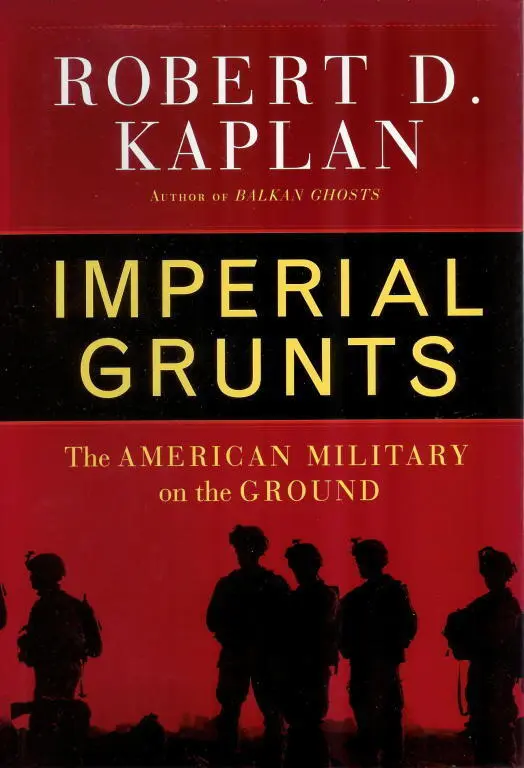
- Название:Imperial Grunts
- Автор:
- Издательство:Random House
- Жанр:
- Год:2005
- Город:New York
- ISBN:978-0-307-27850-0
- Рейтинг книги:5 / 5. Голосов: 1
-
Избранное:Добавить в избранное
- Отзывы:
-
Ваша оценка:
Imperial Grunts: краткое содержание, описание и аннотация
Предлагаем к чтению аннотацию, описание, краткое содержание или предисловие (зависит от того, что написал сам автор книги «Imperial Grunts»). Если вы не нашли необходимую информацию о книге — напишите в комментариях, мы постараемся отыскать её.
Imperial Grunts — читать онлайн бесплатно полную книгу (весь текст) целиком
Ниже представлен текст книги, разбитый по страницам. Система сохранения места последней прочитанной страницы, позволяет с удобством читать онлайн бесплатно книгу «Imperial Grunts», без необходимости каждый раз заново искать на чём Вы остановились. Поставьте закладку, и сможете в любой момент перейти на страницу, на которой закончили чтение.
Интервал:
Закладка:
Looking at the local women, and a few of the fetching European ones by the dock, and smelling their perfume, I remembered that there were marines in the tent in Djibouti who had told me that because of their extended deployments they hadn’t been laid in years.
Capt. Rynearson and Sgt. Philoctete represented the future reality of Special Operations: the Peace Corps with guns, the final articulation of unconventional war. An unstated reason the NGOs (nongovernmental organizations, often relief charities) were uncomfortable with the emerging humanitarian role of the American military was that it represented strong professional competition.
Capt. Steve Stacy had the concentrated look of a sprinter before the starting gun sounded, as Capt. Rynearson began talking to him about how to hire a dhow, what to pay the porters, and which of the “Bob Marley clones” with matted hair and colorful woolen caps who were hanging around the dock were trustworthy and which were not. Staff Sgt. Glenn Elenga and Sgt. Tony Diaz were all smiles: Wow, what a deployment, I could hear them thinking; whoever said, “War is hell”? As for Sgt. Mike McCoy, he was stone-faced. I had heard he was disappointed that the team was not sent to Iraq.
Looking at Sgt. McCoy’s expression, seeing how pale Sgt. Elenga and Capt. Stacy were, and observing their heavy clothes and Stacy’s high-and-tight crew cut he had gotten a few days before at Fort Bragg, I worried that a few days would not be enough for the transition from one team to the other. You wondered who planned these things at Fort Bragg; who it was that ordered Stacy to get a haircut rather than to start growing his hair long and stock up on beach clothes. The problem with the Special Operations community was that it knew intellectually what was necessary for America to project its power stealthily, but it couldn’t bring itself to make the necessary cultural adjustments.
The boat that took us across the channel to Lamu was a Jahazi, the largest type of dhow, capable of sailing as far as India. But ocean journeys were rare now because the Somali coast was covered by pirates. With majestic lateen sails and forward overhangs, dhows looked as aerodynamic as the sleekest fighter jets. They littered the channel, which in the sharp, late-afternoon sunlight resembled a sheet of tinted glass running with condensation. The approaching seaboard was cluttered with faded white archways, flowering trees, and small burros. I saw no paved roads and no cars. After disembarking we rested for a moment by a local hotel with potted palms and a dark, cool bar.
Then things happened fast. We met with the district commissioner, James Mwaura, to whom Capt. Rynearson introduced the new team. That was followed by a discussion about compensation to be paid by the U.S. for the destruction of a boat and a fire station, caused by the wind generated by a CH-46 helicopter during Edged Mallet. Next we walked over to the boys’ secondary school, where Marine Capt. James Bauch of Cedar Falls, Iowa, explained how a platoon from the 13th Marine Expeditionary Unit (MEU), based off the U.S.S. Germantown, had flown in by chopper and in four twelve-hour workdays laid a new roof and refurbished the rest of the building. The marines were now playing basketball with the local kids. Watching the game, Rynearson told me, “This is where we win.” At a ceremony for the opening of the new school building the next day, District Commissioner Mwaura would tell the crowd, “In the midst of all the problems in the world, it is important to see the humanitarian hand of the American military.”
The island’s population was under one hundred thousand. The economy was weak. A few dozen Americans—marines and Army Civil Affairs personnel—going around, spending money in the shops and restaurants, was in and of itself appreciated. Rynearson’s team had convinced some of the locals that the U.S.S. Germantown should pay a port call. Those locals, in turn, convinced other locals at a community meeting. A Navy SEAL team then arrived to “pop smoke,” to keep dhows away from the Germantown ’s wake. “The SEALs put on a real show for the local kids, throwing a lot of colorful smoke grenades,” Rynearson said. Turning to Capt. Stacy, he told him, “Never speak to the community as a group; speak to individuals and have them go to the community. And make sure to call people by their titles here, they like that.”
Such details were critical. The endgame was to turn the local media, as Special Operations Command—Pacific had been able to do with the Philippine media during the Basilan operation. Recently, though, things had gone horribly wrong at Garissa, a town in the Kenyan interior near the Somali border. A local mullah had paid off some demonstrators to throw rocks during a MEDCAP, resulting in stories in the Nairobi press about how the Americans were not wanted.
At sunset, we finally arrived at the villa that Rynearson had rented: a white, cubistic masterpiece graced by bougainvillea, geraniums, and sweet-smelling jasmines. We were so close to the equator that on the balcony in the middle of the night I thought it might be possible to see both the Southern Cross and the North Star at opposite points on the horizon.
It was on the balcony where the two teams gathered for a sit-down over beer. Now I met the two other sergeants from Rynearson’s team, another ethnic Haitian and an ethnic Nicaraguan, both from Miami, who called themselves Wesley and Max. Wesley, like Philoctete, looked like a local; Max looked like a Lebanese trader. They both had short beards and wore beads and knit caps. There was also someone else present: a Marine force protection specialist whom I shouldn’t name. With a short-cropped beard and a café-au-lait complexion, he might have passed for a “bad guy.” With no locals around, the noncoms addressed Capts. Rynearson and Stacy as “sir.”
The evening breeze was nice and cool. The Kenyan Tusker beer was good, and the bottles were big. When everyone got settled, the force protection guy began dourly: “I’m paid to be paranoid. I’m a marine, so I stay in the box. I don’t go out of the box,” meaning that he couldn’t talk about what was not concrete and immediately definable, unlike Army Special Operations, which was comfortable with nebulosity. “Therefore, here’s what I know. The Muslim religious leaders who run the island community are suspicious of us. At the same time they need us to do projects. This house is beautiful, but don’t get into the habit of hanging out here, or else you’ll really be unsafe. If you guys get snatched, hope somebody will rescue you. But you can’t hunker down.”
Rynearson cut in: “Don’t worry. Even on slow days there will always be someone who wants to show you their school or something. You’ll always be busy checking out potential projects. That’s the beauty of Civil Affairs. You figure it out on your own. You’ll be an easy target, but nobody will do anything in their own backyard. On a scale of one to ten, I’d say the threat level is two.”
Then came a long discussion about local contractors and construction materials. It was a disciplined meeting. The new team members took notes. At the end, it was decided that Capt. Stacy would not wear his combat fatigues at the ceremony the next day for the school opening. “Because nobody here knows you yet,” Rynearson suggested, “the uniform will be a barrier to becoming accepted.” It was no big deal to tell the truth about being an American soldier; it was another to intimidate people with a uniform.
After dinner the new team retired to another part of the villa to meet among themselves. Again, they all had notebooks; Capt. Stacy still had the tense look of an athlete before a race.
“I think,” he began, “that we lose the Camel Paks, the military rucks, and the fishing vests. Buy some beach clothes. All of us except for Diaz look too white, too American military. We can’t put that in people’s faces.” The others nodded. “The old team has racial advantages. Looking like some poor, down-and-out Australian or Canadian tourist is the best me and Glenn, for instance, will be able to do. We can grow goatees, they seem big here.” More nods. “The one good thing about my lousy Fort Bragg haircut is that my hair will grow back.” Some laughter, then Stacy concluded: “This place, this assignment.” He searched for the right words. “It will be like herding cats. In Lamu, slow is fast. If we stay uptight, like we are now, if we try to keep people to our schedule, we’ll fail. We have to slow down, do things at their speed. It may take some time before we can recommend our first aid project. There will be a lull. The major and the others at Camp Lemonier are going to have to accept that nothing may happen for a while. We can’t operate like Capt. Rynearson’s team. We’ll have to find our own way.” More nods.
Читать дальшеИнтервал:
Закладка:
Похожие книги на «Imperial Grunts»
Представляем Вашему вниманию похожие книги на «Imperial Grunts» списком для выбора. Мы отобрали схожую по названию и смыслу литературу в надежде предоставить читателям больше вариантов отыскать новые, интересные, ещё непрочитанные произведения.








Обсуждение, отзывы о книге «Imperial Grunts» и просто собственные мнения читателей. Оставьте ваши комментарии, напишите, что Вы думаете о произведении, его смысле или главных героях. Укажите что конкретно понравилось, а что нет, и почему Вы так считаете.