Robert Kaplan - Imperial Grunts
Здесь есть возможность читать онлайн «Robert Kaplan - Imperial Grunts» весь текст электронной книги совершенно бесплатно (целиком полную версию без сокращений). В некоторых случаях можно слушать аудио, скачать через торрент в формате fb2 и присутствует краткое содержание. Город: New York, Год выпуска: 2005, ISBN: 2005, Издательство: Random House, Жанр: Публицистика, nonf_military, на английском языке. Описание произведения, (предисловие) а так же отзывы посетителей доступны на портале библиотеки ЛибКат.
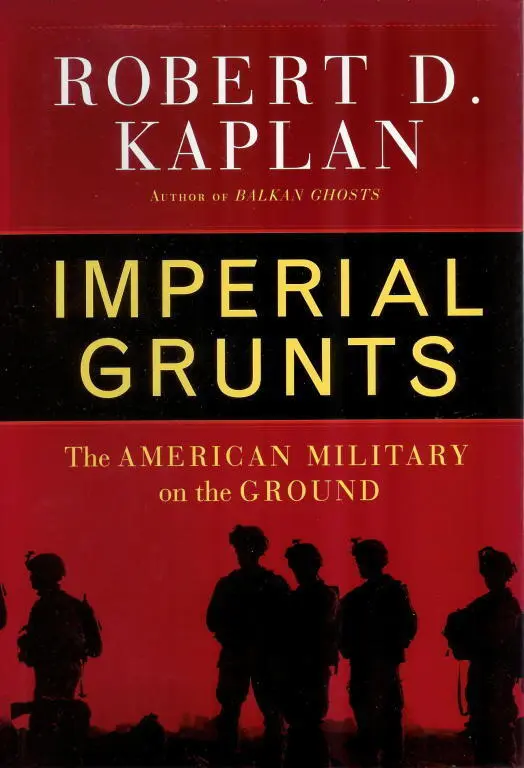
- Название:Imperial Grunts
- Автор:
- Издательство:Random House
- Жанр:
- Год:2005
- Город:New York
- ISBN:978-0-307-27850-0
- Рейтинг книги:5 / 5. Голосов: 1
-
Избранное:Добавить в избранное
- Отзывы:
-
Ваша оценка:
Imperial Grunts: краткое содержание, описание и аннотация
Предлагаем к чтению аннотацию, описание, краткое содержание или предисловие (зависит от того, что написал сам автор книги «Imperial Grunts»). Если вы не нашли необходимую информацию о книге — напишите в комментариях, мы постараемся отыскать её.
Imperial Grunts — читать онлайн бесплатно полную книгу (весь текст) целиком
Ниже представлен текст книги, разбитый по страницам. Система сохранения места последней прочитанной страницы, позволяет с удобством читать онлайн бесплатно книгу «Imperial Grunts», без необходимости каждый раз заново искать на чём Вы остановились. Поставьте закладку, и сможете в любой момент перейти на страницу, на которой закончили чтение.
Интервал:
Закладка:
“Just whacking crack houses doesn’t cut it anymore,” Robeson explained. “The new Economy of Force model we’re working on is to whack people quietly, while running a lot of aid projects that generate good publicity in the areas affected.” Consequently, Robeson was sprinkling his vast desert and savanna fiefdom with aid missions. U.S. troops, often in civilian clothes, were building schools and hospitals and digging wells; holding MEDCAPS and DENTCAPS for the inhabitants, and VETCAPS for their animals. They were training the indigenous troops of several nations in counterterrorism, establishing local coast guards from Kenya to Yemen, and dispatching clandestine Special Operations teams here and there to snatch and kill “bad guys.” September 11 had given the U.S. military the justification to go out scouting for trouble, and at the same time to do some good.
In Ma’rib, the Yemeni badland east of the capital of Sana’a where I had traveled thirteen months before, there had recently been dozens of arrests of al-Qaeda suspects, facilitated by the U.S., which coincided with the insertion of marines to train Yemeni commandos. In the Ogaden desert region of Ethiopia, Army civil affairs teams (CATs) were establishing relationships with local clan leaders who needed help against bandits and refugees seeping in from chaotic Somalia.
“Who needs meetings in Washington?” Army Maj. Trip Narrow of Baton Rouge, Louisiana, told me. “Guys in the field will figure out what to do. I took ten guys for a week through eastern Ethiopia. Everywhere we went people wanted a bigger American presence. They know we’re here. They want to see what we can do for them. One four-man CAT [civil affairs team] can accomplish more than a battalion of infantry. Forget the Vietnam baggage,” he went on. “It’s still about hearts and minds, a Peace Corps role for the military.”
Fifteen years after the collapse of the Berlin Wall a new paradigm was emerging for how the American military projected itself abroad, one that borrowed more from the French and Indian War and the Lewis and Clark expedition than from the major conflicts of the twentieth century. Just like the British and the French dealing with the Iroquois Confederacy on the western slopes of the Appalachians and in northern New York State, Americans in the Horn were interacting with indigenous peoples in small numbers, making various deals of mutual self-interest, and killing a few of them when necessary. And like Lewis and Clark, small groups of soldiers and marines were being dispatched to little-surveyed areas, armed with only general guidelines. But because progress was often imperceptible, it was unclear how much defense officials in Washington appreciated the significance of what was going on here.
The new paradigm gave Brig. Gen. Robeson a sort of power that no U.S. ambassador or assistant secretary of state quite had. Not only wasn’t he burdened by the State Department’s antiquated bureaucratic divisions, but his ability to deal with the region’s leaders and strongmen may also have been helped by a cause-and-effect, working-class mind, disciplined by the logic of Marine tactical operations manuals and the classical military education he had received at Fort Leavenworth. Though democracy was gaining in the region, many of the elected leaders with whom Robeson had developed relationships were former guerrilla fighters and military men, men from hardscrabble beginnings who may have had more in common with a Marine brigadier general who had studied business administration at Bryan College in Dayton, Tennessee, and lived in Jacksonville, North Carolina, than they had with a civilian ambassador who had, say, studied liberal arts at an elite university and lived in a prosperous Washington suburb.
The fact that generals like Mastin Robeson were in the diplomatic forefront, somewhat at the expense of the State Department, troubled commentators who assumed the permanence of industrial-age categories of bureaucratic responsibility, categories helped into being by the early-nineteenth-century professionalization of European militaries, which consequently separated them from civilian command structures. But such distinctions appeared to be weakening.
In 1994, two Special Forces officers helped the Paraguayan government to ratify new laws just after Paraguay’s constitution had been adopted. On the other hand, it was under the State Department’s auspices, not the Pentagon’s, that helicopters were leased to the Colombian military to fight narco-terrorists. And just as Robeson was a model for future generals, the model for future diplomats might have been Deane Hinton, who oversaw counterinsurgency operations as ambassador to El Salvador in the early 1980s, and then oversaw efforts to arm Afghan guerrillas as the ambassador to Pakistan in the middle and late 1980s. In both cases, a military strategy would have been unavailing in the absence of a successful interagency strategy, which backed diplomatic initiatives and aid packages with the power of a cocked gun. As military and diplomatic divisions of responsibility continued to break down, the U.S. government was likely to revert to the unified leaderships of the ancient and early modern worlds—what Socrates and Machiavelli recognized as a basic truth of all political systems, whatever the labels those systems claimed for themselves. 3
With his practical mindset, Gen. Robeson was impressed neither with the appearance of progress nor with scholastic definitions of it, but with progress itself. To wit, like others in the defense establishment, but unlike many in the State Department, Robeson liked the president of neighboring Eritrea, Isaias Afwerki. “Isaias doesn’t need bodyguards,” Robeson told me. “He goes around alone. He lives in a normal house. He governs an African capital that is crime-free, without slums, even though there are relatively few police. There’s no terrorist threat in Eritrea. More than any other country in my AOR [area of responsibility], it has a secular Western sense of patriotism. Isn’t that what we claim we want?” [70] Indeed, a religious map of the region put out by the Pentagon showed Eritrea as a separate category all its own, with a single national identity rather than separate religious identities.
Eritrea was interesting as a symbol of how the Pentagon and the State Department saw the world differently. My own reporting experiences in Eritrea caused me to initially side with the Pentagon, though, as the human rights situation there continued to deteriorate, even I was fast losing hope.
While the State Department defined civil society in terms of generic criteria such as elections, a free press, and the absence of political prisoners, that way of thinking missed vital nuances: President Afwerki did not require a vast security apparatus to protect him as did the prime minister of Ethiopia, Meles Zenawi. Eritrea was arguably the least corrupt of third world countries. It had a record of near-perfect accountability when it came to utilizing international aid, and took care of its handicapped citizens better than any other country in Africa.
As Robeson put it, “Rather than give up on Isaias because he won’t conform with our standards of Western democracy, it’s in our interest to bring him into the tent, before the human rights situation gets even worse there.” He mentioned that the Eritrean leader gave up the disputed Hanish Islands in the Red Sea to Yemen, just as the international community had asked him to. Going on in his mild North Carolina drawl about the tense relationship between Eritrea and Yemen, Robeson remarked: “[Yemeni president Ali Abdullah] Saleh has been a real impressive leader, make no mistake. And the only way he has succeeded is by making deals with one tribe and another. But that’s why Isaias can’t respect him. You see, Isaias lived in a cave for years during the guerrilla war with Ethiopia. Nobody chooses to live in a cave that long except to defend a strong principle. And so in Isaias’s mind, Saleh has no principles, he’s just a wheeler-dealer.
Читать дальшеИнтервал:
Закладка:
Похожие книги на «Imperial Grunts»
Представляем Вашему вниманию похожие книги на «Imperial Grunts» списком для выбора. Мы отобрали схожую по названию и смыслу литературу в надежде предоставить читателям больше вариантов отыскать новые, интересные, ещё непрочитанные произведения.









Обсуждение, отзывы о книге «Imperial Grunts» и просто собственные мнения читателей. Оставьте ваши комментарии, напишите, что Вы думаете о произведении, его смысле или главных героях. Укажите что конкретно понравилось, а что нет, и почему Вы так считаете.