Robert Kaplan - Imperial Grunts
Здесь есть возможность читать онлайн «Robert Kaplan - Imperial Grunts» весь текст электронной книги совершенно бесплатно (целиком полную версию без сокращений). В некоторых случаях можно слушать аудио, скачать через торрент в формате fb2 и присутствует краткое содержание. Город: New York, Год выпуска: 2005, ISBN: 2005, Издательство: Random House, Жанр: Публицистика, nonf_military, на английском языке. Описание произведения, (предисловие) а так же отзывы посетителей доступны на портале библиотеки ЛибКат.
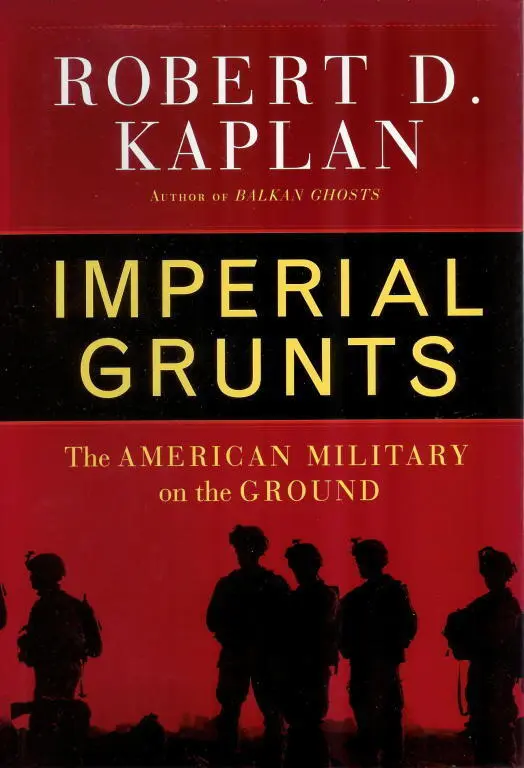
- Название:Imperial Grunts
- Автор:
- Издательство:Random House
- Жанр:
- Год:2005
- Город:New York
- ISBN:978-0-307-27850-0
- Рейтинг книги:5 / 5. Голосов: 1
-
Избранное:Добавить в избранное
- Отзывы:
-
Ваша оценка:
Imperial Grunts: краткое содержание, описание и аннотация
Предлагаем к чтению аннотацию, описание, краткое содержание или предисловие (зависит от того, что написал сам автор книги «Imperial Grunts»). Если вы не нашли необходимую информацию о книге — напишите в комментариях, мы постараемся отыскать её.
Imperial Grunts — читать онлайн бесплатно полную книгу (весь текст) целиком
Ниже представлен текст книги, разбитый по страницам. Система сохранения места последней прочитанной страницы, позволяет с удобством читать онлайн бесплатно книгу «Imperial Grunts», без необходимости каждый раз заново искать на чём Вы остановились. Поставьте закладку, и сможете в любой момент перейти на страницу, на которой закончили чтение.
Интервал:
Закладка:
Key Terrain, Capt. Cassidy explained, was the part of the terrain that provided an advantage toward acquiring Decisive Terrain. Key Terrain could shift, “because there may be only one fucking machine-gun position holding up an advance, to be replaced later by another machine-gun position.” As for Decisive Terrain, “it may not exist at all,” because the nature of the enemy configuration may make it impossible to secure success by holding any one piece of ground. Terrain was also divided between an Area of Operation and an Area of Interest. The Area of Interest, in this case the elevated plain, extended beyond the Area of Operation, which was the marshy woodlands and ridges. Key Terrain in this particular assault was situated near the ridgeline where the Area of Operation met the Area of Interest.
The brief went on, becoming increasingly specific as every ridge and path leading up to the plain was described and considered. It followed the unyielding logic of both the Ranger Handbook and the Fleet Marine Force Manual 6-5 (FMFM 6-5), the latter known as the “Grunt’s Bible.” [69] The Ranger Handbook was the smart sheet for individual tasks; its equivalent was the Guidebook for Marines. The FMFM 6-5 concentrated on squad-level operations.
From the beginning of my journey, I had been meeting men for whom “the mission was everything.” Capt. Cassidy’s brief clarified the mission further. It showed that the mission had to be tangible; that it had to be finite; that to be successful it need not—and often could not—be perfectly executed; and that, most of all, the mission was about priorities. It assumed, in other words, a messy world with imperfect results.
In such a tactical universe, intentions were meaningless; only effects mattered. This was a universe that featured total accountability, for success and failure were specifically measurable in terms of inches of ground and lives of men. It was a restrictive logic, but not self-delusory like other kinds. Therein lay its power.
It was only a few minutes’ walk from Capt. Cassidy’s office to that of Marine Brig. Gen. Mastin Robeson, the commander of the Combined Joint Task Force—Horn of Africa, whom I knew from the Army’s School of Advanced Military Studies at Fort Leavenworth, Kansas. The Marines of India Company guarded Camp Lemonier, from which Brig. Gen. Robeson launched missions throughout the Horn of Africa and beyond. But while Brig. Gen. Robeson applied himself to larger, strategic matters, the disciplined logic of the Marine field manuals guided his approach. From western North Carolina (though he now lived in Jacksonville), he was tall, trim, and gray-haired, and with a sly, curious expression that made me think of a rifle scope being zeroed in.
The CJTF-HOA labored under “the tyranny of distance,” Robeson told me. His AOR (area of responsibility) included not only the traditional Horn of Africa countries—Djibouti, Ethiopia, Eritrea, and Somalia—but also the adjacent real estate of Yemen, Sudan, and Kenya. This subfiefdom of CENTCOM was five times larger than Iraq and Afghanistan combined, yet the American footprint had remained relatively small. “We’re conducting an archaeological dig, not doing urban renewal,” he explained. “It’s about working the fringes, finding needles in haystacks, not dismantling regimes.” There was obviously a lot less going on here than in Iraq and Afghanistan, but what was going on—as in Colombia, Mongolia, and the Philippines—was more instructive of how the U.S. military would likely operate in the future.
The Horn of Africa had registered on the American intelligence radar screen long before the 1998 bombings of the U.S. embassies in Nairobi, Kenya, and Dar es Salaam, Tanzania. Al-Qaeda had been operating around the Horn for years. When Osama bin Laden relocated from Sudan to Afghanistan in 1995, he left a financial support structure behind in Khartoum. Though terrorism thrived on ungovernability, it also required cultural and linguistic access, so that terrorists could blend into the population. In the case of al-Qaeda, Sudan, Somalia, Yemen, and heavily Muslim northern Kenya offered such access.
“This is a region,” Robeson told me, “where young al-Qaeda operatives drift into towns and villages, get established, marry local girls, and go to ground.” Saleh Nabhan, a key operative in the 2002 attack on the Israeli-owned Paradise Hotel in Mombasa, Kenya, and of the surface-to-air missile launched at an Israeli airliner from Mombasa, fit that description perfectly: one day he had arrived at a coastal fishing village near Lamu Island in northern Kenya, settled in and married a fifteen-year-old local girl, then bought a house with the dowry and laid low for several years. “How many more like him are out there that we don’t know about?” the general asked aloud. As it was, CJTF-HOA was tracking more than five hundred terrorists by name. “It’s like pulling up a rug and realizing, holy cow, where’d all those cockroaches come from? Once you start playing zone defense in depth, like we’re doing in the Horn, it’s amazing what turns up.”
To a greater degree than Afghanistan even, the Horn was a place for a light and lethal force structure. Robeson had flattened the command hierarchy by collapsing his own staff and that of the CJTF-HOA’s Joint Special Operations Task Force (JSOTF) into each other. He had created a single intel-fusion center with representatives from all the countries in the area of responsibility to analyze political, military, and terrorist activities in the Horn and beyond, making for a holistic tapestry unavailable at the State Department or the Central Intelligence Agency.
Less so than the State Department, Brig. Gen. Robeson was unburdened by bureaucratic boundary seams. If terrorists could take advantage of the porosity of borders, why couldn’t the U.S. government? And yet U.S. embassies, established according to a system of nation-states, were, by definition, country-centric, with localitis the natural result. The State Department, more than the Pentagon, was also hindered by the Cold War–era divisions of its various “line” bureaus: the Bureau of Near Eastern Affairs, the Bureau of African Affairs, and so forth. Robeson’s area of responsibility, on the other hand, overlapped several geographic domains: the Horn of Africa, the Arabian Peninsula, North and East Africa, and the Pacific. The Horn, Yemen, and Kenya were all inside CENTCOM, which comprised the Middle East and parts of Africa most impacted by the Arabian Peninsula. EUCOM, which handled Europe and sub-Saharan Africa, had allowed Robeson to pursue leads into Tanzania and Uganda. Meanwhile, PACOM had granted Robeson similar access to the Comoros islands.
“Bureaucratically, we’re doing things we never did before,” Robeson said. “I speak a few times a week to Gen. [John] Abizaid [the CENTCOM commander], and that is the extent of my instructions. It’s great to be ignored. It means you can innovate.” The newer and more immature the theater of operations, the more opportunity that existed for entrepreneurship.
Djibouti in its own quiet way manifested the ultimate effect of 9/11, an effect that was general and sustaining rather than specific and transitory. Iraq and Afghanistan were about dismantling regimes and consequent nation-building, which, because it grabbed headlines, excited journalists and intellectuals who lived off the news for their debates and discussions. But the Horn demonstrated that the killing of a few thousand Americans on one day two and a half years earlier had provided the U.S. military with the trigger for a new kind of great power role, a role that was precise and subtle, did not involve large numbers of troops, and was not truly about nation-building.
Читать дальшеИнтервал:
Закладка:
Похожие книги на «Imperial Grunts»
Представляем Вашему вниманию похожие книги на «Imperial Grunts» списком для выбора. Мы отобрали схожую по названию и смыслу литературу в надежде предоставить читателям больше вариантов отыскать новые, интересные, ещё непрочитанные произведения.







Обсуждение, отзывы о книге «Imperial Grunts» и просто собственные мнения читателей. Оставьте ваши комментарии, напишите, что Вы думаете о произведении, его смысле или главных героях. Укажите что конкретно понравилось, а что нет, и почему Вы так считаете.