Robert Kaplan - Imperial Grunts
Здесь есть возможность читать онлайн «Robert Kaplan - Imperial Grunts» весь текст электронной книги совершенно бесплатно (целиком полную версию без сокращений). В некоторых случаях можно слушать аудио, скачать через торрент в формате fb2 и присутствует краткое содержание. Город: New York, Год выпуска: 2005, ISBN: 2005, Издательство: Random House, Жанр: Публицистика, nonf_military, на английском языке. Описание произведения, (предисловие) а так же отзывы посетителей доступны на портале библиотеки ЛибКат.
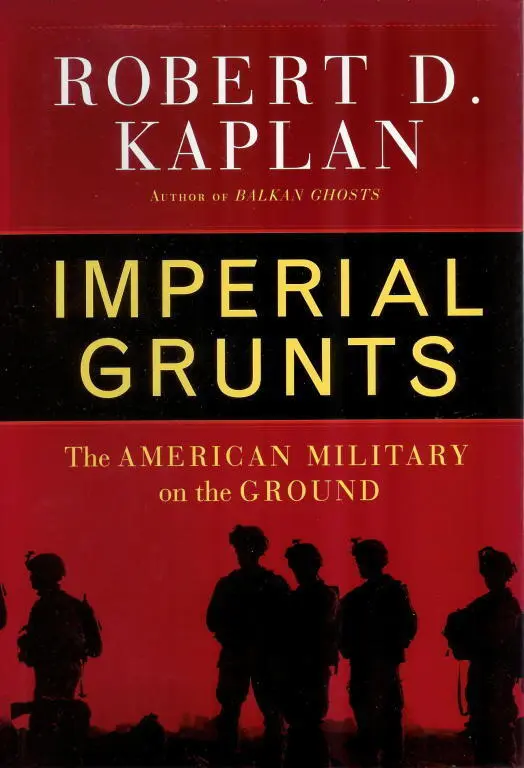
- Название:Imperial Grunts
- Автор:
- Издательство:Random House
- Жанр:
- Год:2005
- Город:New York
- ISBN:978-0-307-27850-0
- Рейтинг книги:5 / 5. Голосов: 1
-
Избранное:Добавить в избранное
- Отзывы:
-
Ваша оценка:
Imperial Grunts: краткое содержание, описание и аннотация
Предлагаем к чтению аннотацию, описание, краткое содержание или предисловие (зависит от того, что написал сам автор книги «Imperial Grunts»). Если вы не нашли необходимую информацию о книге — напишите в комментариях, мы постараемся отыскать её.
Imperial Grunts — читать онлайн бесплатно полную книгу (весь текст) целиком
Ниже представлен текст книги, разбитый по страницам. Система сохранения места последней прочитанной страницы, позволяет с удобством читать онлайн бесплатно книгу «Imperial Grunts», без необходимости каждый раз заново искать на чём Вы остановились. Поставьте закладку, и сможете в любой момент перейти на страницу, на которой закончили чтение.
Интервал:
Закладка:
Had the French not established themselves in Djibouti in the middle of the nineteenth century, it is unlikely that the British would have backed Italian ambitions on the coast farther north, in order to counter the French, in which case modern Eritrea, a creation mainly of Italian colonialism, probably never would have come into being. Because European divisions did not always configure with ethnic ones, in recent decades Djibouti had been wracked by ethnic tensions and civil war, between the Ethiopian- and Eritrean-related Afars and the dominant, Somali-related Issas.
Those ethnic divides had an obsessive Middle Eastern quality to them, for the Horn of Africa constituted a loose and wondrous fragment of the Middle East, whose alkaline volcanic deserts were separated from those of Arabia by only a narrow band of water. 1The line of Ethiopian emperors that ended with Haile Selassie claimed descent from the Hebrew King Solomon and the Yemeni Queen of Sheba. Here nightmarish grand guignols of conquest and regime-induced starvation were punctuated by a chilling precision common to the Middle East, but rare in the rest of Africa. The region’s Semitic and Hamitic languages traced their origins in written form to biblical antiquity. The technical and organizational abilities of the inhabitants were unsurpassed on the African continent. Take the Amhara of Ethiopia, whom Donald N. Levine in his classic study, Wax and Gold, notes are “not much given to aesthetic concerns. They are practical-minded peasants, austere religionists, and spirited warriors.” 2Indeed, warfare on the Horn in the final quarter of the twentieth century featured masterfully orchestrated, set-piece battles with tanks, fighter jets, and helicopter gunships that bore closer relation to the Arab-Israeli wars of 1967 and 1973, and to the Iran-Iraq War of the 1980s, than to any other fighting in sub-Saharan Africa.
In the mid-1980s, when I first began reporting from the Horn, a famine of biblical proportions engulfed the region. The media ascribed it exclusively to drought. But the famine was substantially the result of ethnic and class conflict. In the 1980s, the nineteenth-century empire of the Ethiopian Amharas was finally cracking up, and the regime in the Ethiopian capital of Addis Ababa, fortified by Marxist ideology, was using famine as a means to pressure the rebellious Tigreans and Eritreans into submission. The ethnic divisions never healed. Fighting, which abated in 1991—after which Eritrea officially became independent—resumed from 1998 until 2000, causing tens of thousands of more deaths. Unable to export its goods through Eritrean ports, Ethiopia was dependent on Djibouti for an outlet to the sea. That further boosted Djibouti’s strategic importance, and provided it with its first economic windfall.
The second windfall came in 2002 when, with French connivance, the United States stood up the Combined Joint Task Force—Horn of Africa (CJTF-HOA) in Djibouti. At first, it was located offshore on the U.S.S. Mt. Whitney. Then the Americans moved onshore to the old French foreign legion outpost of Camp Lemonier. Despite their public spat over Iraq, it had been decided at the highest levels of government in both Washington and Paris that the United States and France needed to cooperate on something real, not merely symbolic, in the War on Terrorism, in order to stabilize their bilateral relationship.
Djibouti and the whole exotic world of the Horn soon evaporated, though; within an hour after my plane had landed, I was ensconced in a crowded tent at Camp Lemonier with ten Marine corporals, lance corporals, and privates first class. For many days they would be my only reality before I ventured beyond the base. The CJTF-HOA was a Marine show to the same degree that the CJTF-180 in Afghanistan had been a Big Army one.
The oldest of the marines in my tent was less than half my age. It was a challenge. The differences between groups of men in their early twenties and those in their mid-thirties are vast. The latter are more settled down, often with growing children and divorces behind them, while the former cannot exist for long without loud soul, hip-hop, and salsa, and constant use of the f word. But in the barracks no one remains a stranger. After a day or so, the young marines stopped calling me “sir” and started addressing me by my first name. This was about the time that I had been bitten up by chiggers like everybody else.
Our tent was lost amid many at Camp Lemonier. I might have been back at Bagram, with the same HESCO barriers, sandbags, concertina wire, shower units, gravel pathways, chow hall, and guard towers built of stacked shipping containers—all constructed at breakneck speed by Kellogg, Brown & Root (KBR). KBR was as much a part of the American military empire and the War on Terrorism as any of the armed services. Indeed, KBR’s employees tended to be former military, and were known to take considerable risks when the occasion demanded. The architecture, the town planning, and the entire physical ambience of America’s overseas outposts at the turn of the twenty-first century were basically an invention of KBR. The average soldier never really saw Afghanistan or Djibouti. His world was the KBR instant city: “Just add water and watch it grow,” as the saying on base went.
Camp Lemonier was distinguished from Bagram in that it was much smaller, with 1,400 inhabitants as opposed to Bagram’s 5,000. The air here, rather than dry, thin, and cold as at Bagram, was sticky, humid, and hot. Unlike Bagram, nobody used Zulu time. Zulu time was a requirement of the U.S. Air Force, whose time zone reference had to be the same worldwide. But in the Horn of Africa there was much less need for close air support than in Afghanistan.
My “rack” mates belonged to the 2nd squad of the 2nd Platoon of India Company, which, in turn, was part of the 3rd Battalion of the 2nd Regiment of the Second Marine Expeditionary Force (II MEF), out of Camp Lejeune. [63] “Rack” is the naval term for bunk. The Marines, being part of the fleet, use Navy lingo.
India Company, which had seen action in Kosovo in 1999 and during Operation Iraqi Freedom (OIF) in 2003, was in Djibouti as a component of Security Task Force Betio, a reference to the islet in the Tarawa atoll that the Marines had captured from the Japanese in 1943. India Company was responsible for security inside and around the perimeter of Camp Lemonier.
“It all seems complicated but it’s really very easy,” Staff Sgt. Chad Dickinson of Ilion, New York, explained to me. “In the Marines, we subscribe to KISS—Keep It Simple, Stupid. That’s why everything in the Marines is done in threes: three regiments to a division, three battalions to a regiment, three companies to a battalion, three platoons to a company, three squads to a platoon, three fire teams to a squad, and three men to a fire team. [64] This was a useful simplification. For example, while a company had three “line” platoons, there was often a fourth “weapons” platoon. Moreover, fire teams had four men almost as often as three.
But the most important thing that you have to remember is that our company and our platoon are the best there is in the Marine Corps.”
Staff Sgt. Dickinson was the 2nd Platoon’s leader. His high-and-tight buzz cut revealed fiery red hair. His eyes never seemed to blink. His gaze made me think of a crushing handshake, something that first acquired meaning when I watched him berate the marine in the rack beside mine for a minor infraction. “Don’t try me, son, because you’ll be sorry,” he growled.
“Marines are extremists,” Staff Sgt. Dickinson told me. “When I am at home with my wife and it is my turn to clean the bathroom, I clean with straight bleach. The Marines take people who are mean and troublesome, and transform them into people who are just plain intense.” When I asked him to call me by my first name, he replied, “If I called you by anything other than ‘sir’ and my father found out, he’d whoop my ass.”
Читать дальшеИнтервал:
Закладка:
Похожие книги на «Imperial Grunts»
Представляем Вашему вниманию похожие книги на «Imperial Grunts» списком для выбора. Мы отобрали схожую по названию и смыслу литературу в надежде предоставить читателям больше вариантов отыскать новые, интересные, ещё непрочитанные произведения.










Обсуждение, отзывы о книге «Imperial Grunts» и просто собственные мнения читателей. Оставьте ваши комментарии, напишите, что Вы думаете о произведении, его смысле или главных героях. Укажите что конкретно понравилось, а что нет, и почему Вы так считаете.