Robert Kaplan - Imperial Grunts
Здесь есть возможность читать онлайн «Robert Kaplan - Imperial Grunts» весь текст электронной книги совершенно бесплатно (целиком полную версию без сокращений). В некоторых случаях можно слушать аудио, скачать через торрент в формате fb2 и присутствует краткое содержание. Город: New York, Год выпуска: 2005, ISBN: 2005, Издательство: Random House, Жанр: Публицистика, nonf_military, на английском языке. Описание произведения, (предисловие) а так же отзывы посетителей доступны на портале библиотеки ЛибКат.
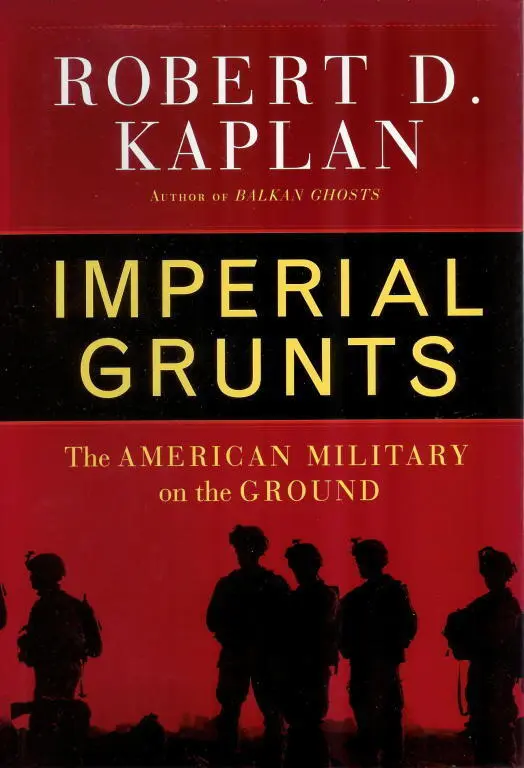
- Название:Imperial Grunts
- Автор:
- Издательство:Random House
- Жанр:
- Год:2005
- Город:New York
- ISBN:978-0-307-27850-0
- Рейтинг книги:5 / 5. Голосов: 1
-
Избранное:Добавить в избранное
- Отзывы:
-
Ваша оценка:
Imperial Grunts: краткое содержание, описание и аннотация
Предлагаем к чтению аннотацию, описание, краткое содержание или предисловие (зависит от того, что написал сам автор книги «Imperial Grunts»). Если вы не нашли необходимую информацию о книге — напишите в комментариях, мы постараемся отыскать её.
Imperial Grunts — читать онлайн бесплатно полную книгу (весь текст) целиком
Ниже представлен текст книги, разбитый по страницам. Система сохранения места последней прочитанной страницы, позволяет с удобством читать онлайн бесплатно книгу «Imperial Grunts», без необходимости каждый раз заново искать на чём Вы остановились. Поставьте закладку, и сможете в любой момент перейти на страницу, на которой закончили чтение.
Интервал:
Закладка:
“Good morning, Marine,” Marine Capt. David Nevers of Chicago—my escort at Camp Lejeune—said to the Marine guard at the checkpoint to the command headquarters of the 24th Marine Expeditionary Unit.
“Good morning, sir,” the guard shot back.
“Ooh-rah,” Capt. Nevers replied.
“Ooh-rah,” the guard repeated.
Such exchanges repeated themselves throughout the day at Camp Lejeune. With Special Forces, which considered itself somewhat of a bastard child of the regular Army, I had never heard Hoo-ah much. Indeed, one high-ranking Green Beret officer told me that he had joined SF “to get away from that Hoo-ah shit.” At regular Army gatherings over the years, I had heard Hoo-ah used mainly as an expression of solidarity during group get-togethers. But Marines exploded in Ooh-rah during one-on-one encounters as though they had deeply internalized it.
When I asked a young female sergeant at Camp Lejeune, a pale and innocent-looking wisp of a girl from Kentucky, why she had joined the Marines, not hesitating half a second even, she barked back: “Because they’re the best. And I wanted to be the best.” Next to her stood a towering sergeant major, an old-timer who described himself as a “southern redneck.” He told me, “You know why we’re going to win eventually in Iraq? I’ll tell ya. Because Marines are there. And Marines don’t fail. We just don’t. Because from boot camp on up, we learn and relearn our history and tradition.”
Such boastful pride may conceal insecurity within. But that did not seem to be the case with the Marines, to judge by the way they handled journalists. In the Pentagon a few weeks earlier I had run into a Marine general who, after I had told him that I would be traveling with the Marines, said: “Write all about us, warts and all. We don’t hide anything. We want the world to know exactly what we’re like.” Arranging trips with the Marines was simply a matter of telling them where I wanted to go. The Army, as I had learned years before while researching a story about Fort Leavenworth, wanted to manage every minute of your day. The Marines let you go off on your own inside the base. They weren’t afraid what you might see by accident.
The United States had marines in the Continental Navy during the Revolutionary War. They were disbanded, though, and reborn as the Corps of Marines in 1798 to fight Barbary pirates in the Mediterranean, hence the line in the Marine Corps anthem, “to the shores of Tripoli.” The Marines helped in the 1846–48 Mexican War (“From the halls of Montezuma”). And for three decades beginning with the Spanish-American War of 1898, the Marines staged landings in Cuba, the Philippines, Puerto Rico, Honduras, Mexico, Guam, Samoa, China, Nicaragua, and the Dominican Republic—part of the legacy of America’s small wars.
From 3,000 marines in the nineteenth century, the corps had risen to only 11,000 at the time of America’s entry into World War I. At the turn of the twenty-first century, with upwards of 174,000 marines, the corps was still by far the smallest and most tightly knit of the services under the Pentagon’s umbrella; [62] The Coast Guard fell under the newly created Department of Homeland Security.
it was less than half the size of the Navy and of the Air Force, and slightly more than a third that of the Army. In perhaps the most insightful words written about the Marines, Washington Post military correspondent Thomas E. Ricks observes:
The Air Force has its planes, the Navy its ships, the Army its obsessively written and obeyed “doctrine” that dictates how to act. Culture—that is, the values and assumptions that shape its members—is all the Marines have. It is what holds them together…. formalistic, insular, elitist, with a deep anchor in their own history and mythology…. Alone among the U.S. military services, the Marines have bestowed their name on their enlisted ranks. The Army has Army officers and soldiers, the Navy has naval officers and sailors, the Air Force has Air Force officers and airmen—but the Marines have officers and Marines. “Every Marine a rifleman,” states one key Corps motto. It means that the essence of the organization resides with the lowest of the low, the peon in the trenches. 6
In fact, the Marines had fewer officers per enlistee than any of the other services, even as they had twice the percentage of the lowest-ranking troops. 7More than two thirds of all marines were young enlistees in their first four-year tour. And partly because reenlistment was selective, the corps was kept deliberately young, hungry, and dynamic. It went with the mission: Whereas the Army won wars, the Marines won battles. The Marines were the ones who broke down doors; “the tip of the spear,” they called themselves.
Because embassy evacuations and humanitarian relief involved quick insertions and a get-it-done-fast approach, the Marines did those things, too, in southeastern Turkey, northern Iraq, Somalia, Haiti, Sierra Leone, East Timor, Bosnia, Kosovo, Liberia, and Afghanistan.
The Marines were a flattened hierarchy in the manner of the most innovative global corporations, with responsibility pushed out to the farthest edge of the battlefield. Every marine a rifleman was the literal truth. Whether a Marine aviator, auto mechanic, or cook, every marine was familiar with infantry skills, and had to keep practicing them. It was a system that suited the guerrilla-style conflicts of the twenty-first century, where battle lines had dissolved and a support unit could easily find itself fighting for its life, as happened during Operation Iraqi Freedom.
The Marines did not quite have the educational opportunities that the Army had, with its vast network of schools and war colleges. The Marines did not have a West Point. Marine sergeant majors did not have a sergeant majors’ academy like the Army’s at El Paso, Texas. The Marines made do with OJT (on-the-job training). Marine OJT taught everyone the job “one up,” so that he could fill the shoes of his immediate superior.
While in Special Forces, a master sergeant was the effective leader of an A-team of twelve men; in the Marines, a lower-ranking staff sergeant led a platoon of thirty-nine men divided into three squads of thirteen, each led by a corporal. They were in turn divided into fire teams of three or four men led by a lance corporal. Most of these noncoms were in their early twenties.
Because the Marines were young, they offered sheer aggression—a not inconsiderable tool in war. Special Forces, on the other hand, with its older and more experienced noncoms, offered deliberation and maturity. Thus, Green Berets may have been better prepared for the nuances of peacekeeping, occupation, and the training of indigenous forces. Still, the Marines had organizational advantages. As I had learned in Afghanistan, Special Forces teams had air support in theory only; they had to fight and bargain for helicopters that were, in fact, owned by the regular Army and joint task forces. But the Marines had, as they put it, “organic” air—helicopters specifically assigned to each unit, giving these young Marine commanders real autonomy and bureaucratic power.
As in innovative businesses, tremendous personal responsibility at the lowest reaches of command was combined with the complete sublimation of the individual within the organizational cult. If you remained an individual, by definition you could not be a marine. 8
The Army Green Berets with their beards, ball caps, and Afghan dress were individualists; the Marines, with their extreme, “high and tight” crew cuts and digital camouflage uniforms, were standard-issue company men. And yet they both shared something vital, something which deeply attracted me: the history and tradition of Special Forces and the Marines were in counterinsurgency and unconventional war. Special Forces and the Marines, each in its own way, epitomized military transformation. Both these branches of the military combined nineteenth-century techniques with twenty-first-century technology. Because the lessons of conventional industrial age warfare of the twentieth century did not apply to the War on Terrorism, real military transformation would come about only when the Big Army and the Big Navy became more like Special Forces and the Marines, rather than the other way around.
Читать дальшеИнтервал:
Закладка:
Похожие книги на «Imperial Grunts»
Представляем Вашему вниманию похожие книги на «Imperial Grunts» списком для выбора. Мы отобрали схожую по названию и смыслу литературу в надежде предоставить читателям больше вариантов отыскать новые, интересные, ещё непрочитанные произведения.






Обсуждение, отзывы о книге «Imperial Grunts» и просто собственные мнения читателей. Оставьте ваши комментарии, напишите, что Вы думаете о произведении, его смысле или главных героях. Укажите что конкретно понравилось, а что нет, и почему Вы так считаете.