Robert Kaplan - Imperial Grunts
Здесь есть возможность читать онлайн «Robert Kaplan - Imperial Grunts» весь текст электронной книги совершенно бесплатно (целиком полную версию без сокращений). В некоторых случаях можно слушать аудио, скачать через торрент в формате fb2 и присутствует краткое содержание. Город: New York, Год выпуска: 2005, ISBN: 2005, Издательство: Random House, Жанр: Публицистика, nonf_military, на английском языке. Описание произведения, (предисловие) а так же отзывы посетителей доступны на портале библиотеки ЛибКат.
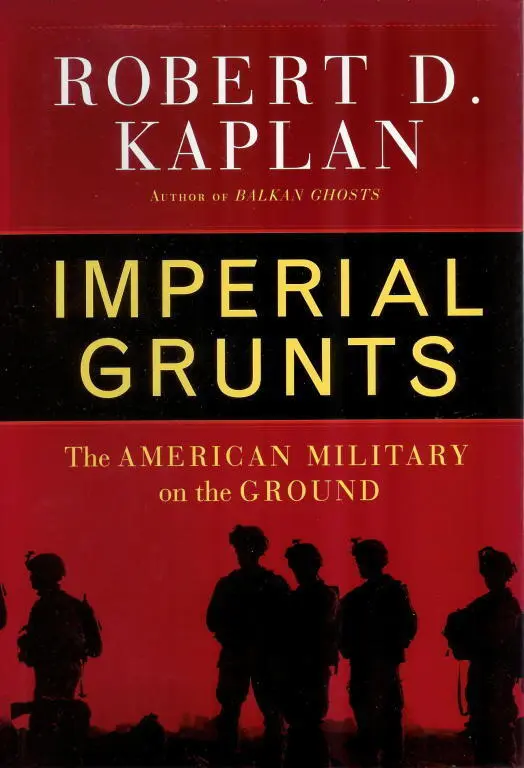
- Название:Imperial Grunts
- Автор:
- Издательство:Random House
- Жанр:
- Год:2005
- Город:New York
- ISBN:978-0-307-27850-0
- Рейтинг книги:5 / 5. Голосов: 1
-
Избранное:Добавить в избранное
- Отзывы:
-
Ваша оценка:
Imperial Grunts: краткое содержание, описание и аннотация
Предлагаем к чтению аннотацию, описание, краткое содержание или предисловие (зависит от того, что написал сам автор книги «Imperial Grunts»). Если вы не нашли необходимую информацию о книге — напишите в комментариях, мы постараемся отыскать её.
Imperial Grunts — читать онлайн бесплатно полную книгу (весь текст) целиком
Ниже представлен текст книги, разбитый по страницам. Система сохранения места последней прочитанной страницы, позволяет с удобством читать онлайн бесплатно книгу «Imperial Grunts», без необходимости каждый раз заново искать на чём Вы остановились. Поставьте закладку, и сможете в любой момент перейти на страницу, на которой закончили чтение.
Интервал:
Закладка:
I am not talking about the poor. The media establishment has always been solicitous of the poor. I am talking about the working class and slightly above: that vast, forgotten multitude of America existing between the two coastal, cosmopolitan zones, which journalists in major media markets had fewer and fewer possibilities of engaging in a sustained, meaningful way except by embedding with the military.
The American military, especially the NCOs, who were the guardians of its culture and traditions, constituted a world of beer, cigarettes, instant coffee, and chewing tobaccos, like Copenhagen and Red Man. It was composed of people who hunted, drove pickups, employed profanities as a matter of dialect, and yet had a literal, demonstrable belief in the Almighty.
Most of all, the divide between a media establishment clustered in the Northeast and a military clustered in the South and the heartland brought regional tensions to the surface.
Journeying from my home in the Massachusetts’ Berkshires, whose voting patterns put it at the extreme edge of Democratic “blue America,” to Fort Bragg and Camp Lejeune, North Carolina, in the heart of Republican “red America,” made me think of my experiences crossing the Berlin Wall in the 1970s and 1980s. The change in political attitudes registered in the local newspapers, in the conversations you overheard at restaurants, and in the people you met was that stark and extreme.
I had been shuttling back and forth between Massachusetts and military bases in the South for seven years now, but it was only in 2003, as casualties mounted in postwar Iraq, that the regional differences moved from the background to the foreground of my thoughts.
The southern bent toward militarism, especially in the Tidewater South, and the Greater New England bent toward pacifism were historically long-rooted tendencies, manifesting themselves in the War of 1812, the Mexican War, the Indian wars, both world wars, and the Vietnam War. [59] Greater New England means New England proper and regions of the country like the northern Midwest and parts of the Pacific Northwest that had been settled by New En-glanders. See Michael Lind’s Vietnam: The Necessary War: A Reinterpretation of America’s Most Disastrous Military Conflict (New York: Free Press, 1999). Chapter 4 presents a penetrating, statistically backed exegesis on the religious, ethnic, and regional divisions over Vietnam and other American wars. For a more general but equally profound observation on the differences between the South and the North regarding military affairs, see Samuel P. Huntington’s mid-twentieth-century classic The Soldier and theState: The Theory and Politics of Civil-Military Relations (Cambridge, MA: Harvard University Press, 1957), pp. 211–21.
Indeed, though the South was opposed to President Franklin Roosevelt’s liberalism in domestic affairs, it supported his military buildup against Nazi Germany, even as it was distinctly cool to the isolationist America First committee. 4
Such history revealed itself in differing attitudes over the casualties in Iraq and the Bush administration’s response to them. It had occurred to me
in Afghanistan that Americans were actually no more casualty averse than the citizens of other nations. The working class’s attitude to casualties was fairly tough, to judge by the soldiers I had met in Gardez and Kandahar. It was the elites that had a more difficult time with the deaths of soldiers and marines. 5
Many of the people I knew at home were well-off New Yorkers who had moved out of Manhattan; the people I knew at military bases in North Carolina, Tidewater Virginia, and other parts of the South were of working-class origin, with modest military salaries. The latter group had friends and family members, many of them deployed in Iraq and Afghanistan. For them, casualties were not a symbolic issue to be discussed at seminars and dinner parties; they were intensely personal business.
While people where I lived were aghast that the White House had barred photos of the coffins of dead soldiers arriving back in the U.S.—a decision they believed reeked of callousness and political calculation—people I knew in North Carolina said they understood the White House action. They believed it saved lives.
Their logic went like this: In small, unconventional wars, especially in an age of global media and battles televised in real time, the home front was even more important than in previous conflicts. The number of American troops killed by insurgents and suicide bombers in postwar Iraq may have been strategically and tactically insignificant, but the casualties mattered politically, because the steady accumulation of KIAs demoralized the home front. Thus, the greater the impact that these deaths appeared to have on the American public, and especially on the White House, the greater the incentive of the insurgents to keep on killing them, and the more likely that the insurgents’ ranks would swell. As one Green Beret in Afghanistan, a southerner, had put it to me after Sgt. Sweeney was killed: “The less emotion the President displays over our deaths, the better for us, here and in Iraq.”
Or as some Marine officers simply put it: “We grieve in private.”
The ghost of Vietnam hovered over this debate. The administration didn’t want the public to see recurring images of flag-draped coffins, as it had in Vietnam. Many anti–Iraq war people I knew in the Northeast had not served in Vietnam. Embarrassment and guilt over that fact helped facilitate their zero tolerance toward casualties. As for those I met in the military, particularly the noncommissioned officer class, because they and their relatives had paid a considerable price in Vietnam, they were free to think pragmatically about the casualty issue—ruthlessly even. Because they were free of complexes, and were closest to the dead and wounded, I trusted their opinion the most. [60] Nearly a year later, an Annenberg Public Policy Center study concluded that 51 percent of the military thought it proper to show flag-draped coffins of troops: a much lower percentage, I suspect, than civilians in New England. Also note that the Special Forces and marine infantry communities tend to be more conservative than other branches of the armed services.
On my latest visit to Fort Bragg from Massachusetts, in mid-December 2003, I came to pay off a debt. U.S. Army Special Forces and the John F. Kennedy Special Warfare Center had opened doors for me in Colombia, the Philippines, and Afghanistan. Now I would brief their top echelons on what I thought the defects of Special Forces were, and how I thought Special Forces should evolve over the coming years.
Much of what I had to say did not represent my own ideas as much as those of the noncoms and middle-level officers whom I had met in the field. Because the Army was burdened by so many layers of bureaucracy—and travel to the field, even for the generals’ own aides, involved much red tape—journalists like me were occasionally useful for communicating ideas from the bottom to the top of the command chain. My Atlantic Monthly colleague James Fallows once noted that the press enjoys unique protection under the Constitution because it is an indispensable part of representative democracy. As an indispensable element of the system, I believed that helping different levels of it to communicate with each other was quite appropriate, especially in wartime.
Hovering in the background of my brief was the issue of money:
Army Special Forces was hot. Not only had it played the lead role in taking down the Taliban, and a significant role in Operation Iraqi Freedom, but it was also involved in the capture of thirty-eight of the fifty-five most wanted Iraqis—the so-called deck of cards—including Saddam Hussein himself. Yet this state of affairs had made Special Forces only more vulnerable. It was like Apple about to be overtaken by Microsoft after having just launched the personal computer revolution. To wit, in Gen. Peter J. Schoomaker the Big Army had a truly innovative chief of staff, a man who wanted to make the Army as a whole more like Special Forces. The Marines, too, were consciously reemphasizing their own unconventional roots. Thus, if Special Forces did not evolve and correct its shortcomings, and stay ahead of the regular Army and Marines, it would go the way of Apple, shortchanged in the Pentagon budget battles.
Читать дальшеИнтервал:
Закладка:
Похожие книги на «Imperial Grunts»
Представляем Вашему вниманию похожие книги на «Imperial Grunts» списком для выбора. Мы отобрали схожую по названию и смыслу литературу в надежде предоставить читателям больше вариантов отыскать новые, интересные, ещё непрочитанные произведения.








Обсуждение, отзывы о книге «Imperial Grunts» и просто собственные мнения читателей. Оставьте ваши комментарии, напишите, что Вы думаете о произведении, его смысле или главных героях. Укажите что конкретно понравилось, а что нет, и почему Вы так считаете.