Robert Kaplan - Imperial Grunts
Здесь есть возможность читать онлайн «Robert Kaplan - Imperial Grunts» весь текст электронной книги совершенно бесплатно (целиком полную версию без сокращений). В некоторых случаях можно слушать аудио, скачать через торрент в формате fb2 и присутствует краткое содержание. Город: New York, Год выпуска: 2005, ISBN: 2005, Издательство: Random House, Жанр: Публицистика, nonf_military, на английском языке. Описание произведения, (предисловие) а так же отзывы посетителей доступны на портале библиотеки ЛибКат.
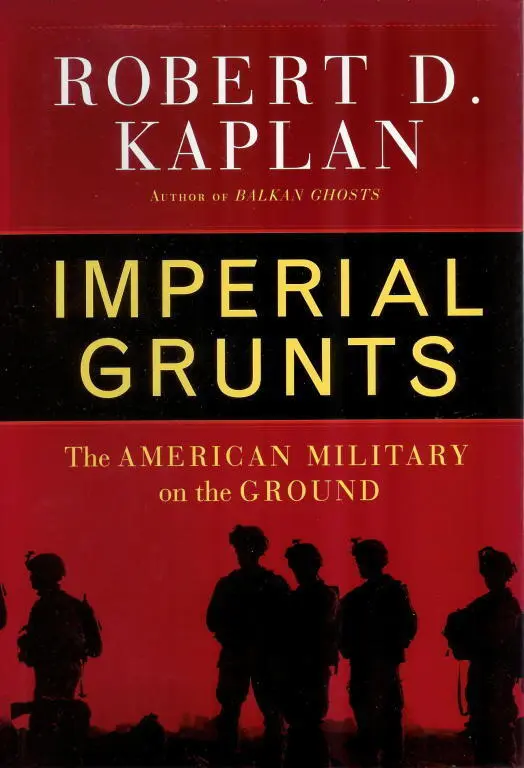
- Название:Imperial Grunts
- Автор:
- Издательство:Random House
- Жанр:
- Год:2005
- Город:New York
- ISBN:978-0-307-27850-0
- Рейтинг книги:5 / 5. Голосов: 1
-
Избранное:Добавить в избранное
- Отзывы:
-
Ваша оценка:
Imperial Grunts: краткое содержание, описание и аннотация
Предлагаем к чтению аннотацию, описание, краткое содержание или предисловие (зависит от того, что написал сам автор книги «Imperial Grunts»). Если вы не нашли необходимую информацию о книге — напишите в комментариях, мы постараемся отыскать её.
Imperial Grunts — читать онлайн бесплатно полную книгу (весь текст) целиком
Ниже представлен текст книги, разбитый по страницам. Система сохранения места последней прочитанной страницы, позволяет с удобством читать онлайн бесплатно книгу «Imperial Grunts», без необходимости каждый раз заново искать на чём Вы остановились. Поставьте закладку, и сможете в любой момент перейти на страницу, на которой закончили чтение.
Интервал:
Закладка:
The fact that the U.S. supported Karzai did not mean that their interests always coincided. In certain places, Karzai needed to weaken the very same Afghan Militia Forces that the Green Berets needed to strengthen in order to perform their mission.
The militia forces here at Gereshk had proved particularly effective under the leadership of one Haji Idriss, described by a Special Forces warrant officer as “small of size, yet great of stature,” to such an extent that Idriss was known locally as the akhund, the “wise man” in Pushtu. “Idriss’s men were quite successful at scarfing up bad guys for us. They helped us PUC twenty-four Taliban. That upset people here, because the Taliban is in leadership positions throughout this area.”
The regional governor, Sher Mohammed, was known to have Taliban connections. The police fell on both sides of the pro- and anti-Taliban divide—that is, if such a divide was even definable here. There were indications that the local police were involved in the ambush that killed Sgt. Sweeney. One piece of intelligence even indicated that Sweeney was killed by mistake: the police had shot at the unmarked Special Forces vehicle he was riding in, thinking it was the Afghan Militia Forces.
Signal intercepts told Special Forces that Haji Idriss and his Afghan militia assistant, Jan Mohammed, were picked up by the police in Gereshk and told to disarm. When they refused, Idriss was shot in the head and Mohammed was severely wounded. Interrogation of detainees indicated that the order to go after Idriss was given by the chief of police, Bader Khan, and carried out by the assistant chief of police, Haji Aruf. The police chief, Bader Khan, was a tribal ally of President Karzai.
To avenge Idriss’s death, the pro-American Afghan Militia Forces deserted the firebase in order to attack the police inside the town of Gereshk—the fighting that we had witnessed upon our helicopter arrival. Haji Aruf was now calling for American intervention to save him and his police troops from the militia forces. Some of the new detainees that the Green Berets had grabbed this very night were, in fact, captured originally by the militia forces. The Americans asserted control over the detainees for the sake of the prisoners’ own protection.
With the arrival of Maj. Tony Dill, whom I had met briefly at Firebase Gecko—Mullah Omar’s former fortress—the discussion intensified as to what to do next.
As one of the Green Berets told me, “We have no real friends on the outside.” Yet in another sense, it was agreed, the recent fighting had created opportunities. “The last thing we want to do now is to bring the various factions together for a powwow. That could blow up in our faces; these guys are not ready for peace and love.”
Maj. Dill spoke:
“The governor knows that we know that he has ACM [anti-Coalition militia, or Taliban] ties. Because of what has just happened, he is in an exposed position. If we let him think the police are all to blame, he can give up the police as low-grade dog food. That’s how we’ll co-opt the governor. Let’s meet alone with him, make him think that we think he’s now on the up-and-up.”
It was also agreed that the Afghan Militia Forces had to be convinced to remain inside the firebase once the fighting died down, with the promise that Special Forces would, in return, exact some retribution on the local police. New alliances would have to be built up. As in the Philippines, where the Green Berets were faced with rampant corruption on all levels of the indigenous government, no one at this firebase was unduly discouraged. Rather than the clean, black-and-white, zero-defect universe of success and failure through which the Washington and New York power elite often discussed far-flung events, here, amid the field mice and the mud-walled flatness of the Helmand desert, there was only constant trial-and-error experimentation in light of the mission at hand.
The smashmouth combat that Lt. Col. Binford had spoken of had not occurred during my visit. Instead, there had been, as Binford later admitted to me with a wry smile, something equally useful: adaptation to the tribal reality through unconventional war.
Here in this unstable borderland where high desert began its descent into plain, warfare was continuous, of low intensity, and inconclusive. U.S. Army Special Forces were facing the same sorts of challenges that the British had faced with the Afghan tribes on the Northwest Frontier of India in the latter part of the nineteenth century. From Waziristan north through Khyber and Malakand, the British used lightly armed militia and friendly tribal auxiliaries as their first line of defense—exactly as the Romans had done against the Germanic tribes—even as they built forts and improved roads to expand their influence. 18
The British colonialists, like the Americans I had met, were eminently practical men. While they had conquered parts of this wild territory, “they did not despise it.” 19They knew from personal experience that traditional society, while not necessarily living up to their own values, was nevertheless admirable in its own peculiar way. And so they “did not pretend that their military conquests had produced anything more than the ascendancy of a particular dynasty.” 20They took men as they found them. As Sir Mortimer Durand of the Indian Army once remarked, “Half of my most intimate friends are murderers.” 21
The young Winston Churchill was reading into America’s own imperial future when, in 1897, he thus described Afghanistan in The Story of the Malakand Field Force:
a roadless, broken and underdeveloped country; an absence of any strategic points; a well-armed enemy with great mobility and modern rifles, who adopts guerrilla tactics. The results… are that the troops can march anywhere, and do anything, except catch the enemy…. 22
But, then, what was our alternative?
“The unpractical,” Churchill replied, “may wonder why we, a people who fill some considerable place in the world, should mix in the petty intrigues of these border chieftains.” 23Some, whom Churchill calls “bad and nervous sailors,” would simply cut and run, even though that would be impossible in the circumstances, whereas others call for “full steam ahead,” that is, a dramatic increase in military and other resources until the frontier valleys “are as safe and civilized as Hyde Park.” But, as Churchill intimates, there are usually neither the troops nor the money nor the will to do any such thing. Therefore, he concludes, the “inevitable alternative” is a system of “gradual advance, of political intrigue among the tribes, of subsidies and small expeditions.” 24
And that, too, was fraught with difficulties. Consider the eerie similarities between the current challenges and those in the Waziristan of the late 1930s and 1940s, when British troops tried and failed to capture the Faqir of Ipi, a radical cleric who, because of his narrow tribal base, appealed to pan-Islamic ideals in the struggle against colonialist occupiers. Well educated and traveled, the faqir, nevertheless, was able to charm the most primitive tribesmen with a wooly messianic message devoid of any specifics. The faqir, or holy man, whose real name was Mirza Ali Khan, hid out for many years in the network of caves that straddles the Afghan-Pakistani border, inspiring his troops with sermons on religious war. Despite aerial bombardments and the most aggressive infantry tactics, the Faqir of Ipi was never apprehended, dying a natural death in one of his cave hideouts in 1960. 25
Given the resemblance between the Faqir of Ipi and Osama bin Laden, it was undeniable that in Afghanistan the United States had found itself in a situation for which the only comparisons were with other empires of the past.
Читать дальшеИнтервал:
Закладка:
Похожие книги на «Imperial Grunts»
Представляем Вашему вниманию похожие книги на «Imperial Grunts» списком для выбора. Мы отобрали схожую по названию и смыслу литературу в надежде предоставить читателям больше вариантов отыскать новые, интересные, ещё непрочитанные произведения.









Обсуждение, отзывы о книге «Imperial Grunts» и просто собственные мнения читателей. Оставьте ваши комментарии, напишите, что Вы думаете о произведении, его смысле или главных героях. Укажите что конкретно понравилось, а что нет, и почему Вы так считаете.