Robert Kaplan - Imperial Grunts
Здесь есть возможность читать онлайн «Robert Kaplan - Imperial Grunts» весь текст электронной книги совершенно бесплатно (целиком полную версию без сокращений). В некоторых случаях можно слушать аудио, скачать через торрент в формате fb2 и присутствует краткое содержание. Город: New York, Год выпуска: 2005, ISBN: 2005, Издательство: Random House, Жанр: Публицистика, nonf_military, на английском языке. Описание произведения, (предисловие) а так же отзывы посетителей доступны на портале библиотеки ЛибКат.
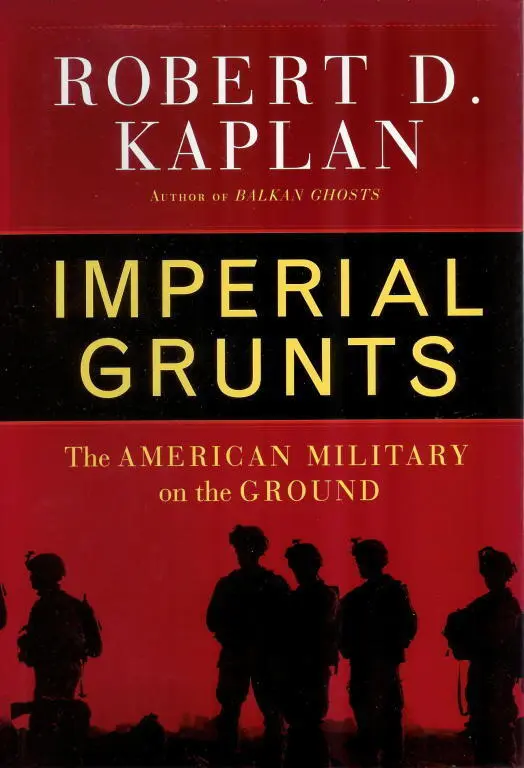
- Название:Imperial Grunts
- Автор:
- Издательство:Random House
- Жанр:
- Год:2005
- Город:New York
- ISBN:978-0-307-27850-0
- Рейтинг книги:5 / 5. Голосов: 1
-
Избранное:Добавить в избранное
- Отзывы:
-
Ваша оценка:
Imperial Grunts: краткое содержание, описание и аннотация
Предлагаем к чтению аннотацию, описание, краткое содержание или предисловие (зависит от того, что написал сам автор книги «Imperial Grunts»). Если вы не нашли необходимую информацию о книге — напишите в комментариях, мы постараемся отыскать её.
Imperial Grunts — читать онлайн бесплатно полную книгу (весь текст) целиком
Ниже представлен текст книги, разбитый по страницам. Система сохранения места последней прочитанной страницы, позволяет с удобством читать онлайн бесплатно книгу «Imperial Grunts», без необходимости каждый раз заново искать на чём Вы остановились. Поставьте закладку, и сможете в любой момент перейти на страницу, на которой закончили чтение.
Интервал:
Закладка:
Having thus gotten the attention of my audience, I told the assembled generals, colonels, sergeant majors, and others that a world of more democracies meant a world of more restrictive rules of engagement. New democracies, besieged by aggressive and newly liberated local medias, could not politically countenance American troops running around on their soil killing people. Therefore, Special Forces had to become much better than it was at winning without firing a shot.
The culture of direct action had taken over Special Forces, and that was bad, I went on. For the real heart and soul of Special Forces was tied to the Kennedyesque vision of embracing their indig brothers, and winning alongside them. Special Forces had to move a few steps away from the direct action culture and back toward the culture of the combat advisor. [61] This idea was not exclusively mine, but originated in comments made by Gen. Geoff Lambert, former commander of all Green Berets before becoming commandant of the John F. Kennedy Special Warfare Center.
That meant more one-man missions in which a single Green Beret would be immersed in the local culture during all his waking hours: more Tom Wilhelms, in other words, even if Col. Wilhelm himself was a foreign area officer from the regular Army. In any case, foreign area officers and Green Berets had much in common, I said.
Moving back to the culture of combat advisor meant better linguistic skills. Yet except for the Spanish speakers in 7th Group, I had not been particularly impressed with the linguistic skills of Green Berets. The United States was more than two years into the War on Terrorism. Pushtu should have become a common language by now among Green Berets assigned to Afghanistan. But with few exceptions, even the counterintelligence officers I met barely spoke the language. The situation was no better in the Pacific; almost everyone I encountered in 1st Group knew some oriental language or other, but rarely the one needed in the country where he was currently deployed.
A number of measures had to be taken. Linguistics had to become an occupational Special Forces skill the same as weaponry, communications, medicine, and intelligence gathering. Gifted foreign language speakers had to be cultivated and tracked through the bureaucratic system. They had to be awarded special consideration to help them over other hurdles, the kind of practice that an impersonal and overly regulated Army was loath to do. In the Middle East and the Pacific, where numerous languages and dialects were spoken, there needed to be a mix of language expertise within every A-team, so that wherever a team was deployed, it would have at least one or two people on the team who spoke the local language. More emphasis had to be given to cultural training, something the Marines had been doing for years.
Furthermore, A-teams in the field were simply not versatile enough. Linguists, psy-ops, and civil affairs specialists needed to be integrated into counterintelligence teams, just as counterintelligence skills were needed at MEDCAPS and other humanitarian exercises. Humanitarian relief facilitated intelligence gathering, as the exercise on Basilan in the Philippines had shown. There were satisfactory ways to do this that did not undermine current laws. Policing skills—the ability to cultivate snitches, to deal with hordes of teenagers in third world villages, to set up stakeouts and roadblocks—should not be confined to National Guard units, who were overstretched as it was. Community policing was central to the War on Terror. It had to be a major part of active duty training.
Women, I went on, who were still barred from the ranks of Special Forces, were also needed. Women attracted less notice during stakeouts and intelligence-related operations. Women could search females detained during mission hits. Women were going to be forced on SF anyway at some point. Might as well develop a plan in advance for using them.
That led to another fact of life. The world was changing, especially global demographics. The future was neither white nor black, but coffee-brown mestizo. Special Forces could not go on indefinitely as a bunch of tattooed, muscle-bound white guys, peppered with blacks and Hispanics, who all went around chewing Skoal, Red Man, and Copenhagen. It needed to aggressively recruit from Afghan, Arab, Persian, and other immigrant communities.
In sum, Special Forces needed a dramatic return to its roots, in which small American commando teams made up of Eastern European immigrants had bonded with indigenous forces behind enemy lines in Nazi- and communist-occupied Europe. It needed more people with funny accents like Gen. Sid Shachnow.
I noted that the Jedburgh tradition lived on only in 7th Group in Central and South America, with its Spanish-language skills and Hispanic soldiers. The ethos of not just 7th Group but all of SOUTHCOM, in fact, was particularly appropriate to fighting a worldwide counterinsurgency. SOUTHCOM was known to insiders as a Strategic Patience Theater—that is, SOUTHCOM saw problems like the drug trade as long-term and intractable, where victory was a matter of decades of suppression, and constant application of unconventional warfare, which included the training of indig armies. The fact that the media ignored Central and South America actually helped in this effort, for all too often the overall effect of the media was to foster impatience on the home front.
SOUTHCOM and the sub-Saharan African component of EUCOM were underdeployed, even as CENTCOM was overdeployed in the Middle East. I said that it made sense, therefore, to add sub-Saharan Africa to 7th Group’s domain and move it away from 3rd Group, which had more than enough on its hands in Afghanistan and nearby countries. After all, Africa and South America were linked to some extent by the Portuguese language, and also by extreme underdevelopment, which led to similar tactical and operational challenges.
My thoughts were put on the agenda for a meeting in January 2004 in Cody, Wyoming, about the future of Army Special Forces. I would not be at the meeting, though. It was time to immerse myself with the Marines. The Special Forces part of my odyssey was over, for the time being.
From Fort Bragg, outside Fayetteville, to Camp Lejeune, outside Jacksonville, was only about eighty miles east through North Carolina as the crow flies. Yet it brought me out of one American military culture and into another: from the Army world of Hoo-ah to the Marine world of Ooh-rah.
Ooh-rah, like Hoo-ah, meant roughly the same thing: “Roger.” “Great.” “Good-to-go.” “How ya doing?” “Stay motivated.” The words were a standard greeting that basically meant anything you wanted it to mean except “no” and “It can’t be done.” And yet each greeting harked back to a different tradition, a different emotion, perhaps, that was key to differentiating the Army and Army Special Forces from the Marines.
The Marines had always been the poorest and scrappiest of the armed services. I remember a visit I had made in the early 1990s to Camp Pendleton, California, where I spent the night in austere, barracks-like quarters. When I made the mistake of telling the Marine driver that, at Fort Leavenworth, the Army had put me up in a lovely suite, he remarked coldly: “Yeah, in the Army people really live the high life.”
Whatever sensory deprivation an aesthetic-minded person might experience with the Army or Special Forces, it was more so with the Marines. Whereas Fayetteville, the Green Beret home base (known as Fayette- nam during the Vietnam War), was a fairly funky, ratty place, measured against Jacksonville it seemed positively upscale. Jacksonville—a Marine chow hall for all intents and purposes—was a wasteland of crumbling 1970s facades and unpaved parking lots that housed strip joints, tattoo parlors, pawnshops, lock shops, judo centers, and barbershops advertising “military haircuts.” Adjacent Camp Lejeune, the principal Marine base on the East Coast, was, likewise, a more blighted version of Fort Bragg. Yet I was not the only journalist for whom being with the Marines felt like a blast of invigorating cold air on an oppressively hot day.
Читать дальшеИнтервал:
Закладка:
Похожие книги на «Imperial Grunts»
Представляем Вашему вниманию похожие книги на «Imperial Grunts» списком для выбора. Мы отобрали схожую по названию и смыслу литературу в надежде предоставить читателям больше вариантов отыскать новые, интересные, ещё непрочитанные произведения.







Обсуждение, отзывы о книге «Imperial Grunts» и просто собственные мнения читателей. Оставьте ваши комментарии, напишите, что Вы думаете о произведении, его смысле или главных героях. Укажите что конкретно понравилось, а что нет, и почему Вы так считаете.