Robert Kaplan - Imperial Grunts
Здесь есть возможность читать онлайн «Robert Kaplan - Imperial Grunts» весь текст электронной книги совершенно бесплатно (целиком полную версию без сокращений). В некоторых случаях можно слушать аудио, скачать через торрент в формате fb2 и присутствует краткое содержание. Город: New York, Год выпуска: 2005, ISBN: 2005, Издательство: Random House, Жанр: Публицистика, nonf_military, на английском языке. Описание произведения, (предисловие) а так же отзывы посетителей доступны на портале библиотеки ЛибКат.
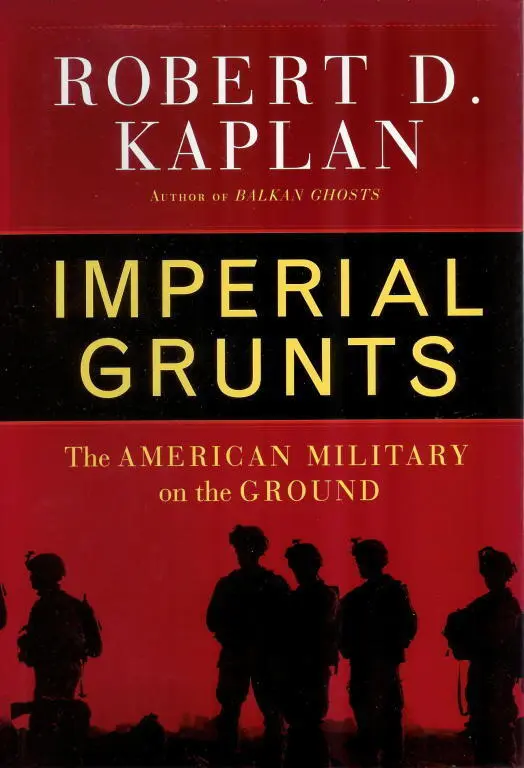
- Название:Imperial Grunts
- Автор:
- Издательство:Random House
- Жанр:
- Год:2005
- Город:New York
- ISBN:978-0-307-27850-0
- Рейтинг книги:5 / 5. Голосов: 1
-
Избранное:Добавить в избранное
- Отзывы:
-
Ваша оценка:
Imperial Grunts: краткое содержание, описание и аннотация
Предлагаем к чтению аннотацию, описание, краткое содержание или предисловие (зависит от того, что написал сам автор книги «Imperial Grunts»). Если вы не нашли необходимую информацию о книге — напишите в комментариях, мы постараемся отыскать её.
Imperial Grunts — читать онлайн бесплатно полную книгу (весь текст) целиком
Ниже представлен текст книги, разбитый по страницам. Система сохранения места последней прочитанной страницы, позволяет с удобством читать онлайн бесплатно книгу «Imperial Grunts», без необходимости каждый раз заново искать на чём Вы остановились. Поставьте закладку, и сможете в любой момент перейти на страницу, на которой закончили чтение.
Интервал:
Закладка:
Max Boot writes that like Special Forces, the Marines “focused on people, not weapons systems.” Like Special Forces, the Marines saw themselves less as tank drivers or fighter pilots than as warriors. “Although caricatured in certain books and movies as homicidal Neanderthals,” Boot goes on, “the Marines were the most intellectually supple of the services.” 9For example, along with Special Forces, the Marines began practicing crowd control and urban warfare long before the urbanization of the planet became a cliché among policy elites.
The greatest intellectual contribution of the United States Marine Corps has been its Small Wars Manual, a summary of lessons learned in the many landings, raiding expeditions, occupations, and nation-building exercises in which it took part in the late nineteenth and early twentieth centuries, in the Caribbean, Central America, and the Pacific. Published in 1940 with a restricted distribution, because of its growing relevance the Small Wars Manual was declassified in 1972, republished in the 1980s, and updated at the turn of the twenty-first century. 10
Echoing Clausewitz, the Marine Small Wars Manual observes that in small wars neither military operations nor diplomacy ever stops, and the battle plan “must be adapted to the character [that is, the culture] of the people encountered.” Small wars “are conceived in uncertainty, are conducted often with precarious responsibility and doubtful authority, under indeterminate orders lacking specific instructions.”
As if foreseeing the situation in Iraq, the Manual notes that after major fighting,
hostile forces will withdraw into the more remote parts of the country, or will be dispersed into numerous small groups which continue to oppose the occupation. Even though the recognized leaders may capitulate, subordinate commanders often refuse to abide by the terms of the capitulation. Escaping to the hinterland, they assemble heterogeneous armed groups of patriotic soldiers, malcontents, notorious outlaws… and by means of guerrilla warfare, continue to harass and oppose the intervening force in its attempt to restore peace and good order throughout the country as a whole.
To countervail such hostile forces, numerous presence patrols must be organized with the help of native militias, and outposts erected that are “dispersed over a wide area, in order to afford the maximum protection to the peaceful inhabitants” of the country. 11
Written decades before the War on Terrorism, with experience from even earlier decades, the Marines’ Small Wars Manual showed the U.S. how to fight unconventionally in both Iraq and Afghanistan.
The Marines were still thinking ahead. They now defined their mission as “Expeditionary Maneuver Warfare, “ instead of “Amphibious Warfare.” As Capt. Nevers explained, “In the future, because of technology, we won’t need to storm ashore like at Iwo Jima, or the way the Army did at Normandy. The sea will be the Navy’s giant maneuver space. We won’t have to telegraph our location; we will be able to operate from beyond the three-mile territorial limit.”
At the moment, military base rights required negotiation with foreign countries, but new planes like the V-22 Osprey might help obviate the need for that; in the Marines’ plan, technology would trump diplomacy in specific instances. The Osprey, scheduled to replace the Marines’ CH-46 Sea Knight helicopter, could take off vertically like a helicopter from the smallest clearing, in mud or sand—no runway or military base would be necessary; then it could fly like a plane and be refueled in the air.
The Marines, like Special Forces, understood that virtue resided in practicality. Marines were articulate in a very nuts-and-bolts way. In the mid-1990s, at Camp Lejeune, I had listened to a typical “down and dirty” from an instructor talking to a group of Marines about to be deployed to the southern Balkans:
You have a meeting, say, at 9:30 a.m. with the local mayor. He’ll show up at ten, if he feels like it. His office will be a shambles. You’ll want to get his cooperation to do something. But he’ll be more interested in what you can do for him. Don’t think of it as a meeting with a set time frame. Don’t start discussing American policy aims in the former Yugoslavia. You’ll get much further bullshitting with him about professional basketball. People in that part of the world love basketball. Ask to see pictures of his family. Always bring pictures of your own family to these meetings. If he offers you a slivovitz, don’t give him bullshit about how it’s against regulations to drink. Drink with him. He’ll have to feel you out, to feel comfortable with you, before he’ll want to help you. You may not leave his office till eleven, and you might not have come to an agreement; you may have to meet his family, play with his kids, and drink with him a few more times for that to happen. You will only get the policy done by relating to him as an individual, on his level. And that is what Americans do best.
Irony, subtlety, and diplomacy were in short supply at Camp Lejeune. “With marines you will always know where you stand. If we have a problem with you, you’ll know it,” a marine informed me. I had entered a world stripped to its bare essentials, the inhabitants of which had taken a veritable monastic vow of poverty. “In our recruitment drives we don’t advertise material or educational benefits like the other services do,” Capt. Nevers said. “We just challenge people to be marines.”
In the deserts of the Horn of Africa I would meet my first marines in the field. As with Army Special Forces, I planned to get to know the Marines in stages, one deployment at a time.
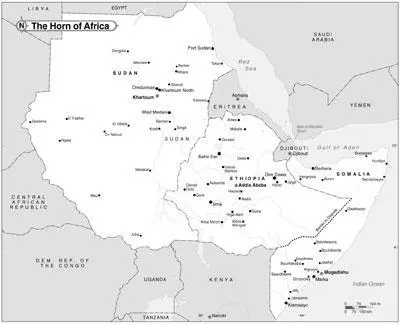
CHAPTER SEVEN
CENTCOM
HORN OF AFRICA, WINTER 2004
WITH NOTES ON EAST AFRICA
“‘Who needs meetings in Washington…. Guys in the field will figure out what to do. I took ten guys through eastern Ethiopia. Everywhere people wanted an American presence.’ A new paradigm was emerging for the military, one that borrowed more from the French and Indian War and the Lewis and Clark expedition than from the major conflicts of the twentieth century.”
Djibouti looked like the pictures sent back from space by the Mars Rover: rocky, rust-red desert with brown and gray welts—a place where the planet’s ability to support life seemed particularly tenuous. From the air, the villages resembled refuse heaps. But little Djibouti, the size of El Salvador, constituted strategic real estate in the Global War on Terrorism. Only minutes by fighter jet across the Bab el Mandeb Strait from Yemen, it was also close to al-Qaeda pockets in Sudan, Somalia, and Kenya. Terrorists lived off ungovernable areas, and there were plenty of those close to Djibouti. In the early twenty-first century, an American base in Djibouti was as advantageous as one in Central Europe during the Cold War.
Djibouti had been part of the first great Ethiopian empire, that of the Roman-era kingdom of Axum. It shared a border not only with Ethiopia, but with Eritrea and Somalia, too. The ethnic Afars of Djibouti’s north were related to the Ethiopians and Eritreans, while Djibouti’s Issa community in the south was related to the Somalis. Djibouti existed courtesy of nineteenth-century French imperialism. With the building of the Suez Canal, European powers had scrambled for ports along the Red Sea and the Gulf of Aden. The French got a foothold in the far north of the Somali coast, which became known as French Somaliland, then as the French Territory of the Afars and the Issas, and finally as the Republic of Djibouti when independence came in 1977. But the French hadn’t left; with three thousand French troops and foreign legionnaires, Djibouti was the largest French overseas outpost, rating a billet for a French one-star general. Only in recent years had French administrators left their posts inside local government ministries.
Читать дальшеИнтервал:
Закладка:
Похожие книги на «Imperial Grunts»
Представляем Вашему вниманию похожие книги на «Imperial Grunts» списком для выбора. Мы отобрали схожую по названию и смыслу литературу в надежде предоставить читателям больше вариантов отыскать новые, интересные, ещё непрочитанные произведения.









Обсуждение, отзывы о книге «Imperial Grunts» и просто собственные мнения читателей. Оставьте ваши комментарии, напишите, что Вы думаете о произведении, его смысле или главных героях. Укажите что конкретно понравилось, а что нет, и почему Вы так считаете.