Robert Kaplan - Imperial Grunts
Здесь есть возможность читать онлайн «Robert Kaplan - Imperial Grunts» весь текст электронной книги совершенно бесплатно (целиком полную версию без сокращений). В некоторых случаях можно слушать аудио, скачать через торрент в формате fb2 и присутствует краткое содержание. Город: New York, Год выпуска: 2005, ISBN: 2005, Издательство: Random House, Жанр: Публицистика, nonf_military, на английском языке. Описание произведения, (предисловие) а так же отзывы посетителей доступны на портале библиотеки ЛибКат.
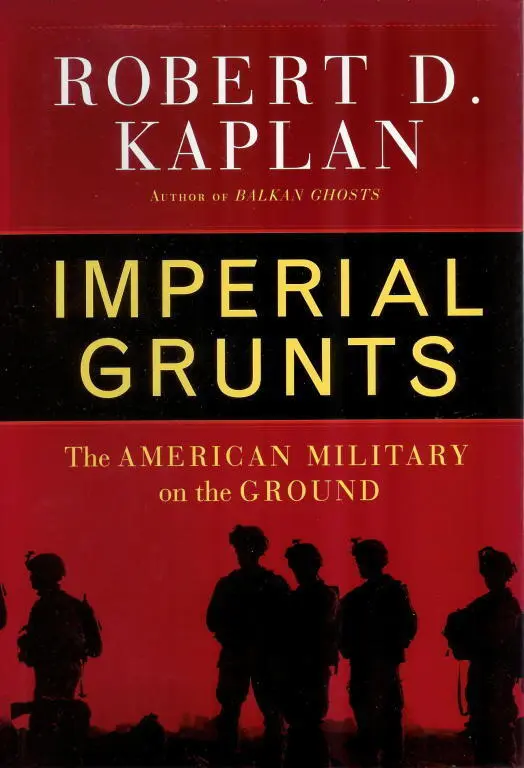
- Название:Imperial Grunts
- Автор:
- Издательство:Random House
- Жанр:
- Год:2005
- Город:New York
- ISBN:978-0-307-27850-0
- Рейтинг книги:5 / 5. Голосов: 1
-
Избранное:Добавить в избранное
- Отзывы:
-
Ваша оценка:
Imperial Grunts: краткое содержание, описание и аннотация
Предлагаем к чтению аннотацию, описание, краткое содержание или предисловие (зависит от того, что написал сам автор книги «Imperial Grunts»). Если вы не нашли необходимую информацию о книге — напишите в комментариях, мы постараемся отыскать её.
Imperial Grunts — читать онлайн бесплатно полную книгу (весь текст) целиком
Ниже представлен текст книги, разбитый по страницам. Система сохранения места последней прочитанной страницы, позволяет с удобством читать онлайн бесплатно книгу «Imperial Grunts», без необходимости каждый раз заново искать на чём Вы остановились. Поставьте закладку, и сможете в любой момент перейти на страницу, на которой закончили чтение.
Интервал:
Закладка:
I met 2nd Lt. Wagner for the first time during a field drill at the range. Though guard duty was the oldest job in the Marine Corps, providing security for Camp Lemonier was routine stuff, so a Marine combat unit like the 2nd Platoon had to fill every available hour with training to remain in fighting trim. American soldiers had their first experience in irregular warfare fighting the Iroquois in the heavily wooded terrain of the Ohio River valley during the French and Indian War, but as 2nd Lt. Wagner remarked during the field drill: “You may not see much combat in a wooded environment again. The future is MOUT [military operations on urban terrain].” In front of us, platoon members advanced in the dirt, elbows smacking against the hard desert floor, each marine holding his M-16 in one hand “chicken wing” style, using the other hand to break the fall. For every two marines who laid down suppressing fire, one advanced. Fire without forward movement is a waste; movement without fire is suicide. The aim was to keep the fields of fire as narrow as possible, to avoid hitting civilians in this imaginary urban environment. Because it was only a drill, to stay motivated the marines practiced Indian war yells that they had heard in the movie The Last of the Mohicans.
The Marines were an example of how government channels the testosterone of young males toward useful national ends. If the military were much smaller than it was, the result might be only more gang violence within the homeland. “I joined because I felt I needed discipline,” one of Staff Sgt. Dickinson’s squad leaders told me. Not only were the crew cuts, tattoos, and bodybuilder-type physiques of all the marines down to the squad leaders similar, so were their expressions. They bore a metallic intensity like water pouring over rocks in a fast stream.
It was at the range where I saw how the Marines made due. With Special Forces, you’d go out and shoot live fire and rocket-propelled grenades to your heart’s content, using the latest M-4 assault rifles with rail systems. The marines shot blank RPGs. They had a limited number of 5.56mm rounds. They did not have the latest helmets, and used older, heavier, and more awkward M-16s. And these were marines who had seen combat in Operation Iraqi Freedom.
Yet this was an afternoon at the range such as I had never experienced. Rather than go out for an hour or two and shoot from a clean berm, we were there six hours in the hot sun, crawling on bare elbows in the greasy African dirt, running from one prone position to another, practicing an assault. Staff Sgt. Dickinson insisted that I experience it firsthand. Lying on my stomach in a prone position, I had trouble aiming because I was so out of breath.
He yelled throughout the day. They were mean yells, especially when two marines fired their rifles on “burst,” for marines were taught to always fire deliberately, in order to make every shot count. The discipline never let up. But it was a discipline that instilled not only obedience but also responsibility, because many of these marines commanded others in ever smaller groups.
That evening a fistfight erupted in the barracks and Staff Sgt. Dickinson stormed in. He looked so angry that his face was as red as his hair. Then he turned calm. He spoke to us about his own anger, why it was necessary, and why it was necessary to solve problems within the squad by looking out for each other.
“We fight. I yell. But we’re a family. I’m your father and mother. It’s the Marine culture. It’s why we’re still around after two hundred years.” These were tough kids from difficult family backgrounds. The Marines were like an orphanage that worked. Cpl. Richard Cabrera was typical. He had joined the Marines to avoid the route that had led his older brother to jail after his father died. His mother was working all the time to support her three children, and Cabrera, being young and ignorant, thought that she hated him because she was rarely around. It was the experience of the Marine Corps, he told me, that made him realize that she had loved him all the time. “All I ever wanted at home was to be missed.”
“Column right, column left. Left, left.” Staff Sgt. Dickinson called cadence on the hot gravel, as the platoon marched to a formation point to mount up for guard duty. At the formation point each marine neatly piled his helmet and rifle atop his web gear, which in turn was atop his flak jacket—or, as Special Forces had called it, IBA (individual body armor). There was a procedure for everything. It was a small example of how the Marine Corps, more than the other services, stripped away civilian identity. [67] At retirement gatherings, marines who had known each other all their lives still addressed each other by rank.
Before heading off to their guard posts there was a PME (professional military education). The Vietnamese-born gunnery sergeant, Taun Pham, strutted around, barking in sing-song fashion: “Why is there a need for repetition, gents?” he asked rhetorically. “Because repetition is the way we learn. When an awesome new hip-hop song comes out, what do you do, gents? You listen to it over and over again, until you know the words. You do the same thing with your weapons that you do with a good hip-hop song. You practice loading and aiming and shooting over and over again. And how do you communicate with each other?” he went on. “Through a brevity code. And why do we do that, gents? In order to convey a lot of information quickly. Marines aren’t like other people. Marines don’t waste time with jibber-jabber. So what do you do when you have to tell someone to shut down the base? You say, ‘Sandstorm.’ Or if you want to announce that there is an improvised explosive device inside the base? You say, ‘Firecracker.’ Or if you want someone to have a magazine inserted in his M-16, with the bolt forward, the chamber empty, and the ejection port closed? You say, ‘Condition Three.’ There is a brevity code for everything, so, like I said, don’t waste time with jibber-jabber. Marines should say in a few seconds what it takes others to say in a minute.”
For the Marine Corps, the most bureaucratically powered-down of the armed services, the gunnery sergeant was the ultimate rank. The “gunny” was the go-to guy, the captain’s technical advisor, the senior enlisted man who handled all logistics, the iron grunt. [68] The gunnery sergeant was also the last rank in the Marine Corps before the noncom command structure branched off: toward the leadership-oriented sergeant major and the technical-oriented master sergeant.
As Gunny Pham continued with his chantlike brief, the officers and noncoms went inside one of the tents for their own PME. The session was led by Capt. Charles Cassidy of Evergreen Park, Illinois, India Company’s commander. Second Lt. Wagner, Staff Sgt. Dickinson, and the officers and noncoms—so domineering moments before with their corporals and privates—now became subservient. In the Pentagon, a Marine captain was lost amid many other officers. But in the field a captain was a company leader, a truly big deal. Capt. Cassidy’s position and responsibility made him seem remote almost. He lectured for over two hours, frequently employing a brevity code. The train of logic and material he packed into his presentation was truly remarkable. In a competition for substance, he would have murdered just about any academic or media pundit. Capt. Cassidy was not interested in what was interesting, only in what mattered.
The subject of the lecture was an imaginary assault on enemy troops that were situated on an elevated plain. The assault route led up through marshy woods and sparsely vegetated ridges. “The terrain comes before the enemy,” Capt. Cassidy told us. “The terrain is the most important element because it impacts everything we and the enemy do. The enemy has a different personality, depending upon the terrain in which it must operate.” Geographical context was everything, in other words.
Читать дальшеИнтервал:
Закладка:
Похожие книги на «Imperial Grunts»
Представляем Вашему вниманию похожие книги на «Imperial Grunts» списком для выбора. Мы отобрали схожую по названию и смыслу литературу в надежде предоставить читателям больше вариантов отыскать новые, интересные, ещё непрочитанные произведения.









Обсуждение, отзывы о книге «Imperial Grunts» и просто собственные мнения читателей. Оставьте ваши комментарии, напишите, что Вы думаете о произведении, его смысле или главных героях. Укажите что конкретно понравилось, а что нет, и почему Вы так считаете.