Robert Kaplan - Imperial Grunts
Здесь есть возможность читать онлайн «Robert Kaplan - Imperial Grunts» весь текст электронной книги совершенно бесплатно (целиком полную версию без сокращений). В некоторых случаях можно слушать аудио, скачать через торрент в формате fb2 и присутствует краткое содержание. Город: New York, Год выпуска: 2005, ISBN: 2005, Издательство: Random House, Жанр: Публицистика, nonf_military, на английском языке. Описание произведения, (предисловие) а так же отзывы посетителей доступны на портале библиотеки ЛибКат.
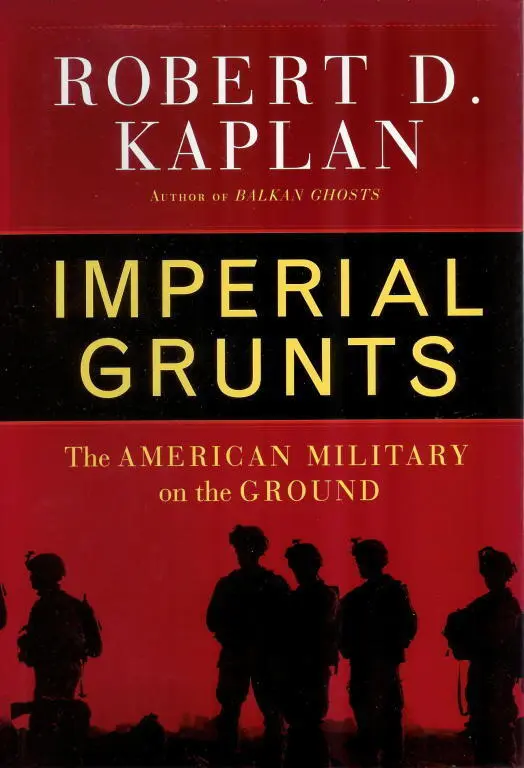
- Название:Imperial Grunts
- Автор:
- Издательство:Random House
- Жанр:
- Год:2005
- Город:New York
- ISBN:978-0-307-27850-0
- Рейтинг книги:5 / 5. Голосов: 1
-
Избранное:Добавить в избранное
- Отзывы:
-
Ваша оценка:
Imperial Grunts: краткое содержание, описание и аннотация
Предлагаем к чтению аннотацию, описание, краткое содержание или предисловие (зависит от того, что написал сам автор книги «Imperial Grunts»). Если вы не нашли необходимую информацию о книге — напишите в комментариях, мы постараемся отыскать её.
Imperial Grunts — читать онлайн бесплатно полную книгу (весь текст) целиком
Ниже представлен текст книги, разбитый по страницам. Система сохранения места последней прочитанной страницы, позволяет с удобством читать онлайн бесплатно книгу «Imperial Grunts», без необходимости каждый раз заново искать на чём Вы остановились. Поставьте закладку, и сможете в любой момент перейти на страницу, на которой закончили чтение.
Интервал:
Закладка:
“Meles [Zenawi] also lived in a cave for years,” he went on, referring to the leader of Ethiopia. “That’s why both these guys are so smart. They had nothing to do for years except read.”
Indeed, President Bush and Defense Secretary Rumsfeld had met with Zenawi in 2002, making Ethiopia a linchpin in the struggle against al-Qaeda. The Ethiopians were granting overfly rights and sharing intelligence with the U.S., even as troops from the 10th Mountain Division were training Ethiopian soldiers. Orthodox Christian Ethiopia clearly felt threatened; it was now 50 percent Muslim, with Saudi-financed mosques spreading radicalism, and the Islamic separatist Oromo Liberation Front active in the south of the country. 4
Robeson showed me a map of the ethnic groups of the Horn. The territory of the Afars overlapped Djibouti, Eritrea, and Ethiopia, and that of the Issas Djibouti, Ethiopia, and Somalia. The numerous Oromos inhabited both Ethiopia and Kenya. The Anuaks inhabited Ethiopia and Sudan, the Digil occupied Somalia and Kenya, and so on. The map looked quaint, but as the Islamic resurgence in Ethiopia evinced, it had urgent political meaning. For example, Somalia was a failed state that had effectively severed into three parts: the Issa-dominated northwest that configured with former British Somaliland; the largely Darood central part called “Puntland” (a reference to the biblical land of Punt, by the mouth of the Red Sea); and the Hawiy-dominated south around Mogadishu, which had been an Italian colony.
Somalia couldn’t get any worse. Only the former British northwest had a semblance of government. Robeson was equally concerned with Ethiopia and Kenya. They dominated the region demographically, and had gone from being repressive regimes to weak democracies, as the U.S. had been in the early nineteenth century. Ethiopia still constituted a sprawling empire more than a country, and was ruled by a minority Tigrean. While predominantly orthodox Christian, it had large Muslim areas, as did Kenya. Mosque construction in Robeson’s area of responsibility had increased more than eightfold. Sub-Saharan Africa’s institutional decline was generating stronger religious identities as the post-colonial state lost its grip on people’s imaginations.
Terrorists were the beneficiaries of such trends.
Talking with Gen. Robeson, I could not help recalling Donald Levine’s mid-twentieth-century portrait of the Ethiopian Amhara, Wax and Gold, an ethnographic area study that is one of the finest of the genre. A professor of sociology at the University of Chicago, Levine labeled himself a “pragmatist”: someone, he explains, who affirms the human values of modernity, yet conceives of modernity not in fixed ideological terms, but as “relative to the cultural context in which modernization takes place.” 5So while democracy may ultimately be the best system for every society, each society must reform in its own time and in its own way, depending upon historical and geographical circumstances. Because Levine’s experience in the Horn was prodigious, and he was unafraid to generalize about human behavior, Wax and Gold, researched between 1957 and 1962, has a practical, old-fashioned common sensibility rare in contemporary academic circles.
Wax and gold, Levine explains— sam-enna warq in Amharic—“is the formula used by the Amhara to symbolize their favorite form of verse.” It is a verse formula built of two semantic layers: the apparent, figurative meaning of the words called the “wax,” and the hidden meaning called the “gold.” This is the key, he implies, to understanding Ethiopian culture. While the relative absence of ambiguity—clear, straightforward talk—is necessary for the running of a modern society and bureaucracy, the management of social and ethnic tensions requires considerable reliance on ambiguity for interpersonal relations. A culture of deception, according to Levine, has always been the obstacle to Ethiopia’s modernization, but also the protector of its relative social peace. 6
In Ethiopia’s “minimal, Hobbesian order,” Levine goes on, moral obligations rarely extend beyond the family and tribal circle. Suspicion and secrecy are ever present, partly due to a history of living under the dual threat of Islam and Western Christianity. (Thus, the Ethiopian Orthodox Church concerns itself with “practical justice, not universal love.”) Ethiopia, to which Levine was lured by its “extraordinarily handsome people in a setting of great natural beauty,” is a hard, cruel place. The author notes “the surly use of authority, the subtle sense of fatalism, the adulation of rank rather than human qualities… the narrowness of outlook… the interpersonal aspects of the ethos of wax and gold.”
The countryside’s appearance is proof of this absence of community. There are few venerable urban centers, or villages even, in the Ethiopian highlands, just thinly scattered groups of houses up and down the mountainsides. Instead of clustering, there is dispersion. 7
Wax and Gold was published a decade before the Ethiopian revolution that toppled Emperor Haile Selassie and brought to power arguably the most systematically murderous regime in the history of twentieth-century Africa, a suspicious and morosely secretive Marxist killing machine that evinced many of the negative cultural traits that Levine had earlier identified in his researches.
Looking at the ethnic map of the Horn and what might transpire there in coming years, I knew that such a book could only grow in relevance, for just as terrain comes before the enemy, in Capt. Cassidy’s words, indigenous culture—a reaction to geographical circumstance—must be appreciated before anything can be accomplished with its inhabitants.
The diminishing emphasis on central authority had led the U.S. military to forge a presence in far-flung parts of Ethiopia and Kenya. That’s what “working the fringes” was all about, according to Brig. Gen. Robeson. Thus, one morning before dawn I slipped out of the penitentiary-like world of the Marine barracks and walked over to the airstrip at Camp Lemonier, boarded a Navy C-20, and by lunchtime was in Nairobi, where I boarded a small commercial prop. Before mid-afternoon I was looking at the top of Mount Kilimanjaro through the plane window. By late afternoon I touched down in the Kenyan coastal town of Manda Bay near the Somali border, where the African bush meets the milky turquoise of the Indian Ocean. Here the Horn gives way to East Africa, and the world of the Muslim Near East melds with that of syncretic sub-Saharan Africa to form the purest Swahili culture. From Manda Bay, I boarded a dhow for the short sail to the island of Lamu, my destination and that of the four-man Army CAT (civil affairs team) with which I was traveling.
Like the Sulu Archipelago in the southern Philippines, Lamu is another lost paradise of empty beaches, aquamarine inlets graced by swirling coral patterns, thatched hutments, and quiet, contemplative alleys hypnotized by the sun and plied by burros. It was saved from mass tourism only by the threat of terrorism and Kenya’s reputation for crime. [71] The reputation for crime was somewhat undeserved because crime was limited mainly to Nairobi.
Muslim dominance was another factor, because it limited liquor licenses on the island.
Lamu, a medieval creation of Arab traders, is the first of the Swahili city-states reached by single-mast dhows sailing from Oman and Yemen. The prevalence of the Persian and the Portuguese in these waters contributed to the cultural eclecticism. Lamu boomed during the centuries of the Arab-dominated East African slave trade. When the slave trade ended, and the British built a rail link from Nairobi to Mombasa south along the coast, Lamu became a backwater, frequented only by a small band of sybaritic Europeans, including the royal family of Monaco. It was in Lamu where Princesses Caroline and Stephanie, with their husbands and hangers-on, attempted to escape from the klieg lights of the paparazzi.
Читать дальшеИнтервал:
Закладка:
Похожие книги на «Imperial Grunts»
Представляем Вашему вниманию похожие книги на «Imperial Grunts» списком для выбора. Мы отобрали схожую по названию и смыслу литературу в надежде предоставить читателям больше вариантов отыскать новые, интересные, ещё непрочитанные произведения.







Обсуждение, отзывы о книге «Imperial Grunts» и просто собственные мнения читателей. Оставьте ваши комментарии, напишите, что Вы думаете о произведении, его смысле или главных героях. Укажите что конкретно понравилось, а что нет, и почему Вы так считаете.