Robert Kaplan - Imperial Grunts
Здесь есть возможность читать онлайн «Robert Kaplan - Imperial Grunts» весь текст электронной книги совершенно бесплатно (целиком полную версию без сокращений). В некоторых случаях можно слушать аудио, скачать через торрент в формате fb2 и присутствует краткое содержание. Город: New York, Год выпуска: 2005, ISBN: 2005, Издательство: Random House, Жанр: Публицистика, nonf_military, на английском языке. Описание произведения, (предисловие) а так же отзывы посетителей доступны на портале библиотеки ЛибКат.
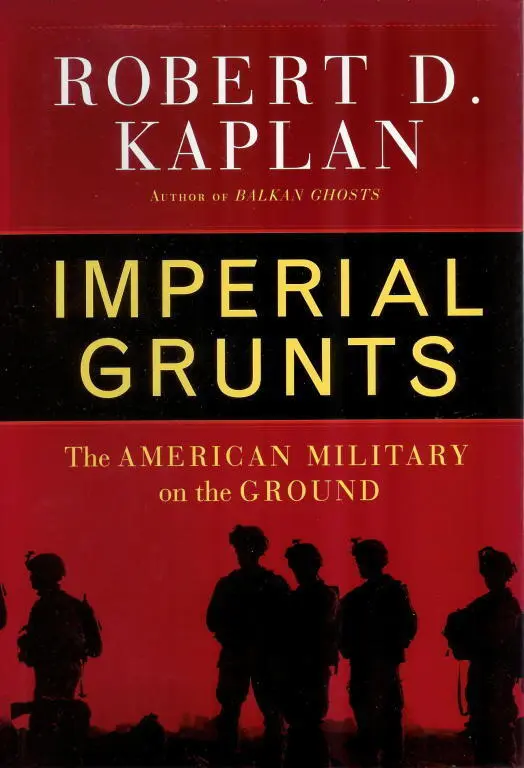
- Название:Imperial Grunts
- Автор:
- Издательство:Random House
- Жанр:
- Год:2005
- Город:New York
- ISBN:978-0-307-27850-0
- Рейтинг книги:5 / 5. Голосов: 1
-
Избранное:Добавить в избранное
- Отзывы:
-
Ваша оценка:
Imperial Grunts: краткое содержание, описание и аннотация
Предлагаем к чтению аннотацию, описание, краткое содержание или предисловие (зависит от того, что написал сам автор книги «Imperial Grunts»). Если вы не нашли необходимую информацию о книге — напишите в комментариях, мы постараемся отыскать её.
Imperial Grunts — читать онлайн бесплатно полную книгу (весь текст) целиком
Ниже представлен текст книги, разбитый по страницам. Система сохранения места последней прочитанной страницы, позволяет с удобством читать онлайн бесплатно книгу «Imperial Grunts», без необходимости каждый раз заново искать на чём Вы остановились. Поставьте закладку, и сможете в любой момент перейти на страницу, на которой закончили чтение.
Интервал:
Закладка:
But the Grimaldi sisters soon had company—Arab terrorists and the American military. Both came for the very reason that had made Lamu and other nearby islands fertile ground for the Swahili language and the slave trade—location. For the Arabs, Lamu was the most forward point of cultural access into sub-Saharan Africa. (Swahili, after all, represents a fusion of Arabic and Bantu words and civilizations.) In these island paradises, filled with welcoming Muslim populations, young al-Qaeda operatives with money and good manners could quietly establish themselves. Kenya was an inviting target because of the large concentration of westerners in
its major cities. The group that bombed the Israeli-owned hotel in Mombasa worked out of Faza Island, next door to Lamu.
As for the American military, it had a long-standing relationship with the Kenyan one. But the relationship intensified with the collapse of the Berlin Wall and the breakdown of order in adjacent Somalia. Next came the bombing of the Nairobi embassy and then 9/11, as the threat shifted from Soviet domination of Central Europe to radical Islamic terrorism fostered by third world institutional decline.
Edged Mallet, an annual joint American-Kenyan military exercise, was in its fourth year now. Its focus was Kenya’s northern coast near Somalia, where at Manda Bay the Kenyan military had an air base and naval station.
Manda Bay required an improved pier and a better runway, which, as it happened, served the interests of the American and Kenyan militaries. It also served the interests of Kenya’s new fledgling democracy, which was trying to upgrade services and establish an institutional foothold after the abuses perpetrated by the former ruler, Daniel arap Moi. In an age of democracy, bilateral military contacts were more important than ever. In countries like Kenya, civilian politicians came and went, but leading security and military men remained as behind-the-scenes props. Thus, the better the relationship between American officers and their Kenyan counterparts, the more likely that the Kenyan military would be honest and democratic. As Brig. Gen. Robeson had put it to me, “The success of Kenya’s democratic experiment offers the best hope for American security in the region.”
A key fact to remember is that the Americans did not require a base of their own; rather, they wanted the Kenyans to have a fully modernized base, so that present and future democratic Kenyan governments would project Kenyan power into the chaotic reaches of Somalia. As for the Americans, they could always use these base facilities if—and only if—the U.S. maintained a strong relationship with the Kenyan military, and with the local inhabitants of Lamu and Manda Bay. That was where Army Civil Affairs entered the calculation.
Civil Affairs had an obviously civilian connotation. That was the beauty of it. In truth, Civil Affairs was part of USASOC, U.S. Army Special Operations Command, headquartered at Fort Bragg, which also included Special Forces and Psychological Operations. Civil Affairs acted like a relief charity or NGO (nongovernmental organization). It built schools, dug wells, provided medical assistance, and so forth. The four-man civil affairs team that I accompanied to Lamu would be replacing a four-man team that had already been on the island for several months.
These teams had a twofold mission: make a sustained contribution to the island’s quality of life, so that the inhabitants would see a relationship with the U.S. as in their best interests; and, more immediately, be the advance guard for U.S. Marines from the U.S.S. Germantown coming ashore to repair a school and conduct a MEDCAP.
Lamu was an example of the new paradigm for projecting American power: modernize host country bases for use as strategic outposts, maintain local relationships through humanitarian projects, then use such relationships to hunt down “bad guys.” Whether it was upgrading a runway, digging a well, or whacking a terrorist, the emphasis was always on small teams.
The civil affairs teams were usually composed of reservists. Rather than the young, high-testosterone marines I had been staying with, they were more like their Special Forces colleagues in Army Special Operations Command: middle-aged men with civilian skills relevant to the task at hand.
But the people skills required on Lamu were not those the U.S. military usually looked for, even as they were the most important skills to have in a new era of ambiguous war.
A four-man team led by Capt. Steve Stacy of Tiffin, Ohio, a graduate of Ohio State University, would be replacing a team led by Capt. Jeff Rynearson of Orlando, Florida, a graduate of Southern Illinois University. On the plane journey from Djibouti, Capt. Stacy’s team did not make much of an impression on me, one way or the other. Stacy’s team sergeant, Glenn Elenga of Phoenix, was a friendly, garrulous former Special Forces 18 Delta medic. Sgt. Anthony Diaz of Tenafly, New Jersey, was a handsome ethnic Colombian who planned to do graduate studies at Johns Hopkins University in Washington, D.C. Sgt. Michael McCoy of Las Vegas was just plain quiet and tense. He seemed more suited to direct action than to the softer, humanitarian unconventional war.
It was only when I met the other team at the civilian airstrip in Manda Bay that I realized how much the new team would have to struggle in order to adapt, for the reality of Lamu and the skill set it required hit me at once.
Lamu was just so laid-back. The moment you landed, and the heat and enervating humidity lathered your skin, rotting the back of your shirt, and you saw your first dhow and bougainvillea bush, any tensions or worries you might have brought with you on the plane simply evaporated. Here there was no gritty dust, only fine white sand. It was an Indian Ocean version of what the Greek islands must have been like in the 1950s, before reduced jet fares and Never on Sunday —just beautiful scenery, uncorrupted natives, a sensuous concoction of Arab architecture and African styles, and a sprinkle of Western pleasure-seekers.
Capt. Jeff Rynearson, the departing commander, met us at planeside. He had a beefy and relaxed surfer’s manner, with a deep tan, longish sun-bleached blond hair, and wraparound shades. He was wearing shorts, sandals, and a loud Hawaiian-style shirt. With his “We Are the World” smile, he was like any engaging relief worker or Peace Corps volunteer, except for the Skoal chewing tobacco in his mouth and the 9mm Beretta under his Hawaiian shirt. Capt. Rynearson’s sidekick, who at first I thought was a Kenyan security heavy, was Sgt. John Philoctete, an ethnic Haitian from Brooklyn. Sgt. Philoctete had the same jet-black complexion as the locals. He wore a white Muslim-style skullcap and gold chains around his neck.
“Jambo,” they greeted us, as well as the people they passed on the short walk to the dock, whom they all seemed to know. It was Swahili for “Hello, how are you?”
“ Mzuri sana [Very good],” came the reply, followed by “hakuna matata,” which strictly translated as “no problem.” But it had a larger connotation akin to “everything is cool.” It was seventeen years since I had last been in Kenya, and I had forgotten the electric sense of life that Swahili imparted.
Beautiful African women in black buibuis smiled broadly at us. The cotton robes concealed everything but their faces, while accentuating their swaying hips. One girl around seventeen began smiling and talking to Capt. Rynearson. She obviously knew him. “It’s sad,” he whispered in my ear. “There are a lot of girls here like her. They’re at the age when the hormones kick in and they start begging their father to arrange a marriage for them. Then they’re finished in this culture.”
Читать дальшеИнтервал:
Закладка:
Похожие книги на «Imperial Grunts»
Представляем Вашему вниманию похожие книги на «Imperial Grunts» списком для выбора. Мы отобрали схожую по названию и смыслу литературу в надежде предоставить читателям больше вариантов отыскать новые, интересные, ещё непрочитанные произведения.








Обсуждение, отзывы о книге «Imperial Grunts» и просто собственные мнения читателей. Оставьте ваши комментарии, напишите, что Вы думаете о произведении, его смысле или главных героях. Укажите что конкретно понравилось, а что нет, и почему Вы так считаете.