Robert Kaplan - Imperial Grunts
Здесь есть возможность читать онлайн «Robert Kaplan - Imperial Grunts» весь текст электронной книги совершенно бесплатно (целиком полную версию без сокращений). В некоторых случаях можно слушать аудио, скачать через торрент в формате fb2 и присутствует краткое содержание. Город: New York, Год выпуска: 2005, ISBN: 2005, Издательство: Random House, Жанр: Публицистика, nonf_military, на английском языке. Описание произведения, (предисловие) а так же отзывы посетителей доступны на портале библиотеки ЛибКат.
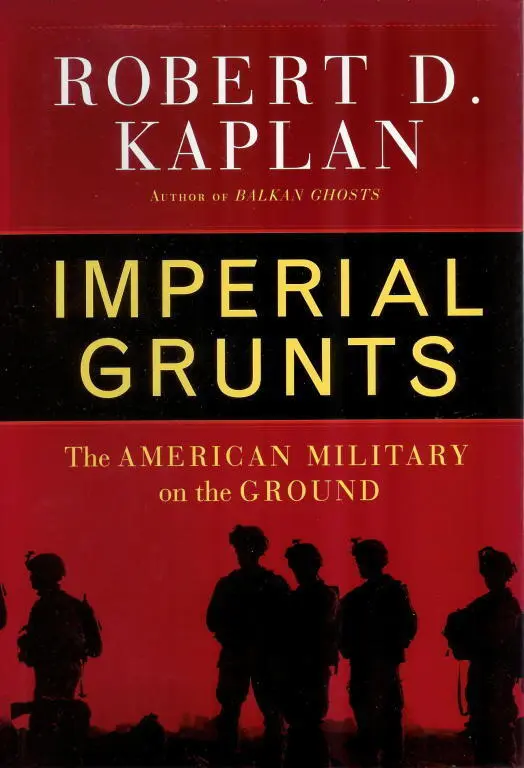
- Название:Imperial Grunts
- Автор:
- Издательство:Random House
- Жанр:
- Год:2005
- Город:New York
- ISBN:978-0-307-27850-0
- Рейтинг книги:5 / 5. Голосов: 1
-
Избранное:Добавить в избранное
- Отзывы:
-
Ваша оценка:
Imperial Grunts: краткое содержание, описание и аннотация
Предлагаем к чтению аннотацию, описание, краткое содержание или предисловие (зависит от того, что написал сам автор книги «Imperial Grunts»). Если вы не нашли необходимую информацию о книге — напишите в комментариях, мы постараемся отыскать её.
Imperial Grunts — читать онлайн бесплатно полную книгу (весь текст) целиком
Ниже представлен текст книги, разбитый по страницам. Система сохранения места последней прочитанной страницы, позволяет с удобством читать онлайн бесплатно книгу «Imperial Grunts», без необходимости каждый раз заново искать на чём Вы остановились. Поставьте закладку, и сможете в любой момент перейти на страницу, на которой закончили чтение.
Интервал:
Закладка:
It was “Staff Sgt. Dickinson” to everyone, never simply “Sgt. Dickinson.” The Marines never abbreviated rank, as they did in the Army. The rule against abbreviating rank helped uphold distinctions that related to real qualitative differences in responsibility. Staff Sgt. Dickinson was in his late twenties, but the authority that he possessed over the twenty-nine marines in my tent and the two next door made him seem much older. [65] Platoons in the Marine Corps, like Special Forces A-teams, varied in size. With only twenty-nine marines, this was a small platoon.
Like so many guys I had met in Special Forces and now in the Marines, the older generations of Staff Sgt. Dickinson’s family included Vietnam veterans. Staff Sgt. Dickinson’s brother was in the Army, and his father-in-law had been a marine. When the economy in upstate New York offered little hope of a job for him, dropping out of college and heading south to enlist in the Marines seemed the natural thing to do. But marines, as I learned the first night in the barracks, were not southern to the degree of Special Forces. They were simply generic working class from all regions of the country.
Much more than Special Forces, marines were tight-lipped and uncommunicative, until it came to their jobs. Then they couldn’t stop talking. Ask them what they do, not how they feel, I had always to tell myself. Staff Sgt. “Dick” was typical. “I don’t really rule the lives of twenty-nine guys,” he told me. “I rule only three, the squad leaders. I oversee the rest. What my job really requires is curiosity—about everything that goes on in the platoon.” He then continued talking nonstop about gear surveys, and regulations governing haircuts, shaving, and physical appearance in general.
“When you go home on leave and see the guys you used to hang out with, you see them different—as slobs,” he continued. “A marine is always a marine, even in civilian clothes. You always dress neat, you tuck in your shirt. You never walk with your hands in your pockets. But in the field we can flip a switch and turn nasty. Then all our cleanliness is channeled into the cleaning of our weapons and equipment only. Semper Gumby. Always Flexible. That’s the real Marine motto.”
Staff Sgt. Dick had seen combat the first time as a corporal in the Balkans. The platoon had been trucked in overland from Greece and set up a base in a gymnasium in northern Kosovo. “We did foot patrols in alleys and were shot at by Serb gunmen, who were then killed by our snipers. We carried the bodies away in our ponchos. After Kosovo I reenlisted.”
By the time of OIF (Operation Iraqi Freedom) he had become a staff sergeant. Sleeping in “coffin racks” for a month “on ship” en route from Camp Lejeune made the floor of the Kuwait desert a step up in creature comfort. Seven-ton trucks got the platoon to the outskirts of An-Nasiriyah, where it experienced its first firefight with the Fedayeen Saddam. That first night in An-Nasiriyah was their worst in Iraq. Torrential rains caused Staff Sgt. Dickinson’s men to bail water as much as dig trenches. It was pitch black. The rain covered up the muzzle flashes. Their night vision goggles fogged up. Rounds buzzed over their heads and next to them. “It’s not so much scary as overwhelming. The adrenaline never stops, you go numb, and all of your training falls into place,” he explained.
For the most part, though, for the 2nd Platoon of India Company, Operation Iraqi Freedom had been a melancholy delirium of cramped and dust-ridden truck rides with piss breaks every six hours while sweating inside their MOPP suits, interspersed with anxious foot patrols. [66] MOPP: mission-oriented protective posture—gear for chemical and biological attacks.
Staff Sgt. Dickinson’s marines often got no more than one meal ready to eat per day, so they killed chickens and stripped dead cows that they had bought from the hajis. While the First Marine Expeditionary Force (I MEF) had marched straight from Kuwait to Baghdad, those of II MEF, which included India Company, were left in the rear to clean up pockets of resistance. They got less publicity, but in some cases saw more combat and had the more interesting experiences.
The platoon went a month without washing until the gunnery sergeant was able to construct makeshift showers. Their socks became hardened, their bodies black with mud and dirt. They became closer to their fellow marines than they had ever been to their buddies back home. They bled, shat, and vomited together. Without radios or TVs, they discovered reading for the first time in their often poor, misbegotten lives. Every night was “story time,” when one of them would read out loud to the others: Larry McMurtry’s Lonesome Dove from beginning to end.
Most of Staff Sgt. Dick’s men were still in their teens, yet they told their Iraq stories to me in the manner of old men talking to their grandchildren. “Iraq made me want to go home and apologize to all the people I had ever been an asshole to; it made me see myself from the outside for the first time,” said Richard Cabrera, a twenty-one-year-old corporal from Riverside, California.
Nineteen-year-old Ty Ogden of Saratoga Springs, New York, told me of how an Iraqi girl had come up and given him a flower, which he stuck in his helmet. “The Iraqis were always so nice to us,” said another nineteen-year-old tattooed lance corporal, Jeremy Kepner of Utica, New York. “In the morning they brought us fresh tea and pita bread, which we traded for MREs. When we finally got home on leave it was weird. Our old friends suddenly seemed so immature, so naive.”
En route home from Iraq, the ship docked in Lisbon, Portugal, for four days. For Lance Cpl. Kepner and most of the others, it was the first time that they had been to Europe. “After months at Camp Lejeune, Kuwait, and Iraq, Portugal blew our minds,” he reflected. “The women were so beautiful, the people so polite and well dressed—not like Americans. The buildings were old, like a castle. It made me think. I want to go to college after my enlistment is up.”
One day I was sitting atop a Humvee with Lance Cpl. Kepner, waiting to go to the rifle range. I happened to mention that I had been to Colombia the previous winter with the Army’s 7th Special Forces Group.
Kepner replied: “That was when my step-grandfather was killed there, in southern Colombia.”
It turned out that Lance Cpl. Kepner was the step-grandson of Tom Janis, the Vietnam veteran and Bronze Star recipient who had been executed by FARC guerrillas after his plane had gone down, and whose remains I had seen in the hangar that day at Larandia.
“Yes,” Kepner said. “My step-grandfather was buried in Arlington National Cemetery.”
Whereas Staff Sgt. Dickinson was the platoon leader, 2nd Lt. Chris Wagner of Hillsborough, New Jersey, a graduate of Towson University in Maryland, was the platoon’s executive officer. It was a similar division of responsibilities as that which existed between the master sergeant and the captain of a Special Forces team, which, in turn, was like that between the managing editor and the editor in chief of a newspaper. Staff Sgt. Dickinson was responsible for the minute-by-minute operation of the human machinery, while 2nd Lt. Wagner provided the platoon its basic orientation: he drafted the training schedules and so on. Second Lt. Wagner was like other lower- and middle-ranking officers I had met in the military: officers’ training (which for Marines took place at Quantico, Virginia) had, in the process of making him more articulate, also given him a vaguely aristocratic bearing. It was very subtle, and it existed only in relation to the noncommissioned officers, but it was there.
Читать дальшеИнтервал:
Закладка:
Похожие книги на «Imperial Grunts»
Представляем Вашему вниманию похожие книги на «Imperial Grunts» списком для выбора. Мы отобрали схожую по названию и смыслу литературу в надежде предоставить читателям больше вариантов отыскать новые, интересные, ещё непрочитанные произведения.







Обсуждение, отзывы о книге «Imperial Grunts» и просто собственные мнения читателей. Оставьте ваши комментарии, напишите, что Вы думаете о произведении, его смысле или главных героях. Укажите что конкретно понравилось, а что нет, и почему Вы так считаете.