Robert Kaplan - Imperial Grunts
Здесь есть возможность читать онлайн «Robert Kaplan - Imperial Grunts» весь текст электронной книги совершенно бесплатно (целиком полную версию без сокращений). В некоторых случаях можно слушать аудио, скачать через торрент в формате fb2 и присутствует краткое содержание. Город: New York, Год выпуска: 2005, ISBN: 2005, Издательство: Random House, Жанр: Публицистика, nonf_military, на английском языке. Описание произведения, (предисловие) а так же отзывы посетителей доступны на портале библиотеки ЛибКат.
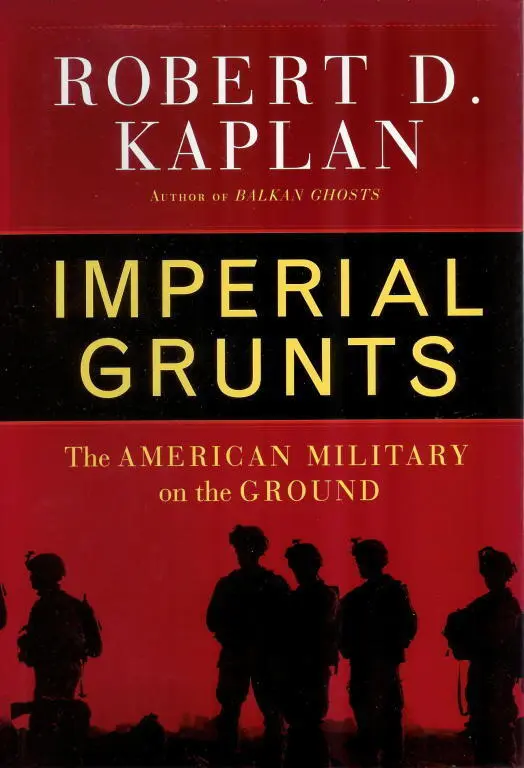
- Название:Imperial Grunts
- Автор:
- Издательство:Random House
- Жанр:
- Год:2005
- Город:New York
- ISBN:978-0-307-27850-0
- Рейтинг книги:5 / 5. Голосов: 1
-
Избранное:Добавить в избранное
- Отзывы:
-
Ваша оценка:
Imperial Grunts: краткое содержание, описание и аннотация
Предлагаем к чтению аннотацию, описание, краткое содержание или предисловие (зависит от того, что написал сам автор книги «Imperial Grunts»). Если вы не нашли необходимую информацию о книге — напишите в комментариях, мы постараемся отыскать её.
Imperial Grunts — читать онлайн бесплатно полную книгу (весь текст) целиком
Ниже представлен текст книги, разбитый по страницам. Система сохранения места последней прочитанной страницы, позволяет с удобством читать онлайн бесплатно книгу «Imperial Grunts», без необходимости каждый раз заново искать на чём Вы остановились. Поставьте закладку, и сможете в любой момент перейти на страницу, на которой закончили чтение.
Интервал:
Закладка:
But was the U.S. really following the British model?
To an extent, yes. Unfortunately, it was also to an extent following the Soviet model. Rather than power down to the level of small units and expand their activities, the U.S. was maintaining a vertical, multi-layered bureaucracy ruled by conventional general officers with conventional mindsets that was undermining the British-style firebases. In Col. Callwell’s Small Wars, published in 1896, there is an emphasis on the decentralization of command, the need for mobility, and the need to stay outside the base perimeters and among the local population as much as possible. 26The CJTF-180 at Bagram was violating all of these principles.
The Soviets had invaded Afghanistan, declared victory, and then were gradually chewed up by unconventional Afghan guerrillas called mujahedin, operating from bases inside Pakistan’s tribal agencies. Likewise, the Americans had swept through Afghanistan, declared victory, and were now encountering resistance from “bad guys,” whose principal sanctuaries were over the border.
In Washington, everyone droned on about military “transformation.” But transformation lay in the past, ever receding, since those precious weeks after 9/11 when the unleashing of 5th Group’s A-teams from the bureaucratic straitjacket of the Pentagon allowed for a situation truly up to British imperial standards, as well as to America’s own nineteenth-century small wars tradition.
CHAPTER SIX
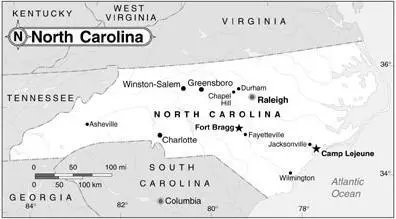
FROM THE ARMY TO THE MARINES—FORT BRAGG AND CAMP LEJEUNE, NORTH CAROLINA
WINTER 2003–2004
“I had entered a world stripped to its bare essentials, the inhabitants of which had taken a veritable monastic vow of poverty.”
Returning home from Afghanistan, I encountered more discussion in the media about the role of embedded reporters in Iraq and elsewhere: to what degree they might have been manipulated by the military; to what degree they might have lost their professional detachment and begun to identify with the troops they were covering. 1Taking stock after a year of traveling, while I had been critical in print of how the U.S. military was fighting the Global War on Terrorism, I happily admitted guilt on the second charge. 2
I should explain: “Every reporter is a citizen of somewhere and a believer in something,” said Ernie Pyle, America’s best-known World War II correspondent, who was killed during the battle of Okinawa in April 1945. 3I was a citizen of the United States and a believer in the essential goodness of American nationalism, a nationalism without which the security armature for any emerging global system simply could not have existed. I did not doubt that at some point, perhaps as soon as a few decades, American patriotism itself might begin to become obsolete. I also had no doubt that we were not there yet.
I had served in the military: in the Israeli rather than the American. In Israel in the 1970s, finding life exclusively among Jews in a small country claustrophobic, I discovered my Americanness anew. For a quarter century thereafter, I had been covering wars and insurrections. During this time I made more friends in the American military than in the international media. At the conferences and meetings I attended in the U.S., I encountered military and national security types far more often than fellow journalists. I felt comfortable among soldiers. Stopping in Dubai en route back from Afghanistan, after two days of fine food and hot showers, I felt a bit lonely.
Most journalists had newsrooms to go back to, where they were swept back into a social and professional world that acted as a countervailing force to their reporting experiences. But I had not seen a W-2 form for thirty years. My articles had appeared in The Atlantic Monthly for two decades, yet I rarely visited the Boston office and lived out in the country.
I had little interest in breaking news. The last time I had filed a hard news story was back in the Cold War days of yellow telex tapes. I owned no satphone, a standard piece of equipment for embedded reporters. On most reporting trips, I went to places where my cell phone wouldn’t work, so I left it behind. The firebase at Gardez had two satphones for the fifty Green Berets. Like everyone else there, I called my family once a week, and talked for a few minutes.
I was not concerned about crossing a professional boundary. My goal as a writer was simple and clear. I wanted to take a snapshot for posterity of what it was like for middle-level commissioned and noncommissioned American officers stationed at remote locations overseas at the beginning of the twenty-first century: a snapshot in words that those sergeants and warrant officers and captains and majors would judge as sufficiently accurate, so they might recognize themselves in it. It should be something, I hoped, that they could give to their grandchildren, saying, “That’s sort of like it was, and like those countries were.” It did not mean that I ignored tough issues and problems. It did mean that I wrote about their problems and frustrations, informed by their perspective.
I once heard the columnist George Will say that he harbored an intelligent empathy for the politicians he wrote about, because he often found them more substantial and interesting than his fellow journalists. That’s how I felt about the troops. I wanted to think of myself as a traveler in the old-fashioned sense. A traveler accepts the people around him, and whatever happens to him. He never demands or complains; he merely listens and observes. I fell into frequent use of the words “we” and “our” because, although a journalist, I was also a fellow American living among the troops, taking part in most of what they did. World War II military correspondents such as Richard Tregaskis and Robert Sherrod made frequent use of those words for the same reasons.
To say that I was objective would be to deny a basic truth of writing: that to every story and situation a writer brings to bear his entire life experience and professional pressures as they exist at that moment. While a journalist may seek different points of view, he can portray and shape those different points of view from only one angle of vision: his own.
For these reasons, the objectivity of the media as a whole was problematic. The media represented a social, cultural, and regional outlook every bit as specific as the southern evangelicalism of the soldiers I knew. Journalists were global cosmopolitans. If they themselves did not own European and other foreign passports, their spouses or friends or colleagues increasingly did. Contrarily, the American troops I met saw themselves belonging to one country and one society only: that of the United States.
The Deep South was heavily represented in the military, just as the urban Northeast, with its frequent air connections to Europe, was heavily represented in the media. Whenever I did meet New Yorkers or Bostonians in the military, they were usually from the working-class boroughs and outskirts of New York City and Boston—heavily Irish and Hispanic.
In fact, the charge that embedded journalists had lost their objectivity was itself a sign of class prejudice. Even with the embed phenomenon, the media maintained a more incestuous relationship with academics, politicians, businesspeople, international diplomats, and relief charities (among other nongovernmental organizations) than it did with the military. The common denominator among all of these groups, save for the military, is that they spring from the same elevated social and economic strata of their respective societies. Even relief workers are often young people from well-off families, motivated by adventure and idealism. But the military is part of another America, an America that the media establishment was increasingly blind to, and alienated from. [58] Obviously, military correspondents—a small part of the media—were an exception to this rule.
Интервал:
Закладка:
Похожие книги на «Imperial Grunts»
Представляем Вашему вниманию похожие книги на «Imperial Grunts» списком для выбора. Мы отобрали схожую по названию и смыслу литературу в надежде предоставить читателям больше вариантов отыскать новые, интересные, ещё непрочитанные произведения.







Обсуждение, отзывы о книге «Imperial Grunts» и просто собственные мнения читателей. Оставьте ваши комментарии, напишите, что Вы думаете о произведении, его смысле или главных героях. Укажите что конкретно понравилось, а что нет, и почему Вы так считаете.