Robert Kaplan - Imperial Grunts
Здесь есть возможность читать онлайн «Robert Kaplan - Imperial Grunts» весь текст электронной книги совершенно бесплатно (целиком полную версию без сокращений). В некоторых случаях можно слушать аудио, скачать через торрент в формате fb2 и присутствует краткое содержание. Город: New York, Год выпуска: 2005, ISBN: 2005, Издательство: Random House, Жанр: Публицистика, nonf_military, на английском языке. Описание произведения, (предисловие) а так же отзывы посетителей доступны на портале библиотеки ЛибКат.
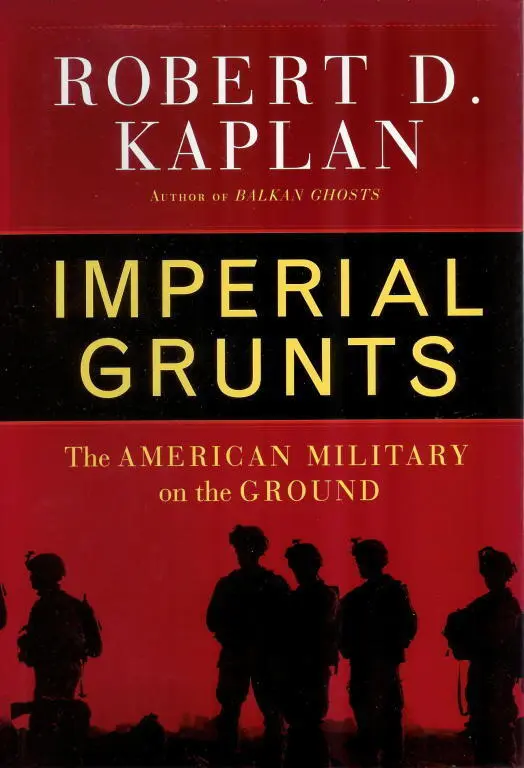
- Название:Imperial Grunts
- Автор:
- Издательство:Random House
- Жанр:
- Год:2005
- Город:New York
- ISBN:978-0-307-27850-0
- Рейтинг книги:5 / 5. Голосов: 1
-
Избранное:Добавить в избранное
- Отзывы:
-
Ваша оценка:
Imperial Grunts: краткое содержание, описание и аннотация
Предлагаем к чтению аннотацию, описание, краткое содержание или предисловие (зависит от того, что написал сам автор книги «Imperial Grunts»). Если вы не нашли необходимую информацию о книге — напишите в комментариях, мы постараемся отыскать её.
Imperial Grunts — читать онлайн бесплатно полную книгу (весь текст) целиком
Ниже представлен текст книги, разбитый по страницам. Система сохранения места последней прочитанной страницы, позволяет с удобством читать онлайн бесплатно книгу «Imperial Grunts», без необходимости каждый раз заново искать на чём Вы остановились. Поставьте закладку, и сможете в любой момент перейти на страницу, на которой закончили чтение.
Интервал:
Закладка:
We were stacked tightly into the back of a small truck with all our gear and driven to the airfield, where the Chinooks, which had finally been secured for Newark, were now to fly to Gereshk instead.
“Where’s my gun bitch?” someone shouted, looking for the person carrying extra magazines for his squad assault rifle.
When the choppers took off, I was sweating. An hour later, prior to landing, night had descended and I had begun to freeze. Amid the darkness and the loud beating of the rotors, there was the usual frantic fiddling with straps for the web gear, rucksacks, and mounted guns. Night optical devices were adjusted. “Hot landing zone,” we all thought we heard the pilot say, meaning there was gunfire.
The hatch opened and we lumbered into the ruler-flat blackness of the Helmand desert. The light of the half moon briefly caught the rotors of the Chinook as it climbed back into the sky. Actually, it was a “rock landing zone,” full of small boulders. But less than two miles away we saw the tracer bullets and rocket-propelled grenade fire—and heard the explosions—of the battle currently under way in Gereshk between rival Afghan factions.
“I apologize, I shouldn’t have had beans for lunch,” someone shouted after we had heard different noises. “At least I’m calling my own shots.” We hiked the several hundred yards to the gate of the firebase, where Maj. Helms directed different squads to fan out around a 360-degree perimeter.
I stumbled in the dark behind Helms into the operations center of the firebase, a large whitewashed room, its walls lined with plastic-covered terrain maps and leadership diagrams of the various local tribes. Laptop computers and communications gear lay cluttered on unfinished plywood desks, with camp chairs all around.
“The AMF [Afghan Militia Force] is fighting the local police in the bazaar near the center of Gereshk,” an intense-looking chief warrant officer with a long black beard who was manning the comms told Maj. Helms. “The AMF commander is dead with a bullet to the head. His number two is all messed up with multiple wounds. I have no line of communications at the moment with the AMF because the AMF guy with the comms is dead. I’ll give you the grid coordinates for the base in case we need CAS [close air support]. We can use the UHF [ultra-high frequency] to vector the gunships. The fighting has moved closer to here.” Continuing, he said:
“Take off the fucking body armor, get comfortable; if they overrun us with all the firepower that has just arrived, they can fucking have us.”
I threw my backpack, body armor, and helmet in a corner, took a Gatorade from the fridge, and walked over in the dark, using my red-tinted flashlight, to the medical shack, where two 18 Deltas were working on an Afghan covered with whip marks. He also had internal bleeding from being beaten with a rifle butt. “Fluid in the right lung,” one medic mumbled, giving the man more morphine. There was blood all over the floor where discarded bandages and guns had been piled up. The room smelled strongly of peroxide. The wounded man was an Afghan Militia Forces member caught and tortured by the police who had just arrived here in the back of a pickup truck.
Soon, two other casualties arrived, one with gunshot wounds through his rectum, the other through his back. It would be a long night, as more casualties were expected to stream in from the fighting.
I decided that I would spend the night shuttling between the operations center and the medical shack rather than at the guard posts; I was not in the mood for a soliloquy from a bored and lonely soldier atop a guard tower. I wanted to understand who was really fighting whom, and why.
When I returned to the operations center, the warrant officer had left, and another intense, darkly bearded noncom, whose right arm was full of tattoos, was manning the communications. “It was the local police who ambushed and killed Paulie,” he said. “This freaking firebase is in the middle of the biggest Taliban concentration in the country. Last night there was a heated exchange between the local police and our AMF buddies; the bullets started flying today.” Then, he spoke into the radio:
“Corn-day, what’s on the freek? I really need some more Copenhagen [chewing tobacco].”
I wasn’t comprehending. My confusion increased when a third Green Beret, also with dark hair and a beard, with a studied rabbinical look, stumbled in and began talking breathlessly about an AMF commander who was linked to the radical HIG.
“How can there be HIG in the AMF?” I asked. After all, the HIG was Gulbuddin Hekmatyar, who was pro-Taliban and pro–al-Qaeda, and the Afghan Militia Forces were pro-American.
Looking at me impatiently, as though I were some idiot, he responded: “How can there be HIG in the AMF? How can there be Taliban in the fucking Karzai government we’re supporting? Because there are, you know.”
Like the others who had remained at the firebase, his eyes were red and dilated. They had all been up for seventy-two hours, and this was going to be another long night. Paul Sweeney’s death had been part of a series of events now unfolding in this area of Helmand, a sparsely inhabited desert region where the Taliban did much of its planning, where it rested and resupplied. Nobody had time to sit down and put the pieces together for me. It wasn’t until morning that I understood what they all were talking about.
The sprawling Pushtun areas of southern and eastern Afghanistan were not, in fact, under the control of the internationally recognized government of America’s ally, Hamid Karzai. In reality, Pushtun Afghanistan was like a loosely administered tribal agency. Karzai had no more control here than Pakistani president Musharraf had in Waziristan—even less, in fact. Karzai and President George Bush had both made uplifting speeches about democracy, the rule of law, and the adoption of an Afghan constitution, even as the Afghan leader had to fall back on tribal allies, who, in turn, were sometimes connected to the very Taliban regime that Bush and Karzai had deposed.
“To maintain power,” one of the noncoms explained calmly to me, as though speaking to a child, “Karzai has to work with people who are not optimal, the same way we had to work with Dostum,” the Uzbek warlord who had helped America topple the Taliban in 2001.
Gereshk over the past few days and hours illustrated how there were no clear lines between friends and enemies here. “Our experience with the Kurds in northern Iraq and the Pushtuns in southern Afghanistan is like night and day,” explained Capt. Ed Croot of Long Valley, New Jersey. “The Kurds had a defined and organized political structure. Here such structures simply don’t exist.” Gereshk illustrated yet another aspect of unconventional war: the willingness—the fervor even—of the Green Berets to engage in ambiguities, which these fatigued and frustrated but keenly sentient noncoms and executive officers were doing, it turned out, magnificently.
Though the U.S. was developing an Afghan National Army to provide Karzai’s government with further legitimacy, each Special Forces firebase still required an alliance with a tribal militia indigenous to the area, for the daily work of intelligence gathering, base security, and other tasks. These Afghan Militia Forces were crucial to the hunt for middle-value targets, even as the Bush administration, under pressure from both the global media and the Karzai government, wanted to phase them out.
As one noncom at the Gereshk firebase complained: “We are not allowed to give the AMF blankets, food, uniforms, ammo, guns because we are officially phasing out the AMF. What the fuck are they thinking in Washington? The AMF are the only ones protecting our firebases.”
Читать дальшеИнтервал:
Закладка:
Похожие книги на «Imperial Grunts»
Представляем Вашему вниманию похожие книги на «Imperial Grunts» списком для выбора. Мы отобрали схожую по названию и смыслу литературу в надежде предоставить читателям больше вариантов отыскать новые, интересные, ещё непрочитанные произведения.



Обсуждение, отзывы о книге «Imperial Grunts» и просто собственные мнения читателей. Оставьте ваши комментарии, напишите, что Вы думаете о произведении, его смысле или главных героях. Укажите что конкретно понравилось, а что нет, и почему Вы так считаете.