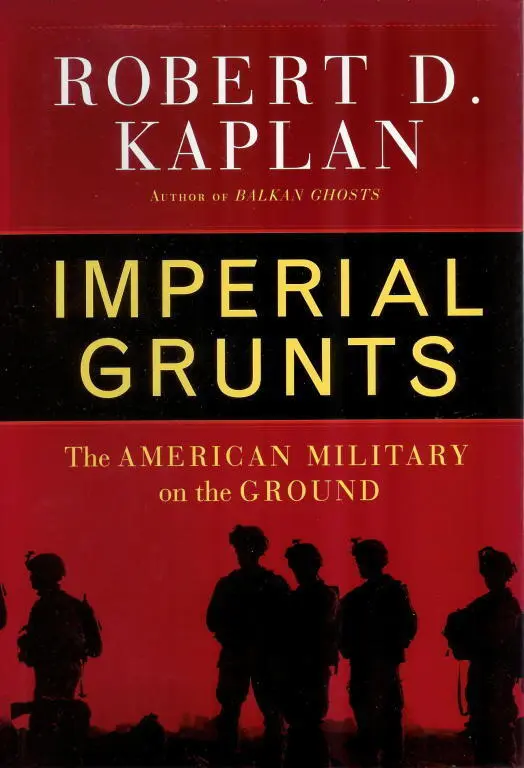
Robert Kaplan - Imperial Grunts
Здесь есть возможность читать онлайн «Robert Kaplan - Imperial Grunts» весь текст электронной книги совершенно бесплатно (целиком полную версию без сокращений). В некоторых случаях можно слушать аудио, скачать через торрент в формате fb2 и присутствует краткое содержание. Город: New York, Год выпуска: 2005, ISBN: 2005, Издательство: Random House, Жанр: Публицистика, nonf_military, на английском языке. Описание произведения, (предисловие) а так же отзывы посетителей доступны на портале библиотеки ЛибКат.
- Название:Imperial Grunts
- Автор:
- Издательство:Random House
- Жанр:
- Год:2005
- Город:New York
- ISBN:978-0-307-27850-0
- Рейтинг книги:5 / 5. Голосов: 1
-
Избранное:Добавить в избранное
- Отзывы:
-
Ваша оценка:
Imperial Grunts: краткое содержание, описание и аннотация
Предлагаем к чтению аннотацию, описание, краткое содержание или предисловие (зависит от того, что написал сам автор книги «Imperial Grunts»). Если вы не нашли необходимую информацию о книге — напишите в комментариях, мы постараемся отыскать её.
Imperial Grunts — читать онлайн бесплатно полную книгу (весь текст) целиком
Ниже представлен текст книги, разбитый по страницам. Система сохранения места последней прочитанной страницы, позволяет с удобством читать онлайн бесплатно книгу «Imperial Grunts», без необходимости каждый раз заново искать на чём Вы остановились. Поставьте закладку, и сможете в любой момент перейти на страницу, на которой закончили чтение.
Интервал:
Закладка:
The dress rehearsal in full kit took place at a mud fort. By the time we arrived everyone was so full of dust, it was as if we had been dipped in a sticky vat of flour. With six A-teams that would each split into two sections, it was like watching a complex work of art. The rehearsal began with “unasseting”—that is, leaving the helicopters—followed by “collapsing in on the target” and the “extraction piece.” There were various “button back” maneuvers in and around the compound walls. Rappelling up and down deep water wells while being pulled by an all-terrain vehicle that would come along on the Chinook was also practiced.
The 18 Echo, or commo specialist, in each unit communicated on five separate radio frequencies: the command network which linked the section leaders with Maj. Helms, two separate lines of communication for each section within each A-team, the air net to communicate with the Chinook and Black Hawk pilots, and a fire net to communicate with the Apache pilots for close air support.
The rehearsal was only the beginning of the buildup to Newark. In the afternoon came the “rock drill,” when little rocks were moved along a floor to review the mission pattern. The rock drill also went over the operations schedule, a list of several pages of small print that covered each detail of the mission as it was likely to progress, with various fragments built out for everything that might conceivably go wrong. During the rock drill it was decided to bring along two females from the 10th Mountain Division to body search and interrogate “ burka babes,” if that proved necessary.
Later on in the day, there was a separate rock drill, or back-brief, just for the section leaders, and a third drill for the helicopter pilots. During the section leaders’ back-brief, the chain of custody for the PUCs was rehearsed: how the PUCs would be transferred from the assault teams to the Army aviators; and how to manage “courtyard control” in the event of large numbers of women and children at the compound. At this meeting each building in the compound, of which there were aerial reconnaissance photos, was given a matrix number in case close air support was necessary. Included in the assault package was an Air Force embed, who carried over a hundred pounds of communication gear on his back, with no extra room for meals ready to eat or a sleeping bag even.
All this was for one operation, involving one MVT (middle-value target), the kind of operation that the battalion did all the time. It was no big deal. It was work.
The guys were not standoffish, as Lt. Col. Binford had warned they might be. In fact, I went through no sniff test at all. I learned later what had happened.
When the battalion found out there would be a journalist among them, there were rude complaints, another fucking left-wing journalist. Then an 18 Delta medic, Master Sgt. Corey Russ of Miami—whose family, he told me, were among the city’s early settlers in the 1920s—used the NIPRNET to check me out online. He downloaded some of my articles and pronounced me “okay” to the others.
Thus, I became immediately privy to what by now were familiar critiques:
The brass at Bagram is sucking too many resources with their helicopter trips. We can’t get enough aviation. Too many levels of decision management up there. It takes three days to get a CONOP approved; what a deterioration since autumn ’01. The moment there is something larger than a FOB [forward opertaing base], there is failure. If only the fucking Big Army hadn’t rewritten the UW [unconventional war] manual in the late 1970s. We don’t need any F-22s. We need more A-10s and AC-130s. The slower the plane, the better for CAS [close air support]. And we need to send out foot patrols, because even the firebases are too big. But the conventional generals are afraid of higher body counts—they suck up to the media. The Big Army doesn’t understand that force protection means force projection. They’re killing us in Iraq because they see that we’re scared. We need more civil affairs units down here. Just because southern Afghanistan is a war zone doesn’t mean you don’t build schools and dig wells at the same time that you’re fighting the bad guys; that’s the essence of unconventional war.
With all this in mind, it came as no surprise to anyone that Newark was postponed for twenty-four hours, because the helicopters had been reassigned elsewhere. Then it was postponed another twenty-four hours, because Bagram was having second thoughts about the whole operation.
Meanwhile, the cycle of presence patrols, cleaning equipment with compressed air hoses, and guard duty continued unabated. The 3rd Battalion of the 3rd Special Forces Group, with its seven A-teams consisting of only about eighty troops, garrisoned at a few far-flung firebases and backed up by two B-teams, had most of southern Afghanistan to cover. Lt. Col. Binford wanted to expand the battalion’s influence farther still, up to the Iranian border, by erecting firebases in Farah Province, west of Kandahar and Helmand.
I used the postponement of Newark to visit Kandahar and Firebase Gecko north of the city, which had been Mullah Omar’s base of operations before 5th Group captured it two years earlier.
Kandahar looked more primitive now than it had when I first saw it, in the autumn of 1973. It was still a pungent confection of dust and woodsmoke over broken-down streets, with few buildings more than one story high. A quarter century of war had left it as much a ruin as a proper city, crowded at dusk with trishaws and rickshaws squeezing themselves between a maze of crumbled mud walls. The water channels that had run thirty years before were now dry, and filled with dirt and garbage. All the women except for young girls were hidden under lapis-blue burkas. Kandahar had been the Taliban stronghold. It remained the most conservative city in Afghanistan, the rebuke to Kabul’s relative cosmopolitanism. It was strange, I thought, eyeing the ratty storefronts separated from each other by aspen poles, and the sidewalks crowded with foodstuffs in old cooking pots; elsewhere in the world, the cities I had seen in my youth had become mostly unrecognizable because of demographic growth, suburban sprawl, and globalization. Yet Kandahar stood still, inside a time capsule of unending conflict.
Beyond Kandahar to the north loomed a Planet of the Apes landscape of strangely shaped buttes and mesas, sweeping up from a bright yellow desert that appeared to have little depth, on account of the thin atmosphere and stagy plateau light. Here two A-teams and a B-team had turned Mullah Omar’s rambling fortress into a warren of sand barriers and concertina wire.
Mullah Omar’s fortress had been the first site objective of the War on Terrorism. At Firebase Gecko, as it was now called, I met Maj. Tony Dill of Pensacola, Florida, the base commander, yet another major with prematurely gray hair, who was at once super-articulate and physically capable—he had parachuted into a stadium during a NASCAR race in North Carolina. I didn’t realize when I said goodbye to Maj. Dill inside Mullah Omar’s private air-raid shelter that I would be seeing him again a few days later, under very different circumstances.
The next day I walked into the operations center for another briefing on the postponed Operation Newark. But rather than the usual personable atmosphere, everyone was sitting around silent, with long faces, listening intently to scratchy voices coming over the command net.
A presence patrol manned by ODA-371, working out of Firebase Gereshk, to the west of Kandahar in Helmand Province, had been “engaged” by anti-coalition militia, and close air support had been called in.
“Are there casualties?” a voice asked.
Читать дальшеИнтервал:
Закладка:
Похожие книги на «Imperial Grunts»
Представляем Вашему вниманию похожие книги на «Imperial Grunts» списком для выбора. Мы отобрали схожую по названию и смыслу литературу в надежде предоставить читателям больше вариантов отыскать новые, интересные, ещё непрочитанные произведения.







Обсуждение, отзывы о книге «Imperial Grunts» и просто собственные мнения читателей. Оставьте ваши комментарии, напишите, что Вы думаете о произведении, его смысле или главных героях. Укажите что конкретно понравилось, а что нет, и почему Вы так считаете.