Robert Kaplan - Imperial Grunts
Здесь есть возможность читать онлайн «Robert Kaplan - Imperial Grunts» весь текст электронной книги совершенно бесплатно (целиком полную версию без сокращений). В некоторых случаях можно слушать аудио, скачать через торрент в формате fb2 и присутствует краткое содержание. Город: New York, Год выпуска: 2005, ISBN: 2005, Издательство: Random House, Жанр: Публицистика, nonf_military, на английском языке. Описание произведения, (предисловие) а так же отзывы посетителей доступны на портале библиотеки ЛибКат.
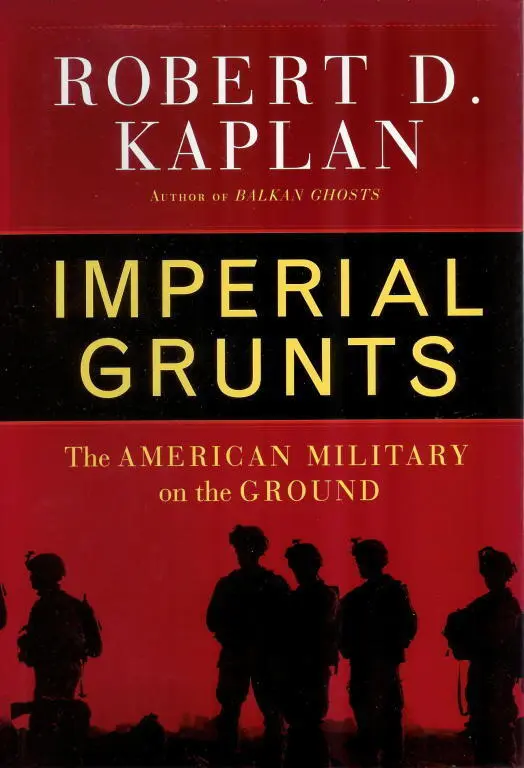
- Название:Imperial Grunts
- Автор:
- Издательство:Random House
- Жанр:
- Год:2005
- Город:New York
- ISBN:978-0-307-27850-0
- Рейтинг книги:5 / 5. Голосов: 1
-
Избранное:Добавить в избранное
- Отзывы:
-
Ваша оценка:
Imperial Grunts: краткое содержание, описание и аннотация
Предлагаем к чтению аннотацию, описание, краткое содержание или предисловие (зависит от того, что написал сам автор книги «Imperial Grunts»). Если вы не нашли необходимую информацию о книге — напишите в комментариях, мы постараемся отыскать её.
Imperial Grunts — читать онлайн бесплатно полную книгу (весь текст) целиком
Ниже представлен текст книги, разбитый по страницам. Система сохранения места последней прочитанной страницы, позволяет с удобством читать онлайн бесплатно книгу «Imperial Grunts», без необходимости каждый раз заново искать на чём Вы остановились. Поставьте закладку, и сможете в любой момент перейти на страницу, на которой закончили чтение.
Интервал:
Закладка:
Alas, the mission with which Lt. Col. Custer was helping Maj. Holiday had been altered and stripped of its teeth by Bagram. What had begun as a hit against an important “bad guy” was transformed into just another presence patrol.
Chief Augustus, another of the warrant officers, provided the background to a crowded chow hall: The CJTF-180 informed President Karzai of the plan to hit Maulvi Jalani’s compound. Karzai then told the CJTF-180 to wait; he wanted to try to reason with Jalani. Karzai told Jalani to start behaving or the Americans would punish him. But American intelligence indicated that Jalani, rather than heed Karzai, turned around and told the police at Sayed Kurram to get out of town, or he would kill them. Nevertheless, the CJTF-180 approved only a presence patrol to Sayed Kurram, with only twelve Green Berets. When Maj. Holiday indicated that was too small a number to have on hand in the event of an attack, the CJTF-180 said that the number of Green Berets might be increased to twenty-two, but this enlarged patrol was authorized to circle the town only, and stay far from Jalani’s compound.
The route we took to Sayed Kurram was different from the one we had taken there on the previous patrol. We drove up a wadi bed into gray draperies of hills, tinged purple at the edges and bearded with scrub pine. The whole vista, noted Cpl. Dan Johnston, reminded him of hunting trips to Wyoming. Here and there groups of Afghans would emerge from a village and smile at us.
“The Afghans are just great,” one soldier said. “They’re unfazed by anything, unimpressed, just themselves.”
“Yeah, they love guns and love to fight. All they need are trailer parks and beer and they’ll be just like us,” said another.
The convoy descended from the mountains through cannabis fields and newly tilled poppy plantations. A massive mud-walled fort with Turkic-style towers loomed in the distance, with marijuana leaves drying on its ramparts. I thought of the poppy fields before the Emerald City in The Wizard of Oz.
We halted in the middle of the road, in front of what looked like a mine. It wasn’t. But the halt led us to a local Afghan intelligence officer, who invited me, one of the counterintelligence guys, and two other Green Berets into his house for green tea, while the rest of the convoy stood guard outside. He served the tea in a carpeted room heated by a dung-fired stove, with aspen beams overhead. I stared at the dust drifting into the tea. The Green Beret from counterintelligence engaged our host in the same kind of conversation that journalists have all the time with their sources, so I felt comfortable joining in.
The journalist and the intelligence officer have different audiences to please: that of the intelligence officer is smaller, narrower in vision, more elite in knowledge, and more technical in scope. But their methods are often similar: get to know someone, get him talking, and some of the truth may dribble out—more truth than if you asked a direct question. You don’t question people so much as hang out with them, and get to know them on their own terms. So the counterintelligence guy and I took turns with the man.
The man eventually told us of Maulvi Jalani’s informal alliance with the former mujahedin leader in Paktia and Khost, Jalaluddin Haqqani, and of the opium profits that were funding the Islamic opposition to Karzai. He believed that the Taliban would not return to power. As pessimistic analyses went, that one was simplistic, he implied. More likely was the coalescing of an Iranian-brokered coalition of anti-American and anti-Karzai forces to include Haqqani, Hekmatyar, and other radical ex-mujahedin leaders, along with disaffected elements of the Northern Alliance, some remnants of the Taliban, and al-Qaeda.
The man wanted us to stay for a meal, but we politely declined, as we had hours of traveling ahead. As usual, the map was useless. The dendritic pattern of dirt roads dissolved into incomprehensibility, so that we found ourselves—in spite of the orders from Bagram—driving smack into the center of Sayed Kurram near Jalani’s compound, amid the sickly sweet smells of mint and hashish.
The idea that the CJTF-180 could determine what roads we turned down, in a land where roads were virtually nonexistent, suddenly struck me as ludicrous. Twenty-first-century communications technology worked toward centralization of command, and thus toward micro-management. But the War on Terrorism would be won only by adapting the garrison tactics of the nineteenth century, in which lower-level officers in the field forged policy as they saw fit. Meanwhile, Custer and Holiday were like the ablative tiles on the bottom of the space shuttle, absorbing the bureaucratic heat for everyone. As it turned out, though we had driven right next to Jalani’s compound, nobody challenged us. [54] Some weeks later, Special Forces finally got permission for a direct hit on Jalani’s compound. Because it was part of a larger, more conventional offensive, Jalani might have been tipped off in advance and was not found at the compound. The intelligence provided to Special Forces indicated that there were no noncombatants inside, but there was a heavy machine gun which could have destroyed the U.S. helicopters taking part in the mission. Tragically, the intelligence was wrong—there was a group of children in the compound who were killed in the attack. Special Forces captured large amounts of explosives in the attack. Because of the attack, many people in the area began turning in their arms caches for destruction. Among the items recovered were five complete, functional SA-7 portable surface-to-air missiles.
The following evening, approval came for a hit near Gardez. Rather than wait, an eleven-vehicle convoy was immediately stood up, and around 9 p.m. we were off. By now I had been on enough raids to know the drill, so after the compound was hit, I drifted away from my assigned vehicle in the dark and proceeded inside the compound itself, to see how the search was progressing. By the outer gate, I ran into Cpl. Johnston, who lent me his night optical devices for a moment.
“Look up into the sky, you won’t believe it,” he said.
In the Philippines, I had never thought to do that with them. It was a revelation: what you might imagine seeing through a high-powered telescope. The sky was crowded with several times more stars than before.
I returned to reality in the courtyard, where several Green Berets were searching with flashlights for two grenades that one of the occupants had just thrown at them and that hadn’t gone off. “Watch where you walk,” I was warned. Along the courtyard were darkened rooms, illuminated by blue Chemlites that the Green Berets had left, to indicate which rooms had already been cleared. Inside the house, I peeked into a room where two Green Berets were kneeling on a carpet, going over a pile of documents they had found with a flashlight, being careful not to wake two children who miraculously were sleeping through all this mayhem.
Upstairs, the roof gave on to another series of rooms, where I watched Lt. Col. Custer go through several strongboxes with a bolt cutter. He found soaps, candies, cheap calico cloths, and other family possessions that only to us seemed meager and without value.
As I left the compound, I noticed a counterintelligence officer interrogating one of the male inhabitants. They were both squatting against a section of mud wall illuminated by flashlights attached to the M-4s held by other Green Berets, who had formed a semicircle around the Afghan. He had a long white beard and brown hood over his pakol. He looked stoic, unafraid. The counterintelligence officer was asking him simple, stock questions in English: Had he seen anything suspicious? Who were his friends?
Читать дальшеИнтервал:
Закладка:
Похожие книги на «Imperial Grunts»
Представляем Вашему вниманию похожие книги на «Imperial Grunts» списком для выбора. Мы отобрали схожую по названию и смыслу литературу в надежде предоставить читателям больше вариантов отыскать новые, интересные, ещё непрочитанные произведения.







Обсуждение, отзывы о книге «Imperial Grunts» и просто собственные мнения читателей. Оставьте ваши комментарии, напишите, что Вы думаете о произведении, его смысле или главных героях. Укажите что конкретно понравилось, а что нет, и почему Вы так считаете.