Robert Kaplan - Imperial Grunts
Здесь есть возможность читать онлайн «Robert Kaplan - Imperial Grunts» весь текст электронной книги совершенно бесплатно (целиком полную версию без сокращений). В некоторых случаях можно слушать аудио, скачать через торрент в формате fb2 и присутствует краткое содержание. Город: New York, Год выпуска: 2005, ISBN: 2005, Издательство: Random House, Жанр: Публицистика, nonf_military, на английском языке. Описание произведения, (предисловие) а так же отзывы посетителей доступны на портале библиотеки ЛибКат.
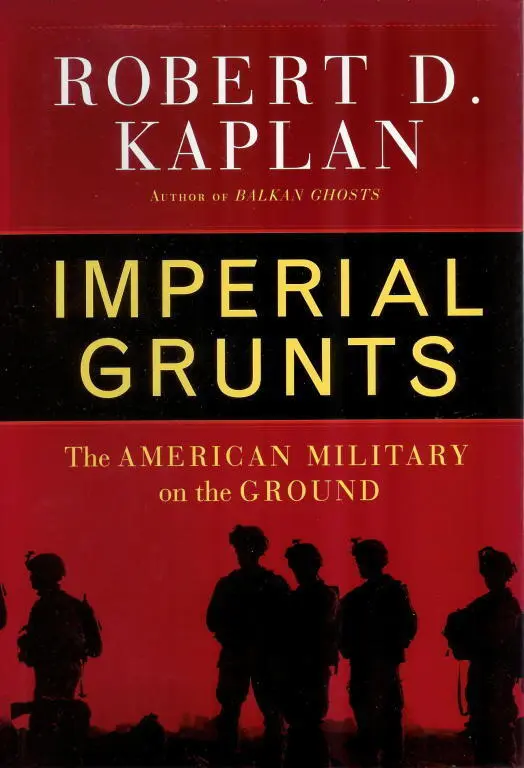
- Название:Imperial Grunts
- Автор:
- Издательство:Random House
- Жанр:
- Год:2005
- Город:New York
- ISBN:978-0-307-27850-0
- Рейтинг книги:5 / 5. Голосов: 1
-
Избранное:Добавить в избранное
- Отзывы:
-
Ваша оценка:
Imperial Grunts: краткое содержание, описание и аннотация
Предлагаем к чтению аннотацию, описание, краткое содержание или предисловие (зависит от того, что написал сам автор книги «Imperial Grunts»). Если вы не нашли необходимую информацию о книге — напишите в комментариях, мы постараемся отыскать её.
Imperial Grunts — читать онлайн бесплатно полную книгу (весь текст) целиком
Ниже представлен текст книги, разбитый по страницам. Система сохранения места последней прочитанной страницы, позволяет с удобством читать онлайн бесплатно книгу «Imperial Grunts», без необходимости каждый раз заново искать на чём Вы остановились. Поставьте закладку, и сможете в любой момент перейти на страницу, на которой закончили чтение.
Интервал:
Закладка:
Outside the sand barriers, the eight-vehicle convoy halted on the road. After five minutes had passed, one of the gunners peered up at the front of the convoy and proclaimed in a bored, knowing manner: “A cluster fuck. That’s what they call this in proper English. They’re waiting for final approval by radio from Bagram, even though the mission was chopped last night. Too many fucking layers. Too many chiefs, not enough Indians,” he said, as though stealing Lt. Col. Custer’s thoughts. “Bureaucracy. Big Government,” he went on. “By the time we get moving, every Afghan for miles will know we’re going to hit a compound. Fuck.”
Passing through Gardez we were mobbed by cheering kids—a good
sign. Two years on, the Americans were still welcome in Afghanistan. “Thank you,” they kept saying in heavily accented English. We drove through the grit for almost two hours, till we had passed Zurmat. Our skins were like dirty brown shrouds. Five minutes out from the compound a piss break was declared. “A leak in the moondust—the rigors of modern warfare,” somebody muttered.
Two compounds were to be hit. Elements of the Afghan National Army and the 10th Mountain Division would man the roadblocks. I was impressed with the efficiency of the ANA soldiers; they moved quickly out of the backs of the vehicles and set up fields of fire in the rice fields. I jumped out of the ground mobility vehicle with Sgt. First Class Cormac Meiners of Raleigh, North Carolina, and followed him along a chain of mud walls inside one of the compounds. There was absolute silence.
It was a typical Pushtun fortress housing several families. In the courtyard lay a vegetable plot and a peach and apricot orchard. Against one wall, near the firewood, stood a bunch of cows decked out with ornamental bangles. The lower level of the rambling mudbrick house was reserved for the animals and for the food stores. The families lived on the upper level, a world of oriental carpets with pillow-lined walls and blankets piled in the corners. We passed through the empty underground storage rooms and stomped with our boots on the carpets upstairs, found nothing suspicious, and were faced with the anxious stares of the women and children in tribal robes. Sgt. Meiners told me, “This is like a bad Vietnam War movie.”
“What can we do not to offend them culturally?” Sgt. First Class Steve Outlaw of Tallahassee, Florida, asked when it became clear that this place was a dry hole. After handing candies to the kids, the Green Berets cleaned their soles before walking on more carpets. The man of the house had been one of the detainees snatched earlier by Sgt. Peraza’s team. “We should have hit this place several days ago,” said one soldier, complaining about the delay getting the con-op approved.
Only two rifles were found: an AK-47 and a Chinese-manufactured SKS. The women protested that they needed the rifles to defend themselves. After all, there was no law here of any kind, and such rifles were quite common in Afghanistan. A discussion ensued. They were allowed to keep one rifle. The other would be turned in to the office of the provincial governor and could be reclaimed later, which I certainly did not believe. To win hearts and minds, they should have let the family keep both of the guns.
There had been more success at the other compound, though. Passports and a large quantity of arms and cash were found. A boy came over to us and said that he had seen large numbers of rocket-propelled grenades and other weapons stashed in a third compound. A GPS grid was taken of this third compound, but it couldn’t be hit until a 5-W or con-op was submitted and approved. “By that time the weapons will have been moved,” one Green Beret told me. “The thing that is really worth doing today we’re not allowed to do.”
Between patrols I read, did laundry, practiced shooting at the range, observed the mechanics at work on the vehicles, and listened to life stories. Not everyone was a law enforcement officer or fireman. One of the 18 Delta medics was a nurse practitioner, another a museum manager, another—as he put it—“practiced law to support my SF habit,” and another had two post-graduate degrees and three ex-wives. Quite a few had drifted from one unsatisfying job to the next, and only truly found their métier after 9/11, when they started being called up for duty on an almost permanent basis.
One night, after the moon had gone and it was so black that shooting stars were everywhere, and Mars was particularly prominent in the sky, I was talking to Sgt. Dave Kellerman of Fort Lauderdale, Florida, an air marshal in civilian life. His nineteen-year-old son had recently been awarded a Bronze Star for valor in Iraq, for taking out a machine gun nest while serving with the 3rd Infantry Division. He recited the citation to me by heart almost. “I was so proud, chills still go up my spine,” he said. “What more could a father ever want of a son?”
Everyone was a gun aficionado, especially Lt. Col. Custer. The morning after I spoke with Sgt. Kellerman, Lt. Col. Custer took me inside the secured room that held the confiscated firearms: a true dog’s breakfast of vintage weaponry, with stacks of rusty chambers and rotting wooden stocks. There were pre–World War I British-built Lee-Enfields, French-built Mosin-Nagants issued to the czarist army, a variety of Russian medium machine guns from both world wars, and so on, all still in use in Afghanistan.
I took one of the oldest Lee-Enfields, known as the SMLE or Smelly (Short Magazine Lee-Enfield), to the range for a hands-on history lesson. What a revolution in weaponry it was! With its “cock-on closing” bolt and stripper clip innovation, this Lee-Enfield could fire almost as fast as today’s semi-automatics. “It could drop a man at four hundred yards all day long,” Custer said enthusiastically. Yet it was the Soviet-manufactured Kalashnikov assault rifle that truly got the lieutenant colonel going; after he had taken hold of one of the AK-47s and briefed me on every part, I realized that you might learn as much about a culture from its weaponry as you could from its literature.
As Custer demonstrated, while stripping the AK-47 down to its constituent parts, it was a rifle designed for use by fifteen-year-old illiterates whose life was valued cheaply by the designer. “Illiterates won’t clean a gun, or at least not meticulously, so the parts are measured to fit loosely. That way the gun won’t jam when it’s filthy with grime. But it also makes the AK-47 less accurate than our M-16s and M-4s, which have tight-fitting parts and must be constantly cleaned. And because illiterate peasants aim less precisely,” he continued, “the lever of the AK-47 goes from safety directly to full automatic, for spraying a field with fire. With our rifles, the lever rests on semi-automatic before it goes to full auto.”
The sites on the Russian rifle could not be adjusted for greater accuracy, unlike on American rifles. The Kalashnikov had a bullet magazine that had to be gripped before it could be released, so it wouldn’t be lost in the dirt, because magazines were dear in the old U.S.S.R. That made changing magazines slower, and thus further endangered the life of the soldier in combat. In the old Soviet Union, soldiers were more easily expendable than bullet magazines. By contrast, American magazines dropped onto the ground and could be lost, but it made for a faster, more fluent performance by the rifleman.
“The M-4 can hit a man at several hundred yards every time,” Custer explained. “The AK-47 is more of an area weapon. We value our soldiers as individuals with precision skills; the Russians see only a mass peasant army.”
Custer also observed the evolution of the bullet over the just-departed century, from the “30-odd-6” (.30-06 caliber, or 7.62mm) in the 1890s to the smaller, sleeker 5.56mm. The manufacturers had learned that smaller bullets were faster, and with just a little increase in velocity you got a disproportionate increase in force at impact. Smaller bullets were also lighter, and thus the individual soldier could carry more along with him onto the battlefield. This was Progress.
Читать дальшеИнтервал:
Закладка:
Похожие книги на «Imperial Grunts»
Представляем Вашему вниманию похожие книги на «Imperial Grunts» списком для выбора. Мы отобрали схожую по названию и смыслу литературу в надежде предоставить читателям больше вариантов отыскать новые, интересные, ещё непрочитанные произведения.







Обсуждение, отзывы о книге «Imperial Grunts» и просто собственные мнения читателей. Оставьте ваши комментарии, напишите, что Вы думаете о произведении, его смысле или главных героях. Укажите что конкретно понравилось, а что нет, и почему Вы так считаете.