Robert Kaplan - Imperial Grunts
Здесь есть возможность читать онлайн «Robert Kaplan - Imperial Grunts» весь текст электронной книги совершенно бесплатно (целиком полную версию без сокращений). В некоторых случаях можно слушать аудио, скачать через торрент в формате fb2 и присутствует краткое содержание. Город: New York, Год выпуска: 2005, ISBN: 2005, Издательство: Random House, Жанр: Публицистика, nonf_military, на английском языке. Описание произведения, (предисловие) а так же отзывы посетителей доступны на портале библиотеки ЛибКат.
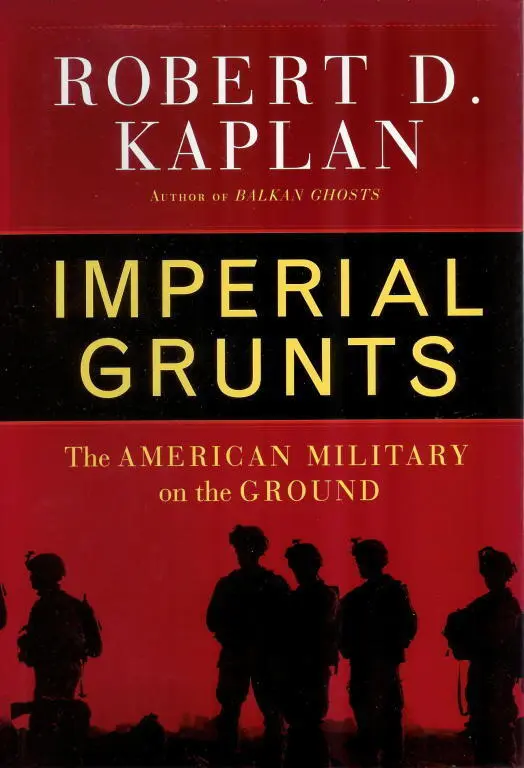
- Название:Imperial Grunts
- Автор:
- Издательство:Random House
- Жанр:
- Год:2005
- Город:New York
- ISBN:978-0-307-27850-0
- Рейтинг книги:5 / 5. Голосов: 1
-
Избранное:Добавить в избранное
- Отзывы:
-
Ваша оценка:
Imperial Grunts: краткое содержание, описание и аннотация
Предлагаем к чтению аннотацию, описание, краткое содержание или предисловие (зависит от того, что написал сам автор книги «Imperial Grunts»). Если вы не нашли необходимую информацию о книге — напишите в комментариях, мы постараемся отыскать её.
Imperial Grunts — читать онлайн бесплатно полную книгу (весь текст) целиком
Ниже представлен текст книги, разбитый по страницам. Система сохранения места последней прочитанной страницы, позволяет с удобством читать онлайн бесплатно книгу «Imperial Grunts», без необходимости каждый раз заново искать на чём Вы остановились. Поставьте закладку, и сможете в любой момент перейти на страницу, на которой закончили чтение.
Интервал:
Закладка:
Fremling commented, “We won’t get back to the base till dark. It’ll be an entire day with a convoy just to keep one contractor honest. But that’s what a lot of these days are like. The road is gone, the school is far from done. People at home have no idea how difficult the conditions are here.” I thought of a remark by a late-nineteenth-century British army colonel, C. E. Callwell, that small wars are “campaigns against nature.” 14
Everything was possible in Afghanistan—with years and patience. The empires that had succeeded in bringing order and a better material life to their colonies had had both of those elements. But it was unclear if the Americans did. A decade-long presence in Afghanistan was not a pessimistic scenario, but an optimistic one.
“We represent the Karzai government,” one of the American soldiers said through a terp, as locals gathered around him. “We’re trying to get this school built for you.” Looking at the villagers with their beards and turbans, and their dead eyes and blank expressions, the fellow from the Department of Agriculture—his gnarled, tanned face caked in dust—quietly remarked: “They have loyalty to no one beyond their tribe. They are easily bent and intimidated by whoever the power happens to be at the moment. They just want to be left alone.” We were nothing to them.
On the way back we took another route—never establish patterns, never use the same route twice. This route was much faster, and dustier, if that was possible—a veritable ocean of red and mustard yellow powder, broken only by heaps of black boulders.
Returning after dark I checked in on Col. Tony Hunter, a reservist from South Kansas City, Missouri, who commanded the Gardez PRT out of the 10th Mountain fort. A police officer in civilian life, he was tall, with short gray hair and a conventionally rugged appearance. He provided more background about the PRTs.
“The PRT concept was the brainchild of the CJTF-180 staff,” he told me, spitting tobacco juice into a bottle in his hootch. “It was invented to extend the power of the provincial governments. President Karzai had said he wanted it started in Gardez, where there was a high Taliban population and a lot of tribal conflict close to the border with Pakistan. So in December 2002 we stood up four PRT teams.
“Basically,” Col. Hunter went on, “the PRT is an Army civil affairs unit that is remoted out, and employs either the 10th Mountain or the 82nd Airborne for base security, depending upon the deployment. The PRT uses humanitarian aid money provided by DOD [the Department of Defense]. It gives us influence without the stigma of occupation. The goal is to civilianize the PRTs by embedding reps from the State Department and USAID.
“You saw the road today,” he went on, continuing to spit tobacco. “You saw how bad and difficult it was. A lot of the world is like that. That’s why aviation assets will be critical for the future. There will also be a huge need for desert-worthy vehicles for this kind of stuff. We’re finding that Toyotas are better than Humvees, and that the commercially sold phones are better than the military-issue ones. We’re learning how to adapt to this new world in a low-tech style. Sure, we lose two people a week here in combat. It’s the price of doing good work.”
When I left Col. Hunter it was completely dark, with no moon out yet. Taking out my red-tinted flashlight to negotiate my way back to the Special Forces fort, I noticed small groups of soldiers holding Christian services with candles under the stars. It was not a holiday—it was something they did every night. Back at the fort, I learned that I had to move tents, as mine was being readied for a team of Navy SEALs arriving the next day for a hit. I moved in with the 7th Group Puerto Ricans, who had extra blankets and a liner for my sleeping bag.
The next morning the Green Berets kitted up for another presence patrol, this time down a road known as “sniper alley” near the Pakistan border. One sergeant downloaded the route from a computer into his GPS device. It was so dusty that Alex, one of the 7th Group advisors from Puerto Rico, had to clean not only his M-4, but his magazine loader too. Alex’s father and grandfather had fought in Vietnam and Korea, respectively. “We Puerto Ricans have done our share,” he remarked good-naturedly.
The mission brief was at 9:30 a.m. “Watch the fucking ridgelines,” warned Ed, a police officer from Dade County, Florida, with a gray beard, friendly eyes, and a permanent out-of-bed look. “It can get ugly quick. Decide in advance who the second driver will be if the driver is hit. Every vehicle is responsible for the one in front.”
I had a seat in the up-armor driven by team Master Sgt. Henry Peraza, a jocular, dark-complexioned Cuban-American who complained in jest about “white boys” who didn’t look Pushtun enough. My job was to feed ammunition to the gunner riding on top in case we were ambushed. Forget about keeping my professional distance. With this bunch, either you helped out or you didn’t go along.
“Practice feeding that ammo, Bob,” another one of the 7th Group advisors told me. “I will probably run out of ammo, because I’m going to let ’em know just who we are.”
I noticed that there were now three American flags flying atop the fort. “What for?” I asked.
“We get more patriotic by the day,” someone said.
Another soldier was cleaning his MK-19 .40-caliber auto grenade launcher on a makeshift table. “It’s a labor of love,” he told me. “It’s like a wife or girlfriend. You put all your passion into it, then you move on to the next one and forget.” It was an unwritten law, particularly among those from the National Guard, that you needed to have at least one ex-wife to qualify for membership in the Special Forces community. I recall one conversation between a colonel and a sergeant:
“Son, where is the rest of your body armor? Do you want to be killed?”
“Well, sir, according to my alimony settlements, my first ex-wife gets half my retirement income, and the second gets the other half. So I’m not sure.”
I put on my body armor and stuffed my cargo pockets with earplugs, Power Bars, and small mineral water bottles. But just as we were ready to leave the compound, the mission was put on hold. A medium-value target had just been positively identified walking into a meeting with the supposedly pro-American provincial governor of Gardez, and the decision was made to PUC him. The presence patrol was canceled in favor of this operation.
Ed, the Dade County policeman, did a “drive-by,” checking out the location where the snatch would occur. “The alleys are real narrow; we can’t use Humvees. There are lots of kids hanging around; bring Power Bars.” Instead of Humvees, two Toyota Land Cruisers were dispatched, with Master Sgt. Henry Peraza driving the lead car. Peraza wore a shalwar kameez, pakol, and deshmal with body armor underneath. On close inspection this dark-complexioned Cuban-American really didn’t look Pushtun. But for a moment or two he could fool anybody, and that was all the time that was needed.
Because only two cars went on the snatch, the rest of us suddenly had nothing to do, and people zoned out in the chow hall watching a really bad science fiction movie.
The Land Cruisers returned several hours later with four PUCs. Peraza and his crew had spent most of their time waiting around, talking to street kids, after they had decided to set up a roadblock in typical state trooper style. “Did they resist?” someone asked. “No,” Master Sgt. Peraza said. “Their hands shot up over their heads like jack-in-the-boxes.”
The PUCs were brought to a detention facility behind the fort. They were low-priority detainees. After a few days they either had to be released or sent up to Bagram for a higher level of interrogation. In Bagram they could be held only a short period as well, before they were either sent home or on to Guantánamo Bay, Cuba. You could wake them every few hours, disorient them, but that was about it. Well-documented accounts of prisoner abuse by Americans notwithstanding, prisoners knew that in the vast majority of cases the Americans would not mistreat them nearly to the degree that the Soviets and other Afghans had. Usually, an Afghan willing to be uncomfortable for a few days could stiff the American interrogators with impunity. Everyone complained about this.
Читать дальшеИнтервал:
Закладка:
Похожие книги на «Imperial Grunts»
Представляем Вашему вниманию похожие книги на «Imperial Grunts» списком для выбора. Мы отобрали схожую по названию и смыслу литературу в надежде предоставить читателям больше вариантов отыскать новые, интересные, ещё непрочитанные произведения.




Обсуждение, отзывы о книге «Imperial Grunts» и просто собственные мнения читателей. Оставьте ваши комментарии, напишите, что Вы думаете о произведении, его смысле или главных героях. Укажите что конкретно понравилось, а что нет, и почему Вы так считаете.