Robert Kaplan - Imperial Grunts
Здесь есть возможность читать онлайн «Robert Kaplan - Imperial Grunts» весь текст электронной книги совершенно бесплатно (целиком полную версию без сокращений). В некоторых случаях можно слушать аудио, скачать через торрент в формате fb2 и присутствует краткое содержание. Город: New York, Год выпуска: 2005, ISBN: 2005, Издательство: Random House, Жанр: Публицистика, nonf_military, на английском языке. Описание произведения, (предисловие) а так же отзывы посетителей доступны на портале библиотеки ЛибКат.
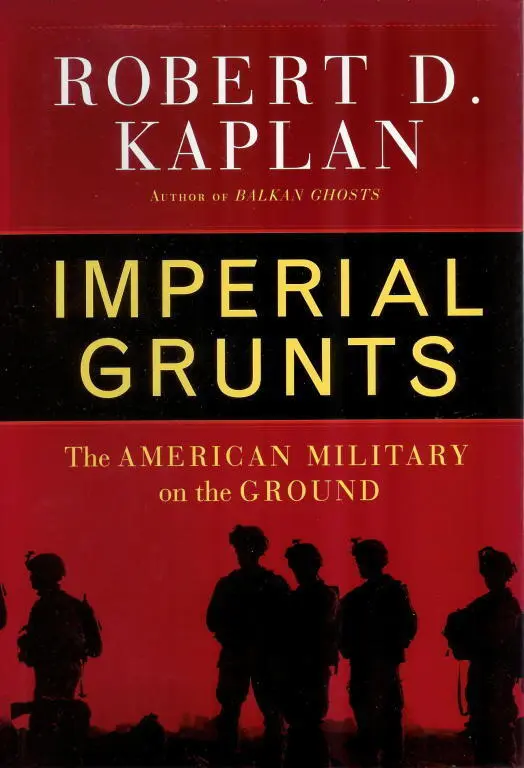
- Название:Imperial Grunts
- Автор:
- Издательство:Random House
- Жанр:
- Год:2005
- Город:New York
- ISBN:978-0-307-27850-0
- Рейтинг книги:5 / 5. Голосов: 1
-
Избранное:Добавить в избранное
- Отзывы:
-
Ваша оценка:
Imperial Grunts: краткое содержание, описание и аннотация
Предлагаем к чтению аннотацию, описание, краткое содержание или предисловие (зависит от того, что написал сам автор книги «Imperial Grunts»). Если вы не нашли необходимую информацию о книге — напишите в комментариях, мы постараемся отыскать её.
Imperial Grunts — читать онлайн бесплатно полную книгу (весь текст) целиком
Ниже представлен текст книги, разбитый по страницам. Система сохранения места последней прочитанной страницы, позволяет с удобством читать онлайн бесплатно книгу «Imperial Grunts», без необходимости каждый раз заново искать на чём Вы остановились. Поставьте закладку, и сможете в любой момент перейти на страницу, на которой закончили чтение.
Интервал:
Закладка:
There was much chai consumption. Intelligence was best gathered not by asking direct questions, but simply by establishing relationships. The problem was that the counterintelligence guys spoke insufficient Pushtu and had to work through interpreters, making the conversations awkward. Two years into the War on Terrorism, the linguistic situation was a scandal. Only when the other Special Forces groups and representatives from other government agencies could converse with the locals in exotic languages to the degree that 7th Group was able to do in Spanish in Latin America would authentic human intelligence emerge in sufficient amounts.
The real labor began only after dark, when the convoy returned to the firebase: The Green Berets went over every inch of the vehicles and weaponry with compressed air hoses, to get rid of the corrosive dust. It took hours, and was essential after every patrol. U.S. Army vehicles were designed for the soft soil of Central Europe, where it was thought the Soviets would one day be confronted, not for the pulverized crust of the Near Eastern deserts. Mechanical problems were legion, and the mechanics were the true kings of the firebase, especially as the rocks and gravel of this wasteland ruined the suspension systems of the up-armors.
Very late at night we gathered on Bukharan carpets to share in a feast prepared by the local tribal militia, which included lamb kebab, savory pilaf with raisins, spicy dumplings, sweet melons, pomegranates, and so forth. “This is the only pleasure we have. The generals have taken away the rest,” one of the sergeants observed. “No beer, no porn, no nothing. If they knew about this meal with the militia they’d probably forbid this, too.”
In fact, morale was great, as everyone knew and privately admitted, fighting as they were al-Qaeda, the HIG, and “Johnnie Taliban.” Before going to bed, we stood around a potbellied stove to warm ourselves before diving under sleeping bags and blankets in the freezing desert night. “The dismal cold reminds me of deployments in Korea,” somebody said. “No, it’s better than Korea. We can break doors down and arrest people here,” another responded.
The next morning no patrol was scheduled. I had heard that the PRT (provincial reconstruction team) in the adjacent fort was going out on a mission, so I asked Chief Shorter if he would introduce me to the PRT guys. “They don’t think much of us bearded ones,” the chief warned, “but let’s go next door to the 10th Mountain hootch and see.” Going out with the PRT was no problem. I was on the road again.
The provincial reconstruction teams were a new and trendy concept in the autumn of 2003. The PRTs did the very things that the media loved: civil and humanitarian affairs—nation-building, that is. The PRTs were interagency, combining different military units and governmental departments into a single package. They constituted a recognition that in war zones the military, rather than the civilian charities (nongovernmental organizations), was best positioned to carry out civil affairs. The PRTs, while part of the conventional Army, represented a form of unconventional warfare, for humanitarian aid, besides winning “hearts and minds,” and thus breaking the link between the insurgents and the general population, was a useful cover for informal intelligence gathering. The global media was less comfortable with this aspect of the PRTs.
The PRT mission in which I took part was composed of the 407th Army Civil Affairs Battalion out of Arden Hills, Minnesota, a combat escort from the 10th Mountain Division, Afghan National Army troops, and interpreters. The State Department representative happened to be in Kabul that day, so the only civilian besides myself was a rugged leathery-skinned official from the U.S. Department of Agriculture, who with his bush hat reminded me of the Australian dinosaur hunter in the movie Jurassic Park.
We were six vehicles: two Toyota pickups and four scout trucks or Humvees, fitted with MK-19 automatic grenade launchers. The object was to drive south to a remote village in the Shah-i-Kot mountains near the Pakistan border, in order to inspect a school that was under construction. The journey was to take ninety minutes, according to the map. Maj. Dean Fremling, an Airborne Ranger from Milwaukee, was the mission commander. The brief he delivered was simple: “If we’re ambushed, lay down suppressing fire and keep moving. We’ll now have a last-minute piss break. We roll in ten.”
Ten minutes later we left the HESCO barriers behind us, and Maj. Fremling began telling me about Ranger school at Fort Benning in the same vein as Col. Wilhelm in Mongolia had done: “I have never been so cold, hot, thirsty, and tired in my whole life.” Dean Fremling was bald, hairless, utterly self-effacing, and forgettable looking. He was also lively, talkative, blessed with a great disposition, and full of interesting tales from Thailand, the Arctic, the Atlas Mountains of Morocco, the Costa Rican jungles, and elsewhere on the planet, where he had either gone on a deployment or as a tourist.
Passing an encampment of Kuchi nomads, he briefed me on a PRT program of vaccinating children and animals against disease. I worried that the Americans were being too altruistic; nobody aside from the people actually helped would know about such programs, even as high-profile projects with political payoffs, like rebuilding the ring road connecting the major cities, were behind schedule.
Next we passed a rock quarry where Maj. Fremling told me he had seen a group of Afghans chipping away with only one shovel. “They said they needed new rocks. No shit, in a wasteland of rocks they needed new ones. They explained that the old rocks had too much dust on them to be mortared. So they wanted new, clean rocks. I was able to get them some extra shovels.
“Stay on the goat trail,” Fremling continued, this time into the radio for the benefit of the other vehicles. “Goat shit means we’re safe from mines.” Then the major complained about his fair complexion and that of the rest of the team. “Most of us are of Scandinavian descent, so we can never blend in with the people of these war-torn countries. We’re not like the Puerto Ricans in 7th Group, who look like Pushtuns. There are no counterinsurgencies in Scandinavia.”
Fremling took out some Copenhagen chewing tobacco. The landscape got increasingly mountainous, so bare it resembled a child’s sandpit. The familiar squads of dark-haired young girls in flowing robes waved at us in a village. “FFN,” Fremling said, “Full facial nudity. That’s all there is here. But they’re not in school. The village elders give us all these excuses. The truth is that outside of the urban areas, most Afghans don’t want their girls to go to school.” I had heard similar reports from nonmilitary experts, too, who worried that the Americans were becoming resented by the Pushtun population for forcing their values upon it in regard to women’s rights.
A stream of clear blue water appeared suddenly out of the ashen wasteland. We gasped in appreciation. Then came more mud-walled fortresses with crumbling towers. The GPS device indicated that we were still far from the school; the road that appeared on the map had been washed away in a flash flood, so we just followed the wadi. One of the pickups could not make it up a hill. As it strained and belched black smoke, the driver said, “It ain’t got enough pony, it’s on its fifth radiator, poor girl.” It had to be yanked up with a chain at a forty-five-degree angle by a 10th Mountain Humvee. A few hours more of blowing moondust and we arrived at Babukhel, the site of the school. It had taken five and a half hours instead of one and a half. No one was surprised.
The school was supposed to have been 50 percent completed, according to the bill submitted by the Afghan NGO contractor. The foundation appeared finished, along with a security wall, but they were not built correctly, said an expert with the team. “They mixed too much dirt with the cement. One winter and this whole thing is done for. It’s not even 20 percent completed. And these are not our construction standards; we certainly don’t expect that—they’re theirs, the local standards.”
Читать дальшеИнтервал:
Закладка:
Похожие книги на «Imperial Grunts»
Представляем Вашему вниманию похожие книги на «Imperial Grunts» списком для выбора. Мы отобрали схожую по названию и смыслу литературу в надежде предоставить читателям больше вариантов отыскать новые, интересные, ещё непрочитанные произведения.





Обсуждение, отзывы о книге «Imperial Grunts» и просто собственные мнения читателей. Оставьте ваши комментарии, напишите, что Вы думаете о произведении, его смысле или главных героях. Укажите что конкретно понравилось, а что нет, и почему Вы так считаете.