Robert Kaplan - Imperial Grunts
Здесь есть возможность читать онлайн «Robert Kaplan - Imperial Grunts» весь текст электронной книги совершенно бесплатно (целиком полную версию без сокращений). В некоторых случаях можно слушать аудио, скачать через торрент в формате fb2 и присутствует краткое содержание. Город: New York, Год выпуска: 2005, ISBN: 2005, Издательство: Random House, Жанр: Публицистика, nonf_military, на английском языке. Описание произведения, (предисловие) а так же отзывы посетителей доступны на портале библиотеки ЛибКат.
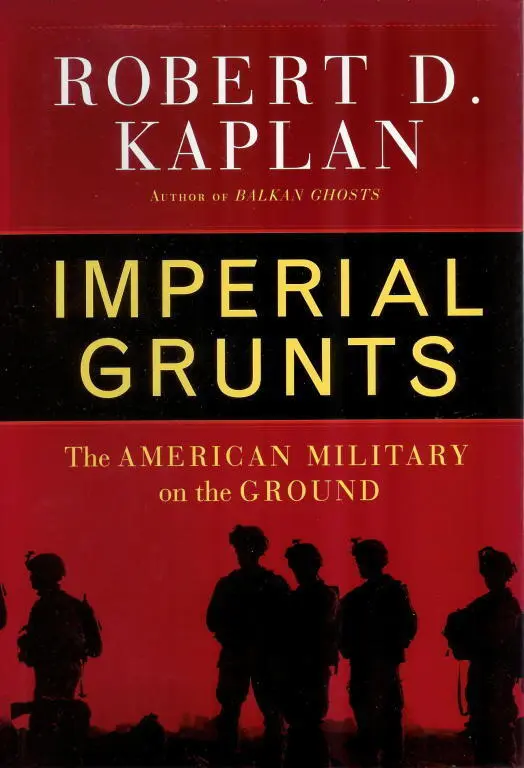
- Название:Imperial Grunts
- Автор:
- Издательство:Random House
- Жанр:
- Год:2005
- Город:New York
- ISBN:978-0-307-27850-0
- Рейтинг книги:5 / 5. Голосов: 1
-
Избранное:Добавить в избранное
- Отзывы:
-
Ваша оценка:
Imperial Grunts: краткое содержание, описание и аннотация
Предлагаем к чтению аннотацию, описание, краткое содержание или предисловие (зависит от того, что написал сам автор книги «Imperial Grunts»). Если вы не нашли необходимую информацию о книге — напишите в комментариях, мы постараемся отыскать её.
Imperial Grunts — читать онлайн бесплатно полную книгу (весь текст) целиком
Ниже представлен текст книги, разбитый по страницам. Система сохранения места последней прочитанной страницы, позволяет с удобством читать онлайн бесплатно книгу «Imperial Grunts», без необходимости каждый раз заново искать на чём Вы остановились. Поставьте закладку, и сможете в любой момент перейти на страницу, на которой закончили чтение.
Интервал:
Закладка:
Big Country pointed to a firetrap of a building housing a restaurant with private rooms, where he held talks with local informers. He took me to where local timber was loaded for transport to Pakistan; the Soviets had deliberately deforested large parts of Afghanistan to deny the mujahedin cover and concealment. The process was continuing, even though it had been outlawed by Karzai’s government. “This is the most corrupt place in town,” he said.
Returning to the firebase, Big Country pointed out a village where he had gone “for shits and giggles”—that is, to climb a mountain, inspect a minefield, and talk and drink chai (tea) with the hajis, the nickname that American military personnel had given the Afghans. I noticed that Big Country was great with the local kids, stopping the vehicle, shaking hands, talking to them at length, handing out Power Bars and other treats. He wasn’t deeply read in the country’s history or culture. By academic standards he was no area expert. He had simply glommed on to the language and treated people as people. Thus he was terrifically useful.
When I arrived back at the firebase, a convoy was preparing to leave on a “presence patrol” in the direction of the Pakistan border to the north. “Could I go along?” “No, too dangerous.” Then: “Wait, give us a minute.” Finally, a sergeant emerged from the operations center and told me to pack my gear, “Yeah, you can come along.”
I threw on my body armor—a flak vest with steel rifle plates—and grabbed my helmet and day pack, in which I stuffed some MREs and a sleeping bag, in the event we didn’t return by nightfall. Cpl. Dan Johnston, a counter-narcotics policeman from Lake Tahoe, Nevada, handed me a deshmal: “You’ll need it over your mouth and nose against the dust,” he said. [51] Johnston was one of a handful of 19th Group National Guardsmen at Gardez. Because 19th Group is Utah-based, its ranks are filled with westerners.
Knowing what to bring and what to leave behind was always problematic, something made worse by Bagram’s utter ignorance of conditions in the field. A public affairs spokesman for the CJTF-180 had told me I should “mentally prepare myself” to ruck many miles if I was to be embedded with Special Forces. But Special Forces, I learned upon arrival at Gardez, did very little rucking in Afghanistan. The desert terrain favored convoys, partly because you couldn’t carry enough water in your rucksack to sustain you. I had also been told that Gardez would be warmer than Bagram; it was colder. All I could do was keep filtering my gear. I left my computer and duffel bag behind at Bagram, and split my day pack off from my backpack when I left Gardez.
Another complication was the body armor which I could not take off during patrols, so it was impossible to remove layers of clothing as the day became hotter. With little vegetation to retain the heat, the temperature in Afghanistan dropped at night like the dark side of the moon. You had a choice: you could either freeze at night and in the dawn hours, or bake during the day. I chose to freeze at night.
We were a convoy of eight vehicles. There was one Toyota Land Cruiser filled with counterintelligence guys (the same category of Green Beret that in the Philippines had roamed the ports and whorehouses), two ground mobility vehicles fitted with M2 .50-caliber machine guns, and five up-armored Humvees: Humvees with reinforced roofs and doors and mounted guns that had the clunky look of World War II vehicles. I rode in the Land Cruiser with the counterintelligence guys.
Everyone carried M-4s and Berettas, while some of the 7th Group advisors had shotguns. “We’re a bunch of Kuchi nomads trolling for fire,” one of the counterintelligence guys remarked, referring to the funky, gypsy-like nomads whose tents littered the Afghanistan-Pakistan border area. He then organized the cassette music for the trip: Latin salsa and “Afghan road rage,” or “country eastern” as they called the local tunes. We flew two flags: an American flag on one of the up-armored Humvees and the Confederate flag on another. “It’s not a racist flag, it’s a flag of regional pride,” was the explanation I got.
One Green Beret on the convoy besides Chief Shorter was black, and he joked about the Confederate flag. He told me about a deployment he had had in South Africa. “The Zulus could not believe that I wasn’t one of them, or that I wasn’t from southern Sudan. I had a white Afrikaner translator with me, who explained to them in their tribal language where I was actually from. The irony that I could only talk to my African brothers through this so-called racist Afrikaner was not lost on me. Heck, the Afrikaners are just another African tribe, though their skin happens to be white.”
Within half an hour of leaving Gardez I was matted with dust and my day pack had turned from black to solid brown. I was fifty-one years old. Why was I doing this? I was full of doubt my last night amid the pampered luxury of Dubai. In Bagram, the night before flying to Gardez, I was again doubtful. But now the past and future, and every other place on the planet besides here, did not exist. I was living completely for the moment: the ultimate happiness. Every trip followed the same pattern.
The desert receded and we entered a string of villages with fruit orchards. Aspen and poplar trees lined berms, turning golden yellow in this Afghan autumn. Girls in spectacular ruby robes smiled and waved at us. There was an unbroken line of cannabis fields, with thick bunches of marijuana drying on rooftops and piled high in trucks. The guys who worked counter-narcotics in civilian life just loved it. They could not stop snapping pictures. They saw the idea of destroying these crops as sheer lunacy that would only mire the country in deeper poverty.
There were no houses as such, only immense mud-walled forts and compounds just like the firebase, each constituting a hidden maze within. We were in the territory of the Ahmadzai branch of the Pushtuns. Two or three compounds comprised a village, with only a narrow dirt alley separating one compound from another. This was the medieval architecture of paranoia and distrust, even as it provided relief from the wind and blowing dirt. The mid-twentieth-century expert on Afghanistan Louis Dupree had referred to such compounds as “mud curtains” that kept the outside world at bay, because the outside world usually came “to extract from, not bring anything into” these enclosed universes. They made Afghanistan an “inward-looking society.” 13The architecture made finding terrorists that much more difficult. “Bin Laden could be in one of these villages and we’d never find him,” one of the guys told me, completely serious, gazing at one mud-walled compound after another.
A few hours later we reached Sayed Kurram, less than twenty miles from the border with Pakistan, where there had just been fighting between the Mangal and Totakhel Pushtuns. You could tell if a village was friendly by the behavior of the children: if they came out and waved you were welcome; if they didn’t you weren’t. Silent streets meant trouble. The worst sign of trouble was if a convoy stopped and the kids slowly filtered away; it might mean an explosive device was about to go off. Special Forces troops always brought along extra Power Bars for the kids on these trips and took pictures with them—anything they could think of to break down barriers.
Sayed Kurram was somewhat friendly, judging by the handful of kids hanging around us. The counterintelligence guys took the lead in talking to the local police, and exchanging some flags and uniforms with them for the sake of goodwill. Presence patrols were not only a way for the Americans to demonstrate that they were here, but also to dissuade bad behavior. The patrols often went to the remotest locations for no other reason than to show that the bearded ones (as Special Forces was known locally) could go anywhere, anytime. The call on the chief of police at Sayed Kurram had a specific reason, though: to collect a stockpile of Soviet artillery and mortars that locals were willing to hand over. Explosives, ordnance, and demolition experts who had come along with the Green Berets took possession of the weapons and would later destroy them with C-4 explosives.
Читать дальшеИнтервал:
Закладка:
Похожие книги на «Imperial Grunts»
Представляем Вашему вниманию похожие книги на «Imperial Grunts» списком для выбора. Мы отобрали схожую по названию и смыслу литературу в надежде предоставить читателям больше вариантов отыскать новые, интересные, ещё непрочитанные произведения.


Обсуждение, отзывы о книге «Imperial Grunts» и просто собственные мнения читателей. Оставьте ваши комментарии, напишите, что Вы думаете о произведении, его смысле или главных героях. Укажите что конкретно понравилось, а что нет, и почему Вы так считаете.