Robert Kaplan - Imperial Grunts
Здесь есть возможность читать онлайн «Robert Kaplan - Imperial Grunts» весь текст электронной книги совершенно бесплатно (целиком полную версию без сокращений). В некоторых случаях можно слушать аудио, скачать через торрент в формате fb2 и присутствует краткое содержание. Город: New York, Год выпуска: 2005, ISBN: 2005, Издательство: Random House, Жанр: Публицистика, nonf_military, на английском языке. Описание произведения, (предисловие) а так же отзывы посетителей доступны на портале библиотеки ЛибКат.
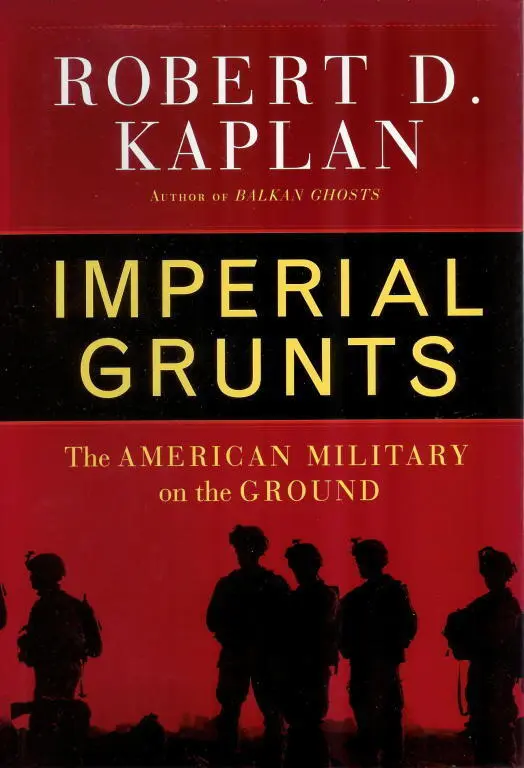
- Название:Imperial Grunts
- Автор:
- Издательство:Random House
- Жанр:
- Год:2005
- Город:New York
- ISBN:978-0-307-27850-0
- Рейтинг книги:5 / 5. Голосов: 1
-
Избранное:Добавить в избранное
- Отзывы:
-
Ваша оценка:
Imperial Grunts: краткое содержание, описание и аннотация
Предлагаем к чтению аннотацию, описание, краткое содержание или предисловие (зависит от того, что написал сам автор книги «Imperial Grunts»). Если вы не нашли необходимую информацию о книге — напишите в комментариях, мы постараемся отыскать её.
Imperial Grunts — читать онлайн бесплатно полную книгу (весь текст) целиком
Ниже представлен текст книги, разбитый по страницам. Система сохранения места последней прочитанной страницы, позволяет с удобством читать онлайн бесплатно книгу «Imperial Grunts», без необходимости каждый раз заново искать на чём Вы остановились. Поставьте закладку, и сможете в любой момент перейти на страницу, на которой закончили чтение.
Интервал:
Закладка:
“The north of Afghanistan is doing pretty well,” Col. Herd told me, “which in Afghanistan means that there’s not a lot of massive killing going on. In the north we can focus on political-economic activities.” The north, of course, was controlled by the Northern Alliance and by Ismael Khan and Abdul Rashid Dostum, two long-standing warlords. The south and the southeast, however, which were under President Karzai’s jurisdiction, Herd called “Injun Country,” where Special Operations had fifteen “Fort Apaches” of various sizes: “ ‘Firebases,’ we call them. From these firebases we try to spread peace and sunshine. The object is to seduce who we can and kill the rest. If we succeed, the political-economic stuff can follow like in the north.
“The enemy,” he went on, “is the Taliban, al-Qaeda, and the HIG [Hezb-i-Islami Gulbuddin, the Party of Islam faction led by Gulbuddin Hekmatyar]. Everything we do against these ACF [anti-coalition forces] is ‘by,’ ‘through,’ and ‘with’ the indigs [indigenous forces]. So we try always to have the ANA [Afghan National Army] with us, and we try to give the ANA the credit for what we do.”
The string of Special Operations firebases was mainly located in the vicinity of the Pakistani border region. Third Special Forces Group, supported by 19th Group Special Forces National Guardsmen, manned the firebases in southern Afghanistan, while those in the southeast were manned by 20th Group Guardsmen, helped by some 19th Group members and advisors from 7th Group. As I would be headed first to the southeast, I despaired that I would be mainly with National Guardsmen. Like most Americans, I was ignorant of a subculture of National Guardsmen which was tougher and more experienced than many active duty personnel.
I had a day to kill at Bagram before the helicopter flight to southeastern Afghanistan. I spent it with ODA-2027, a 20th Group National Guard A-team, currently in isolation with a thirty-man Afghan National Army contingent, preparing together for combat deployment. “You’ll love these guys,” Maj. Jeb Stewart, their commanding officer from northern California, told me. “They’re not into the politics of active duty. All they want to do is serve their country, though they’ll never talk about it.”
Isolation meant that they lived in the same compound with the Afghan soldiers. They fended for themselves, as if already deployed in the field. They had built their own shower unit and bought oriental carpets to decorate their hootch. “They say the compound is haunted,” one of the A-team members told me. “I hope the ghosts are naked females with big boobs.”
All of ODA-2027 were self-described “guard bums,” or “guard whores.” In civilian life most were law enforcement officers or firemen, though Capt. Bo Webb, the team’s executive officer from South Carolina, had been a real estate agent whose license had lapsed. A graduate of the Citadel, he had, nevertheless, risen through the enlisted ranks by attending Officer Candidate School at Fort Benning. He told me that the team was on a nine-month rotation, including a thirty-day ramp-up and a thirty-day demobilization at the end. Since 9/11 they had been mobilized two thirds of every year. But they had no complaints. They might have been the happiest A-team I had encountered thus far in my travels. And why not: they would be going into a war zone with sufficiently loose rules of engagement as to make A-teams in Colombia and the Philippines drool with envy.
They were mainly from northern Florida—the parts of the state known as “lower Alabama” and “lower Georgia,” not to be confused with southern Florida, whose large population of Latinos and retirees from the cold Northeast made it another culture entirely. “Orlando is the DMZ [demilitarized zone] between us and them,” Sgt. First Class Chris Grall, a counter-drug instructor for the Florida State Police, told me. He, Capt. Webb, and Team Sgt. Russ Freeman had all been members of ODA-2027 since 1996. “We’ve been together for much longer than most active duty SF teams,” Grall said. Indeed, whereas the Reserve represents the generic civilian world, the National Guard constitutes the Good Old Boys.
They had all been in the regular Army or Special Forces prior to entering civilian life. They ranged in age from the late twenties to the mid-thirties. Quite a few were sons of Vietnam veterans. They were avid NASCAR fans. In college football they had intense loyalties, rooting for either the University of Florida Gators or the Florida State Seminoles. They often ate southern: grits and biscuits with gravy for breakfast. Several were divorced at least once. They were all self-described “A” personalities. As Grall explained: “There is a guy in the unit who actually hates NASCAR, and another who hates college football. In our own weird way, we’re all individualists.
“It’s a great life being a guard bum,” Grall continued. “You get to see places tourists never do. We’re like tourists with guns.” Bosnia, Liberia, Panama, and Honduras were some of the places where 2027 had been deployed.
Kyle Harth, a particularly burly and friendly member of the team, told me this story: “I was in a bar in Naples, Florida. There was this guy even bigger than me wearing a Seminoles cap. What the heck, I thought. I told him, ‘That’s a pretty ugly cap you got on.’ ’Gator fan, uh,’ he replied. ‘Yeah,’ I said. Then he extends his hand and shows me his national championship ring. The guy had actually played for the Seminoles. Wow, I was impressed. But you know what, when he lies to people, I’ll bet you he tells them he does what I do.”
The truth about these guys was that while some had college degrees, and most had jobs to return to, they defined themselves by their membership in the National Guard and Special Forces, not by what they did in civilian life. September 11 had allowed them to come into their own, to truly define themselves, giving them a social status that they had not had before. Specifically, the War on Terrorism had provided them wider opportunities for merging their law enforcement skills with their Special Forces ones. In the 1990s they had all become fluent in Spanish, hoping to deploy to Cuba when Castro fell. That still hadn’t happened. So they were constantly pulling Dari and Pushtu dictionaries out of their cargo pockets, as they instructed Afghan soldiers in the intricacies of assaulting a fort. They ate with their Afghan trainees at lunch and socialized with them at night. While the media was full of lugubrious stories about the great sacrifices being made by reservists in Iraq and Afghanistan, these guys were having the time of their lives.
Maj. Jeb Stewart had called these guys the ultimate patriots. In fact, they constituted something closely related: the great southern military tradition that had produced the gleaming officer corps of the Confederacy, without which the nation would not have been able to fight its later wars quite as well as it had. It is a tradition poignantly described in W. J. Cash’s 1941 classic, The Mind of the South.
In that book, Cash paints a lyrical and penetrating portrait of the frontier, with its “thin distribution” of population, its raggedy backcountry, and its virtual absence of effective government that the southern plantation system—by appropriating the best land in self-contained units—essentially preserved until late into Reconstruction. For a long time, the South “remained by far the most poorly policed section of the nation,” Cash writes. This unpoliced frontier bred a violent mix of romance and individualism, with its “ultimate incarnation” the Confederate soldier, who became every southern schoolboy’s “hero-ideal.” 12
Sir Michael Howard writes that the frontier in the United States had produced a “war culture.” [47] See the Prologue, p. 10.
The South, according to Cash, was that war culture incarnate. It helped explain why, for example, just two states of the old Confederacy, Texas and Florida, accounted for nearly a quarter of the men and women in the American armed forces in the first years of the twenty-first century. [48] The Economist, Mar. 22, 2003, p. 28. (Also footnoted in Chapter 2, p. 56.) In fact, that statistic was inflated because tax laws encouraged many troops to declare their residence in those two states. The real truth is that many more came from other states of the Old South, and fewer from Texas and Florida.
Интервал:
Закладка:
Похожие книги на «Imperial Grunts»
Представляем Вашему вниманию похожие книги на «Imperial Grunts» списком для выбора. Мы отобрали схожую по названию и смыслу литературу в надежде предоставить читателям больше вариантов отыскать новые, интересные, ещё непрочитанные произведения.





Обсуждение, отзывы о книге «Imperial Grunts» и просто собственные мнения читателей. Оставьте ваши комментарии, напишите, что Вы думаете о произведении, его смысле или главных героях. Укажите что конкретно понравилось, а что нет, и почему Вы так считаете.