Robert Kaplan - Imperial Grunts
Здесь есть возможность читать онлайн «Robert Kaplan - Imperial Grunts» весь текст электронной книги совершенно бесплатно (целиком полную версию без сокращений). В некоторых случаях можно слушать аудио, скачать через торрент в формате fb2 и присутствует краткое содержание. Город: New York, Год выпуска: 2005, ISBN: 2005, Издательство: Random House, Жанр: Публицистика, nonf_military, на английском языке. Описание произведения, (предисловие) а так же отзывы посетителей доступны на портале библиотеки ЛибКат.
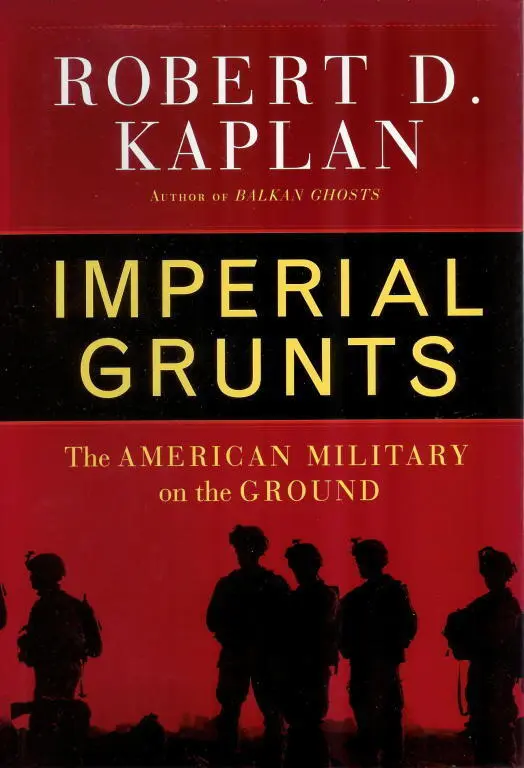
- Название:Imperial Grunts
- Автор:
- Издательство:Random House
- Жанр:
- Год:2005
- Город:New York
- ISBN:978-0-307-27850-0
- Рейтинг книги:5 / 5. Голосов: 1
-
Избранное:Добавить в избранное
- Отзывы:
-
Ваша оценка:
Imperial Grunts: краткое содержание, описание и аннотация
Предлагаем к чтению аннотацию, описание, краткое содержание или предисловие (зависит от того, что написал сам автор книги «Imperial Grunts»). Если вы не нашли необходимую информацию о книге — напишите в комментариях, мы постараемся отыскать её.
Imperial Grunts — читать онлайн бесплатно полную книгу (весь текст) целиком
Ниже представлен текст книги, разбитый по страницам. Система сохранения места последней прочитанной страницы, позволяет с удобством читать онлайн бесплатно книгу «Imperial Grunts», без необходимости каждый раз заново искать на чём Вы остановились. Поставьте закладку, и сможете в любой момент перейти на страницу, на которой закончили чтение.
Интервал:
Закладка:
Kandahar was probably the only Greek place name to have survived in Afghanistan. It stemmed from the Arabic form of Alexander’s name, Iskander. In 330 B.C., Alexander the Great had led his army through the Kandahar region in search of further conquests, following his victory over the Persian forces of Darius at Gaugamela, in northern Iraq. Kandahar lay in the frontier zone between the Persian historical homeland and the Moghul territories to the east that the Persians and their assassinated leader, Nadir Shah, had vanquished. In this sea of blood and turmoil, Ahmad Khan conceived of an island of order: a native Afghan kingdom that would be sanctioned by whoever would rule next in Persia, in exchange for which he would aggressively patrol the mother kingdom’s new territories to the east.
Ahmad Khan was only twenty-four when he became King Ahmad Shah of Afghanistan. In a camp outside Kandahar, as Sir Olaf Caroe tells it, the other Abdali tribesmen “took pieces of grass in their mouths as a token that they were his cattle and beasts of burden.” 8Because King Ahmad Shah liked to wear a pearl earring, he became known by the title Durr-I-Durran (Pearl of Pearls). From this time on, he and his Abdali tribesmen would be known as Durranis.
From Kandahar, Ahmad Shah conquered Kabul and Herat, so the Durrani empire became modern Afghanistan. The Durranis ruled Afghanistan until 1973, when Prime Minister Mohammed Daoud, in a Soviet-assisted coup, overthrew the last Durrani monarch, King Zahir Shah. Zahir Shah would not return to Afghanistan until three decades later as a private citizen, after the dismantling of the Taliban regime by American forces and the election of his tribal kinsman Hamid Karzai as Afghan president.
Hamid Karzai, the headman of the Popolzais, a tribal subgroup of the Durranis, was himself Afghan royalty. Like the original Ahmad Shah, as well as the radical Taliban, Karzai hailed from Kandahar. Kandahar was always considered the pure Afghan homeland, unadulterated by the Persian influences in Herat to the northwest or those of the Indian subcontinent that pervaded Kabul to the northeast.
The Taliban had been so impressed by Hamid Karzai’s Kandahari lineage that in the early 1990s, before they came to power, they sought out his support, and in the first days of their rule offered him the post of United Nations ambassador, which he refused. 9Whereas the U.S. saw the Taliban as radical Islamists, they were also ethnic Pushtuns with deep reverence for tribal heredity. The Taliban lived by the primitive tribal creed of Pushtunwali—“the way of the Pushtuns”—a code more severe than Koranic law. It was the joining of Pushtunwali with Koranic law that produced such a savage end product.
Indeed, the moment you dismissed the importance of tribe and ethnicity you began to misread Afghanistan. From the days of King Ahmad Shah, Afghanistan constituted a fragile webwork of tribes and ethnic groups occupying the water-starved wastes between the settled areas of the Russian Empire in Central Asia, the Persian Empire in the Middle East, and the British Empire in the Indian subcontinent. The killing of 1.3 million Afghans by the Soviets in the 1980s shattered this fragile ethnic webwork. Anarchy was the result. The anarchy continued after Soviet troops departed, leading to the ideologically severe but institutionally weak Taliban government, dismantled by the Americans in order to deny al-Qaeda its principal base of operations following 9/11.
In late 2003, with the state barely functioning despite Karzai’s valiant attempts to resurrect it, Afghanistan had been reduced to its constituent ethnic parts. To the north of the Hindu Kush mountains lay the Tajiks, Uzbeks, and Turkomens, all allied with their ethnic compatriots in the former Soviet empire. To the south of the Hindu Kush lay the Pushtuns, allied with Pushtuns inside Pakistan. The unrelenting stream of guerrilla attacks on U.S. and other coalition forces in southern and eastern Afghanistan following the collapse of the Taliban regime was meant, among other things, to drive out the American infidels from this historic Pushtun territory.
The reality of Afghanistan began five minutes away from the luxurious glitter of my hotel in the Persian Gulf emirate of Dubai. One dark October morning at 4:30 a hotel shuttle transported me from a world of fine chocolates, good wines, and the animal scents of expensive perfumes and colognes to Dubai’s old terminal, the one used mainly for cargo flights. There I found a horde of Afghans in beards, massive turbans, and shalwar kameez (robes and baggy trousers) sprawled all over the departure lounge, their bare feet resting on battered suitcases, while other Afghans, their turbans off, snored in fetal positions on the floor.
In their coarse and costumed splendor, memorialized by Kipling and other writers, the Afghans were like the Yemenis: another unreconstructed people of the mountains and high plains who had never been successfully colonized. The grimy wide-bodied jet that took off from the Dubai cargo terminal, bound for the Afghan capital of Kabul, with every seat occupied, was nearly devoid of women. In the early twenty-first century, such a barren social landscape usually meant violence and unrest.
Two and a half hours later, the plane descended onto a biscuit brown tableland surrounded by ashen hills. As I left the airport in Kabul, the change wrought by American troops quickly became manifest. Near the gateway to the Indian subcontinent, Kabul had always been the most cosmopolitan place in Afghanistan. Thus, the Taliban singled it out for particularly harsh treatment. Women were stoned, banned from school and the workplace, erased from existence practically. Now hundreds of schoolgirls, laughing and smiling, in uniforms and headscarves, crowded the road from the airport. There was colorful new signage advertising consumer goods and civil society groups. Whereas the human image itself had been forbidden by the Taliban, now portraits of the martyred Ahmad Shah Massoud, who had led the guerrilla struggle against both the Soviets and later the Taliban, were omnipresent.
The metamorphosis, superficial and limited to the capital though it was, testified to the power of human agency. Had the Bush administration reacted to 9/11 in a different and less forceful manner, those schoolgirls simply would not have been present on the street.
But I saw it all from a great distance. I was inside a van, riding with American soldiers, both male and female, from the 211th Mobile Public Affairs Detachment, out of Bryan, Texas. They used call signs like “chili” and “beans,” and talked about the league play-offs in baseball. From downtown Kabul the van turned east and then north across the Shomali Plain. Singular sawtooth monuments of volcanic gray rock erupted off the high desert floor, swallowed by dust, like bones swiftly disintegrating. The bleached landscape made you thankful for every primary color, whether a red pomegranate or the lapis lazuli blue of a burka even. [43] A burka is a loose-fitting, all-enveloping cloak with veiled eye slits that devout Muslim women wear in Afghanistan and Pakistan.
Less than an hour after I left Kabul, the snow-crenellated ramparts of the Hindu Kush, rising sheer off the tableland to a height of twenty-one thousand feet, heralded Bagram.
Bagram Air Force Base was the headquarters of Combined Joint Task Force 180 (CJTF-180), an American-led alliance of thirty-three countries. Of its 11,000 troops, 8,500 were American, and 5,000 of those were located at Bagram, so the Americans dominated the environment. (The task force was separate from the NATO-led International Security Assistance Force, or ISAF. Whereas ISAF kept the peace in Kabul, CJTF-180 was responsible for the rest of Afghanistan at the time of my visit.)
Читать дальшеИнтервал:
Закладка:
Похожие книги на «Imperial Grunts»
Представляем Вашему вниманию похожие книги на «Imperial Grunts» списком для выбора. Мы отобрали схожую по названию и смыслу литературу в надежде предоставить читателям больше вариантов отыскать новые, интересные, ещё непрочитанные произведения.




Обсуждение, отзывы о книге «Imperial Grunts» и просто собственные мнения читателей. Оставьте ваши комментарии, напишите, что Вы думаете о произведении, его смысле или главных героях. Укажите что конкретно понравилось, а что нет, и почему Вы так считаете.