Robert Kaplan - Imperial Grunts
Здесь есть возможность читать онлайн «Robert Kaplan - Imperial Grunts» весь текст электронной книги совершенно бесплатно (целиком полную версию без сокращений). В некоторых случаях можно слушать аудио, скачать через торрент в формате fb2 и присутствует краткое содержание. Город: New York, Год выпуска: 2005, ISBN: 2005, Издательство: Random House, Жанр: Публицистика, nonf_military, на английском языке. Описание произведения, (предисловие) а так же отзывы посетителей доступны на портале библиотеки ЛибКат.
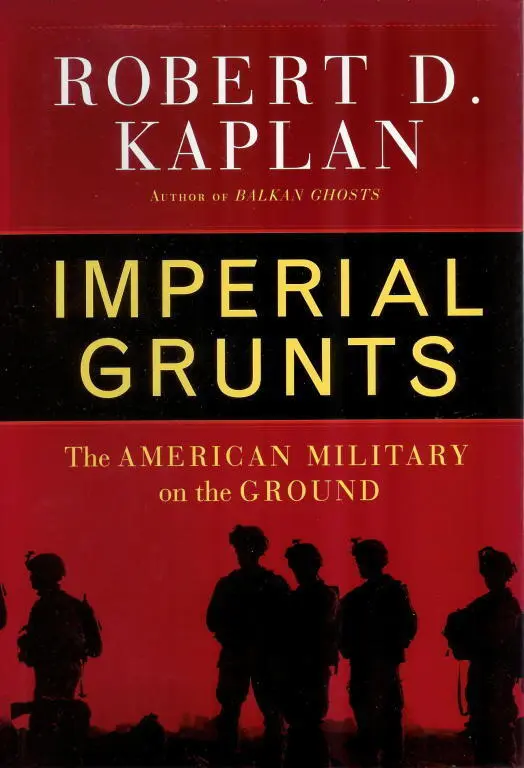
- Название:Imperial Grunts
- Автор:
- Издательство:Random House
- Жанр:
- Год:2005
- Город:New York
- ISBN:978-0-307-27850-0
- Рейтинг книги:5 / 5. Голосов: 1
-
Избранное:Добавить в избранное
- Отзывы:
-
Ваша оценка:
Imperial Grunts: краткое содержание, описание и аннотация
Предлагаем к чтению аннотацию, описание, краткое содержание или предисловие (зависит от того, что написал сам автор книги «Imperial Grunts»). Если вы не нашли необходимую информацию о книге — напишите в комментариях, мы постараемся отыскать её.
Imperial Grunts — читать онлайн бесплатно полную книгу (весь текст) целиком
Ниже представлен текст книги, разбитый по страницам. Система сохранения места последней прочитанной страницы, позволяет с удобством читать онлайн бесплатно книгу «Imperial Grunts», без необходимости каждый раз заново искать на чём Вы остановились. Поставьте закладку, и сможете в любой момент перейти на страницу, на которой закончили чтение.
Интервал:
Закладка:
As for Afghanistan, the destruction of the state was actually less manifest than in Iraq. Even in the best of times (the mid-twentieth century, under the leadership of King Zahir Shah) the Afghan state had existed only partially, and extended to not much more than the major cities and towns, and the ring road connecting them. Contrary to popular wisdom, the Soviet invasion of December 1979 had not ignited the mujahedin uprising. That uprising began more than a year earlier, in April 1978, when the Afghan regime attempted to extend the power of the central government to the villages. However brutal and incompetent that regime’s methods were, one had to keep in mind that Afghans had less of a tradition of a modern state than Persians or Arabs.
Warlordism had always been strong in Afghanistan, bolstered in recent decades by the diffuse nature of the mujahedin rebellion against the Soviets, the destruction wrought by the fighting among the mujahedin themselves after the Soviet departure, and the bureaucratic incompetence of the Taliban, who constituted more of an ideological movement than a governing apparatus. Thus, with the state barely in existence even before the American invasion of October 2001, barring some catastrophe like the fall of a major town to a reconstituted Taliban or the assassination of President Hamid Karzai, reading success or failure in Afghanistan would be a subtler enterprise than in Iraq.
The continued turmoil in the Greater Near East, plus my desire to observe Army Special Forces in a more varied role than in Colombia and the Philippines—before I moved on to other branches of the military—was to take me on a two-month journey to Afghanistan. Iraq would wait until early the next year; I was not chasing news, but trying to understand the mechanics of America’s security commitments worldwide, on the ground, piece by piece.
Afghanistan and Army Special Forces fell within the domains of CENTCOM (Central Command) and SOCOM (Special Operations Command). Both, as it happened, were headquartered at MacDill Air Force Base in Tampa, Florida.
CENTCOM was an unusual area command in that it was new, had few war-fighting units permanently assigned to it, and yet bore the burden of most of the fighting for the U.S. at the dawn of the twenty-first century. This was in spite of the fact that CENTCOM’s area of responsibility was significantly smaller than the other commands, for the Greater Middle East did not compare in square mileage to the vast Pacific; to South America and its oceanic environs; or to Europe, Russia, and Africa—the responsibility of European Command.
But what CENTCOM’s area of responsibility lacks in size, it compensates for in strategic importance. It stretches from northeastern Africa across the Middle East to former Soviet Central Asia and Pakistan and comprises that vast desert region which lies east of Europe, south of Russia, and west of China and India. Here the legacies of the Byzantine, Turkish, and Persian empires overlap amid two thirds of the world’s proven oil reserves and 40 percent of its natural gas.
While SOUTHCOM and PACOM boast venerable roots in American history—in the building of the Panama Canal and the old Pacific Army before World War II—and while European Command constitutes a legacy of the Allied victory over Hitler’s Germany, CENTCOM is without a storied past. It is a creature of the last phase of the Cold War and the challenge posed by extremist Islam, a granite-like ideology as dynamic, inflexible, and ruthless as Soviet communism and European fascism. [39] The comparison between extremist Islam and the granite-like ideology of Soviet communism was made by Bernard-Henri Levy in Who Killed Daniel Pearl? (Hoboken, NJ: Melville House, 2003).
Central Command was activated in 1983 by President Ronald Reagan as a successor to the Rapid Deployment Joint Task Force, which had, in turn, been created by President Jimmy Carter in order to project power in Africa and the Middle East following the Iranian hostage crisis. [40] The Rapid Deployment Joint Task Force was specifically promoted by President Carter’s hawkish national security advisor, Zbigniew Brzezinski. See Michael R. Gordon and Gen. Bernard E. Trainor, The Generals’ War: The Inside Story of the Conflict in the Gulf (Boston: Little, Brown, 1995), p. 43.
In 1990 and 1991, CENTCOM became a household word when under its then-commander, Army Gen. Norman Schwarzkopf, it executed Operations Desert Shield and Desert Storm, respectively the defense of Saudi Arabia and the liberation of Kuwait from Iraqi occupation. In 1992, CENTCOM carried out Restore Hope, the humanitarian intervention in Somalia. And throughout the 1990s CENTCOM enforced the Iraqi no-fly zone.
Along with NATO, CENTCOM had grown into the ultimate coalition manager. Its headquarters, at the point where Tampa Bay opens into the Gulf of Mexico, was distinguished not by its huge nondescript building, but by the enormous expanse of mobile homes, each flying a different national flag, which housed liaison officers from all the countries taking part in Operations Enduring Freedom—Afghanistan and Iraqi Freedom. When one walked inside the main building, not only were the desert cammie utilities (DCUs) that the American soldiers wore different from the dark green BDUs of the other area commands, so was the corridor presence of officers from a host of nations, as indicated by their distinctive uniforms. One of my briefers was not even an American, but a Norwegian army major.
CENTCOM’s pace of activity made SOUTHCOM and PACOM look sleepy by comparison. People worked longer hours than at the other commands. Most of the higher-ranking officers were not at the Tampa headquarters even, but forward deployed in Afghanistan, Iraq, and elsewhere in the AOR (area of responsibility). Officially, every area command reported directly to the secretary of defense, but CENTCOM’s channels of communication to the “SecDef” (as he was called) were simply more direct and seamless.
U.S. Air Force Maj. Michel Escudi, my escort, remarked, “Here you’ve got a third of the world at your fingertips. Everything is informal with little red tape. All the nations go to the briefings, and that generally goes for the exchange of intelligence, too. If you asked me to diagram the bureaucratic chain of command as it actually works, I couldn’t. People just walk in cold on each other’s offices.”
The U.N. and NATO must have been like this in the early 1950s, I thought, before a formalized rigidity set in. Since the end of the Cold War, CENTCOM had been emerging as an international organization of the kind that elites in the major capitals and financial centers talked about but did not imagine taking shape inside the American military, amid western Florida’s tacky sunbelt sprawl. Organizations are at their most dynamic when they are in the process of becoming —when they work out of temporary structures and have the sense of the guerrilla outfit about them, disrupting the established order. That was CENTCOM (though NATO, too, had been revitalized somewhat with the entry of former Warsaw Pact countries into its ranks, and by successfully intervening and fighting wars in Bosnia and Kosovo).
Another distinctive feature of CENTCOM was the way that I was treated. At SOUTHCOM and PACOM, whose military operations were largely ignored by the media, I was an oddity, a threat, and a VIP all at once, to be handled with care and lots of planning. At CENTCOM, I was just another journalist being processed through a series of briefings. People barely had time for me.
Special Operations Command, or SOCOM, was activated four years after CENTCOM, in 1987, and thus was even newer. It was forced on a reluctant Pentagon by the U.S. Congress, through an amendment sponsored by Democratic Senator Sam Nunn of Georgia and Republican Senator William Cohen of Maine. [41] William Cohen later served as the secretary of defense in the second administration of President Bill Clinton.
The two senators had become frustrated with the military’s slowness in adapting to unconventional threats. In 1976 the Israelis had carried out a spectacular raid on Entebbe airport in Uganda to rescue hostages taken by Ugandan leader Idi Amin. The following year, the West German military, with help from the British Special Air Service (SAS), performed a similar feat, freeing hostages taken by Baader-Meinhof terrorists at Mogadishu airport in Somalia. In 1980, however, a U.S. attempt to rescue American hostages in Iran was a disastrous failure. SOCOM, like the Rapid Deployment Force and CENTCOM, was yet another consequence of that signal crisis and national humiliation.
Интервал:
Закладка:
Похожие книги на «Imperial Grunts»
Представляем Вашему вниманию похожие книги на «Imperial Grunts» списком для выбора. Мы отобрали схожую по названию и смыслу литературу в надежде предоставить читателям больше вариантов отыскать новые, интересные, ещё непрочитанные произведения.







Обсуждение, отзывы о книге «Imperial Grunts» и просто собственные мнения читателей. Оставьте ваши комментарии, напишите, что Вы думаете о произведении, его смысле или главных героях. Укажите что конкретно понравилось, а что нет, и почему Вы так считаете.