Robert Kaplan - Imperial Grunts
Здесь есть возможность читать онлайн «Robert Kaplan - Imperial Grunts» весь текст электронной книги совершенно бесплатно (целиком полную версию без сокращений). В некоторых случаях можно слушать аудио, скачать через торрент в формате fb2 и присутствует краткое содержание. Город: New York, Год выпуска: 2005, ISBN: 2005, Издательство: Random House, Жанр: Публицистика, nonf_military, на английском языке. Описание произведения, (предисловие) а так же отзывы посетителей доступны на портале библиотеки ЛибКат.
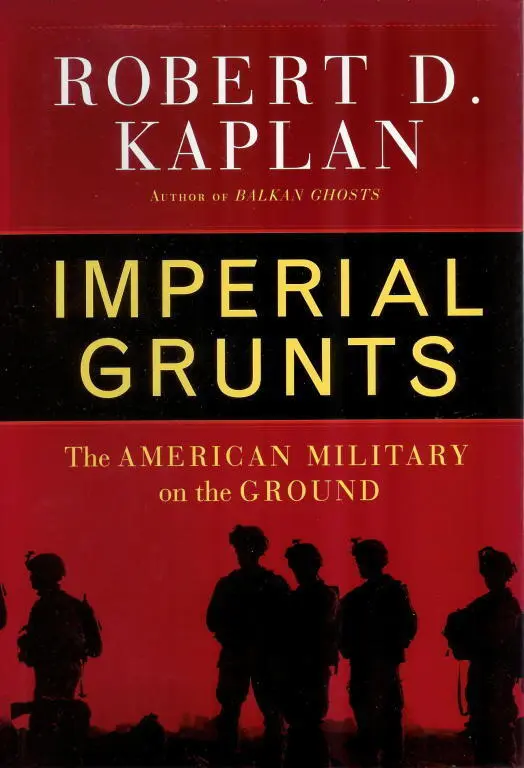
- Название:Imperial Grunts
- Автор:
- Издательство:Random House
- Жанр:
- Год:2005
- Город:New York
- ISBN:978-0-307-27850-0
- Рейтинг книги:5 / 5. Голосов: 1
-
Избранное:Добавить в избранное
- Отзывы:
-
Ваша оценка:
Imperial Grunts: краткое содержание, описание и аннотация
Предлагаем к чтению аннотацию, описание, краткое содержание или предисловие (зависит от того, что написал сам автор книги «Imperial Grunts»). Если вы не нашли необходимую информацию о книге — напишите в комментариях, мы постараемся отыскать её.
Imperial Grunts — читать онлайн бесплатно полную книгу (весь текст) целиком
Ниже представлен текст книги, разбитый по страницам. Система сохранения места последней прочитанной страницы, позволяет с удобством читать онлайн бесплатно книгу «Imperial Grunts», без необходимости каждый раз заново искать на чём Вы остановились. Поставьте закладку, и сможете в любой момент перейти на страницу, на которой закончили чтение.
Интервал:
Закладка:
“The Army was my own idea. Nobody encouraged me in that direction. Nobody was a role model for me while growing up,” Mark Lopez explained. Now I was on the beach in Subic Bay, sipping beers at sunset, and he and I spent hours talking. He was part Mexican, part American Indian. He was born in Sacramento, California, and grew up in Yuba City to the north, where “everyone became farmers, loggers, or contractors. I just felt I had to escape that. As a junior in high school I got permission from my parents to join Army ROTC. At first I wanted to become a drill instructor.”
Lopez’s early years in the Army were spent with the 1st Ranger Battalion (Airborne) at Hunter Airfield in Savannah, Georgia, then with U.S. forces in South Korea, and with the 10th Mountain Division at Fort Drum, New York. In 1992 he was accepted into Special Forces. From then on, his only goal in life, he told me in his burly voice, “was to one day become an SF team sergeant. No other job in the world gives you the opportunity to be such a role model and molder of men. You’re the glue of the whole squad. Nobody has as much freedom or as much responsibility.”
I didn’t laugh. Since meeting Mike Fields at Tolemaida in Colombia, I had never ceased to be impressed with the workload carried by Green Beret team sergeants, most of whom held the rank of master sergeant. Later in the Philippines I met a sergeant major, Steve Gregurek, of Navasota, Texas. When Gregurek had been at sergeant majors academy in El Paso, Texas, he was asked what his goal in the military was. “I told them that I had already been there. After being an SF team sergeant, there was nothing left to attain in this world.”
Team sergeants spent years with their Special Forces detachments, and often never left Special Forces, whereas captains and majors would serve a few years on a team and then transfer elsewhere in the Army, returning to Special Forces only later in their careers, if at all. Sergeants, particularly team sergeants, or master sergeants, were the true repositories of Special Forces tradition.
All Lopez wanted to do was talk about his experiences in Basilan. He and his team had lived in the bush there, marched full pack through mangrove swamps and triple canopy rain forest, rebuilt a mosque, and held medical clinics twice weekly in villages threatened by Abu Sayyaf. His medic, Sgt. Keith Pace of Ann Arbor, Michigan, had, among other exploits, saved a seven-year-old girl’s life with a Gatorade enema. “She had spinal meningitis,” Pace explained to me. “She was dehydrating fast. I couldn’t find a vein for an intravenous solution. I filled an enema with a bottle of Gatorade, lifted her butt, and rammed the Gatorade up her anus. It got into her bloodstream and rehydrated her.” Sgt. Pace was personally commended by the Philippine government for his work on Basilan. “I pulled teeth. I treated farm animals. There was no lab nearby. You treated everything empirically. You didn’t wait for proof; by that time someone would be dead. If you thought someone had this or that disease, you treated them for it immediately.”
Lopez felt that everything his team did on Basilan could have been done at less risk and more effectively without a joint task force. Unloading his frustration under a laterite sunset, he said: “The whole JTF-JSOTF concept violated much of what was taught at the Q course in Fort Bragg,” referring to the Green Beret qualification course. “There was relatively little the JTF did that could not have been handled more quietly, efficiently, and with a smaller signature by a Special Forces B-team. The whole point of a B-team is to serve as a forward operating base for several A-teams many miles from their home base.
“The problem,” he continued, “wasn’t just the PACOM mindset, it was Washington. The Special Operations mission in Basilan was the only hot item in the Pacific theater at the time, so we became the plaything of larger forces. Everybody wanted a piece of it, so it became bigger than it needed to be. Instead of rolling with two-and-a-half-ton trucks into Isabela, we should have come in quietly at night on Zodiacs [inflatable boats used by combat divers] and infiltrated into the countryside with CAFGUs [Citizens Armed Forces Geographical Units]. The JTF represented the kind of heavy-handed approach that had made Vietnam go drastically wrong, and which ignored the lessons of the Philippine War a hundred years ago. It’s a good thing that Abu Sayyaf didn’t have the teeth or balls to sabotage us.”
Everything Lopez told me was backed up by other noncoms from other detachments. Furthermore, Lopez’s commanding officer in Basilan, Lt. Col. David Maxwell, would tell me later in Washington that Enduring Freedom—Philippines had operated “ass backwards.” The joint task force in Zamboanga “had supposedly set the conditions for our deployment, but there were no conditions to set up until the A-teams were actually deployed on the island.”
Tactically speaking, Lopez and Maxwell made sense. But it could also be argued that the larger-than-necessary base complex at Zamboanga delivered political benefits that fell outside a purely tactical analysis; it got the U.S. semi-permanently established south of Luzon for the first time since World War II, positioning it for a future conflict with China.
It wasn’t far from Subic Bay to Fort Magsaysay in the interior of Luzon, where more Green Beret teams were deployed training Filipinos. [37] Ramón Magsaysay was the Philippine minister of national defense and later the country’s president. In the early 1950s, helped by an American covert action program, he mounted a successful counterinsurgency campaign against the communist Huk guerrillas in Luzon.
The atmosphere inland was totally different. Subic Bay was exhilarating, Fort Magsaysay depressing. Fort Magsaysay, located near the Japanese prisoner-of-war camp of Cabanatuan, where American survivors of the Bataan Death March had been incarcerated, was flat, with no views or breezes. The heat was crushing. A typhoon system had arrived, submerging the landscape under constant torrential downpours.
The “typhoon blues” had set in around the barracks. Rain lashed the windows. Frogs leapt through the latrines. Some training exercises were canceled. I had plenty of time to talk with Maj. Robert E. Lee Jr. of the Panama Canal Zone and later of Mobile, Alabama, the commanding officer for all Americans at Magsaysay.
Maj. Ed Lee spoke in quick, staccato bursts. He was pale and a bit scrawny compared to the others, with brown hair and a mustache. He was the first member of his family to attend college, at the University of South Alabama in Mobile. His oldest son was named Stonewall, after the Confederate general Thomas “Stonewall” Jackson. He told me that his right-of-passage experience was working for a year as a volunteer for the Southern Baptist mission in a poor African-American section of Wichita, Kansas. “It was my first real exposure to blacks, I mean not from afar. It was a year of learning, day after day, that folks are just folks.”
Maj. Lee had conducted training missions all over Asia: South Korea, Singapore, Tonga, the Solomon Islands, the Philippines…. He judged cultures and political systems by what he saw of their armies, which wasn’t a bad idea. At least it was ground truth rather than abstractions. Armies are usually accurate cultural barometers. America had among the best noncommissioned officer corps in history because the U.S. was the epitome of a mass middle-class society. Poorly led and corrupt third world countries tended to have militaries in which weapons and other equipment were not maintained. Maintenance—a dull, unpleasant, and yet necessary task—is an indication of discipline, esprit de corps, and faith in the future, because you maintain only what you plan to use for the long term.
Читать дальшеИнтервал:
Закладка:
Похожие книги на «Imperial Grunts»
Представляем Вашему вниманию похожие книги на «Imperial Grunts» списком для выбора. Мы отобрали схожую по названию и смыслу литературу в надежде предоставить читателям больше вариантов отыскать новые, интересные, ещё непрочитанные произведения.








Обсуждение, отзывы о книге «Imperial Grunts» и просто собственные мнения читателей. Оставьте ваши комментарии, напишите, что Вы думаете о произведении, его смысле или главных героях. Укажите что конкретно понравилось, а что нет, и почему Вы так считаете.