Robert Kaplan - Imperial Grunts
Здесь есть возможность читать онлайн «Robert Kaplan - Imperial Grunts» весь текст электронной книги совершенно бесплатно (целиком полную версию без сокращений). В некоторых случаях можно слушать аудио, скачать через торрент в формате fb2 и присутствует краткое содержание. Город: New York, Год выпуска: 2005, ISBN: 2005, Издательство: Random House, Жанр: Публицистика, nonf_military, на английском языке. Описание произведения, (предисловие) а так же отзывы посетителей доступны на портале библиотеки ЛибКат.
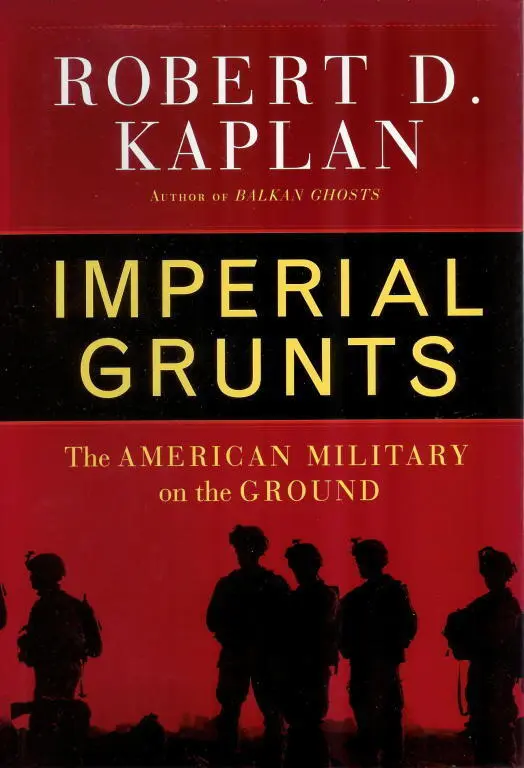
- Название:Imperial Grunts
- Автор:
- Издательство:Random House
- Жанр:
- Год:2005
- Город:New York
- ISBN:978-0-307-27850-0
- Рейтинг книги:5 / 5. Голосов: 1
-
Избранное:Добавить в избранное
- Отзывы:
-
Ваша оценка:
Imperial Grunts: краткое содержание, описание и аннотация
Предлагаем к чтению аннотацию, описание, краткое содержание или предисловие (зависит от того, что написал сам автор книги «Imperial Grunts»). Если вы не нашли необходимую информацию о книге — напишите в комментариях, мы постараемся отыскать её.
Imperial Grunts — читать онлайн бесплатно полную книгу (весь текст) целиком
Ниже представлен текст книги, разбитый по страницам. Система сохранения места последней прочитанной страницы, позволяет с удобством читать онлайн бесплатно книгу «Imperial Grunts», без необходимости каждый раз заново искать на чём Вы остановились. Поставьте закладку, и сможете в любой момент перейти на страницу, на которой закончили чтение.
Интервал:
Закладка:
In the meantime, I ensconced myself at a small resort hotel on the beach in Subic Bay. The offshore insertion, I knew, was incidental to my purpose here. Training exercises are essentially technical and abstruse; the real purpose of my observing them was the venue they provided for conversation: the “bull session,” the “soldier’s greatest hobby,” as James Jones writes. 35
I would have a lot of bull sessions at Subic Bay. The setting was perfect for them, and deserves to be described in detail.
Subic Bay features scintillating tropical grandeur: a steamy panel of blue and chemical green water trapping the heat, bordered by the junglescapes of Bataan and western Luzon. Subic Bay is testimony to the old saw that nobody acquired nicer real estate than the U.S. Navy and the Catholic Church. A legacy of the Spanish-American War, it was a major U.S. naval base until 1991, when a vote of the Philippine Senate closed it: an assertion of national sovereignty that put thousands of Filipinos employed by the U.S. out of work.
The U.S. Navy loved Subic Bay. So did its Australian counterparts. After the base closure, retired U.S. Navy SEALs and Australian SAS veterans began settling here as expatriates, opening bars, discos, and dive shops. [36] SEALs: Sea, Air, and Land, the Navy’s equivalent of Delta Force. SAS: Special Air Service, an elite commando team.
Australians were particularly prevalent, with leathery tans, rugged musculatures that were beginning to crumble with age, and so many tattoos on their arms they approximated weird shirtsleeves. The Aussies had the game beat.
As one American observed, “Say you’re Australian, just retired from the police or military and divorced, with a pension. You’re in your late fifties. You move here and set up with a twenty-something-year-old Filipina. Living here is inexpensive. Even with alimony payments you’re financially better off than if you stayed in Australia.”
They were hard workers, though, and quite a few did not fit the stereotype. Take one Australian I met, Brian Homan, had bought a wrecked coaling station with nothing left to it but the rusted iron pierage. He poured three concrete slabs over the pierage to make an enormous deck and opened a bar straightaway. Meanwhile, he built a proper restaurant and scuba center, which included a small museum filled with the remains of old galleons and Chinese junks, as well as sixteenth-century Chinese and Vietnamese pottery he had salvaged from these and other nearby shipwrecks. His next project was an adjacent hotel fronting the bay, with bedposts in each room made of old U.S. Navy telephone poles he had found: “Authentic Douglas fir from Washington State,” he told me, banging on one with his hand.
The place where I stayed, though not as inventive in its construction,
boasted an atmosphere in which, as somone had told me, “the rules of middle-class society simply didn’t apply, provided no one infringed on anyone else’s peace and security.” Families were welcome but not encouraged. The beach bar had no closing bell. It was open twenty-four hours a day, seven days a week. Couples would drift out of their rooms in the middle of the night to have a quiet drink by the sea. What you did was your own business, although there was a security guard on constant patrol against thieves. I left my valuables beside my bed and never worried. There was little random crime in the area anyway.
My hotel and others in the area constituted mildewy, somewhat seedy, pre-luxury-era paradises that were able to go on existing because there was just enough terrorism and political instability in the Philippines to keep global tourism and its regulated standards of behavior far, far away.
There were nearby strip joints with names like Muff Divers. Walking into them was like entering an octopus. Several sets of hands would suddenly be all over you, offering massages and more. The women were not down-and-out as one might expect. I interviewed Filipinas in their forties who looked considerably younger and had turned to sex to put children through good colleges and boarding schools. They had specific strategies for investments, future jobs, and cushy retirements. They were not strippers or prostitutes per se. The Philippines offered something subtler: “the girlfriend experience,” it was called in Manila. There was an entire class of attractive Filipinas who made an excellent living, relative to the standards of the local economy, by becoming companions of Western men. Relationships lasted days, weeks, or months even. Couples were often loyal to each other. Such overtly sex-for-money relationships sometimes evolved into marriages. It was crude by the standards of the middle-class West, and yet quite sophisticated and discriminating by the standards of conventional prostitution.
While the Philippines was an Eden without rival for Western males, for the same reason the wives of American servicemen harbored “a visceral hatred of the place,” as one soldier observed. When Subic Bay and Clark Field were in operation as American bases, female spouses who came out here were often in an uproar when they saw what was going on. It led to real “morale problems,” as the U.S. military would euphemistically put it: spousal screaming matches, divorces, and the like.
With the bases gone, soldiers interacted more with the locals. It wasn’t like the days of the old Pacific Army prior to World War II. But the situation had moved back a bit in that direction. The result, actually, was a better relationship with the immediate environment, a phenomenon which, in fact, has a basis in imperial history.
In Armies of the Raj, British military historian Byron Farwell writes that the opening of the Suez Canal, by allowing the wives of British officers in India to conveniently join their husbands, cut the officers off from native society, and became one of the contributing factors leading to the Indian Mutiny of 1857–58 against British rule. “In all societies women have been the conservators of culture,” Farwell explains. “When British women began to arrive in India in numbers, they brought with them British attitudes, British fashions, and British morality; they were soon imposing their ideas, standards, and customs upon their new environment.” 36Consequently, British soldiers, many of whom had preferred to be orientalized themselves rather than to Christianize the Indians, now no longer went native, and a new divide opened between them and the locals. 37
The situation in the Philippines posed a particular dilemma for the American military. Rudyard Kipling noted that “single men in barracks don’t grow into plaster saints.” 38Or as one American serviceman whom I met briefly in Manila put it: “I’m thousands of miles from home, I’m away from the base for a few days with a nice hotel room. Do you really think I should go back to my hotel alone tonight?” Another serviceman angrily derided the “Bible-thumpers” in the U.S. military, who, he said, employed all kinds of budgetary and procedural reasons for getting R & R locations moved from Manila to Okinawa, because in Okinawa “everybody knew it was a bit harder to get laid.”
In fact, I concluded that the U.S. military was handling this aspect of the Philippine reality fairly sensibly. It was a version of Don’t Ask, Don’t Tell, applied to heterosexual activity. For example, I noticed that quite a few soldiers got passes periodically, for one reason or another, to visit Manila. One officer whom I would meet there, with many years of experience in sexually charged places like Thailand and the Philippines told me: “I always make sure the medics have lots of antibiotics for venereal disease. I don’t go crazy against a guy as long as he doesn’t go overboard, as long as he shows up on time for formation, and as long as his wife doesn’t start calling and complaining to me. But once it becomes a family problem, then it’s a team problem, and an Army problem. And I’ve got to take action against him.”
Читать дальшеИнтервал:
Закладка:
Похожие книги на «Imperial Grunts»
Представляем Вашему вниманию похожие книги на «Imperial Grunts» списком для выбора. Мы отобрали схожую по названию и смыслу литературу в надежде предоставить читателям больше вариантов отыскать новые, интересные, ещё непрочитанные произведения.











Обсуждение, отзывы о книге «Imperial Grunts» и просто собственные мнения читателей. Оставьте ваши комментарии, напишите, что Вы думаете о произведении, его смысле или главных героях. Укажите что конкретно понравилось, а что нет, и почему Вы так считаете.