Robert Kaplan - Imperial Grunts
Здесь есть возможность читать онлайн «Robert Kaplan - Imperial Grunts» весь текст электронной книги совершенно бесплатно (целиком полную версию без сокращений). В некоторых случаях можно слушать аудио, скачать через торрент в формате fb2 и присутствует краткое содержание. Город: New York, Год выпуска: 2005, ISBN: 2005, Издательство: Random House, Жанр: Публицистика, nonf_military, на английском языке. Описание произведения, (предисловие) а так же отзывы посетителей доступны на портале библиотеки ЛибКат.
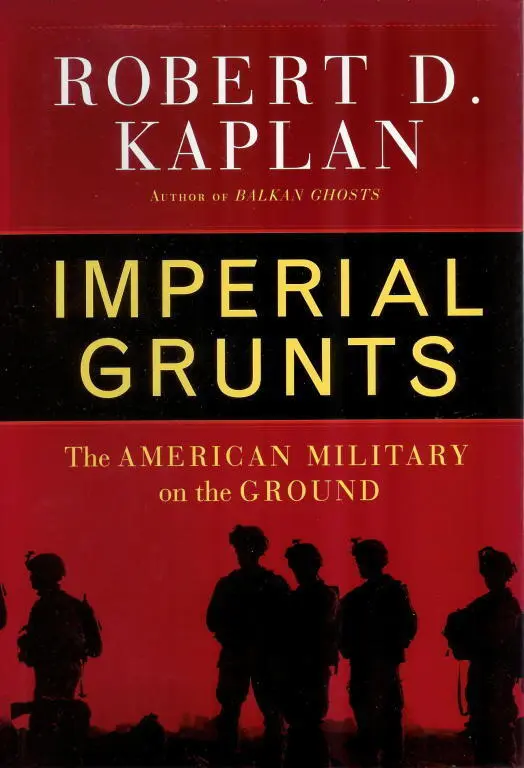
- Название:Imperial Grunts
- Автор:
- Издательство:Random House
- Жанр:
- Год:2005
- Город:New York
- ISBN:978-0-307-27850-0
- Рейтинг книги:5 / 5. Голосов: 1
-
Избранное:Добавить в избранное
- Отзывы:
-
Ваша оценка:
Imperial Grunts: краткое содержание, описание и аннотация
Предлагаем к чтению аннотацию, описание, краткое содержание или предисловие (зависит от того, что написал сам автор книги «Imperial Grunts»). Если вы не нашли необходимую информацию о книге — напишите в комментариях, мы постараемся отыскать её.
Imperial Grunts — читать онлайн бесплатно полную книгу (весь текст) целиком
Ниже представлен текст книги, разбитый по страницам. Система сохранения места последней прочитанной страницы, позволяет с удобством читать онлайн бесплатно книгу «Imperial Grunts», без необходимости каждый раз заново искать на чём Вы остановились. Поставьте закладку, и сможете в любой момент перейти на страницу, на которой закончили чтение.
Интервал:
Закладка:
The three of us sat apart on the ferry’s upper deck, which was filled with well-groomed middle-class people, giving me yet again the sense that the security precautions were ridiculous. Then a typically good looking Filipina carrying a medical textbook sat next to me and asked, “You’re not afraid to visit Basilan?”
“Should I be?” I replied.
“Yes, you should. Foreigners get abducted there.”
She told me that she was a nurse in the northern part of the island but now lived in Zamboanga and commuted to Basilan a few days a week, afraid to spend the night there. I told her not to worry about me, that I would be met by Philippine soldiers at the dock in Isabela. I was slightly taken aback. In almost every previous instance as a journalist, the moment I had actually arrived somewhere that the outside world considered dangerous, I immediately encountered the most ordinary people going about their daily lives, making me ashamed of my fear.
“Whatever you do,” the woman added, “don’t go to Tuburan, avoid that area,” referring to the anarchic, Muslim-inhabited eastern finger of Basilan that Col. Walker had said was off limits. In the middle of the strait she pointed out the islet of Santa Cruz. “Foreigners were abducted there,” she said.
Meanwhile, I was benumbed by the purity of the scene. Beyond the lacquered blue strait crowded with bancas, Basilan emerged as a vast line of extinct volcanoes rising sheer above palm jungles. It was a coast of terror as beautiful as could be imagined, with few signs of human habitation. Amid the screen of uninhabited atolls, a perfect white sandy beach came into view that stretched for miles, empty. “Nobody goes to that beach; they’re afraid,” the woman told me. I noticed a small settlement of thatched, coconut-leaf huts; it looked like a vacation village, but it was an outpost of the 103rd Brigade. Traveling with the military, and particularly with Special Forces, had brought me to the last unspoiled places on earth, the places still too unstable to be touched by tourism.
A tangle of boat-strewn channels and hutments on stilts, with overlapping scrap iron roofs, heralded Isabela. At the dock, hundreds of pairs of eyes stared wondrously and suspiciously at me, their fingers busy texting on cell phones. Again, I was struck by just how off limits this beautiful place was. In almost every other remote and war-ravaged part of the world, I had always come across at least a few intrepid backpackers and relief workers; not here.
Three Filipino soldiers in a Humvee met us at the dock. Suddenly I was careening through crowded and decayed streets, jammed with trikes and motorcycles, and cleansed by fresh sea breezes. Isabela seemed noisy and sleepy at the same time, a backwater in the way that I had found Freetown, Sierra Leone; Port-au-Prince, Haiti; and St. George’s, Grenada, many years and decades before: places whose violence and instability were partly a consequence of their isolation. Soon we arrived at the 103rd Brigade outpost, the one I had seen from the ferry. Up close it looked no less idyllic, the kind of place where you expected to find nude Scandinavian holiday makers. Instead I found Philippine Army Col. Bonifacio Ramos and his troops.
Col. Ramos had been the Philippine defense attaché in Washington. As an up-and-comer he was afterwards given a field position in a volatile area, which is where I found him prior to his promotion to brigadier general. “In Basilan,” he told me, the sweat pouring down our faces on a rain-darkened veranda, “you cannot define the battlefield, so you might as well organize every community to defend itself.”
The Abu Sayyaf guerrillas, Col. Ramos began, had been routed from the island. They were now holed up on Jolo and elsewhere farther south in the archipelago. All that remained in Basilan were a few lawless remnants bent on piracy and kidnapping. The Americans had built roads, schools, and water wells the year before, but they could not stay indefinitely. There was no police force to speak of. And the Manila government had taken two of his five battalions away from him to fight Islamic terrorists in Mindanao.
“Firearms are a prerequisite for living here,” Ramos told me. “And as long as people are armed, you might as well organize them into support groups, for defense and intelligence gathering.” The vehicle for this was the Citizens Armed Forces Geographical Units, vigilante outfits of the kind that the ethnic Chinese had organized in Zamboanga. It was not as sinister as it sounded. Civil defense is crucial in a counterinsurgency, because it allows individuals to cast their lot in favor of the existing order and against revolutionary upheaval. 33But these units could not operate in a vacuum. “Without economic development,” Ramos warned, “Basilan will die a natural death. It’s only when you care for people that you are credible.”
Later in Manila, the Philippine foreign minister, Blas Ople, a veteran of the World War II fighting against the Japanese, would have a similar message for me. “The Muslims of Basilan strongly appreciated the humanitarian assistance provided by the U.S. military. Now it is our responsibility to integrate and consolidate Mindanao and Sulu, socially and economically, for the sake of our own national security.” The foreign minister referred to the threat of a radical, breakaway Muslim state that could emerge to the Philippines’ south, were Indonesia to weaken further. [35] Foreign Minister Ople died a few months after I met him.
But was there any evidence, I asked myself, that the Christian oligarchy in Manila, which ruled under the brand name of democracy even as it presided over corrupt and ineffectual institutions, would actually do that? Almost none at ground level. Yet, in the aftermath of September 11, as PACOM began to plan Operation Enduring Freedom—Philippines, U.S. military officers understood that getting the Philippine government to assume responsibility for its own Muslim citizens would be decisive.
When I was in Honolulu, a Special Forces officer at PACOM recapped for me the significance of what happened in Basilan during the first eight months of 2002: “We were an enabler. We tried to help get the Philippine government to look more benignly on its southern, Muslim population: to treat them as real citizens. The American Joint Task Force set out to be a spine donor. That is, it tried to put some backbone into the Manila authorities so they would better take care of their own people. Success meant that we couldn’t take credit for anything. We had to give the credit to the Philippine government. We didn’t want credit; that would have ruined the operation. In SF, all we ever want is more missions. For us it is always about access, not publicity. Anyway, speaking personally, getting my name in the paper—even for something good—would make my skin crawl.”
PACOM decided to focus on Basilan because it was the northernmost and most populous island in the Sulu chain—the link between the southern islands and the mainland of Mindanao. Were Abu Sayyaf and other Islamic insurgents to be ejected from Basilan, they would be instantly marginalized. Basilan, with a population of 360,000, was important enough to matter, yet small enough for the U.S. to achieve a crucial victory in a short amount of time.
The first thing that Army Special Forces did about Basilan was conduct a series of population surveys. Special Forces surveys are a bit like those conducted by university academics; indeed, many a Special Forces officer has an advanced degree. But there is a difference. Because the motive behind these surveys is operational rather than intellectual, there is a concrete, cut-to-the-chase quality about them that is uncommon in academia. Months are not needed to reach conclusions. Nobody is afraid to generalize in the bluntest terms. Thus, conclusions do not become entangled in exquisite subtleties. Intellectuals reward complexity and refinement; the military, simplicity and bottom-line assessments. For the Green Berets, there was only one important question: what did they need to know about the people of Basilan that would help them kill or drive out the insurgents?
Читать дальшеИнтервал:
Закладка:
Похожие книги на «Imperial Grunts»
Представляем Вашему вниманию похожие книги на «Imperial Grunts» списком для выбора. Мы отобрали схожую по названию и смыслу литературу в надежде предоставить читателям больше вариантов отыскать новые, интересные, ещё непрочитанные произведения.









Обсуждение, отзывы о книге «Imperial Grunts» и просто собственные мнения читателей. Оставьте ваши комментарии, напишите, что Вы думаете о произведении, его смысле или главных героях. Укажите что конкретно понравилось, а что нет, и почему Вы так считаете.