Robert Kaplan - Imperial Grunts
Здесь есть возможность читать онлайн «Robert Kaplan - Imperial Grunts» весь текст электронной книги совершенно бесплатно (целиком полную версию без сокращений). В некоторых случаях можно слушать аудио, скачать через торрент в формате fb2 и присутствует краткое содержание. Город: New York, Год выпуска: 2005, ISBN: 2005, Издательство: Random House, Жанр: Публицистика, nonf_military, на английском языке. Описание произведения, (предисловие) а так же отзывы посетителей доступны на портале библиотеки ЛибКат.
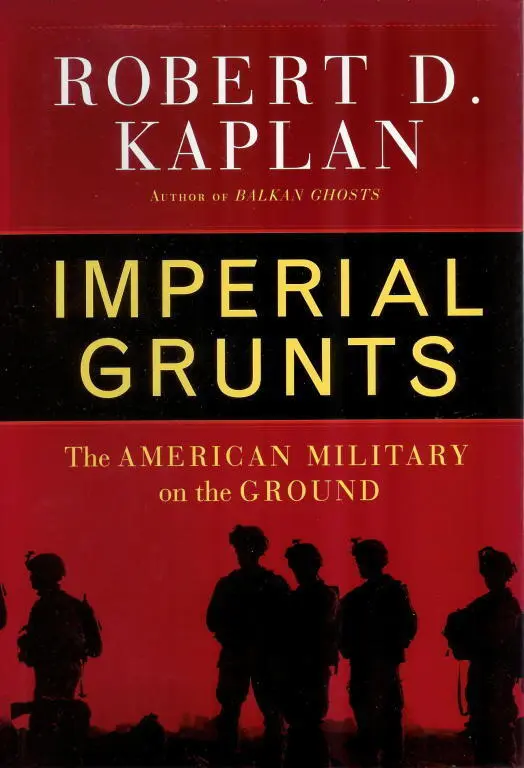
- Название:Imperial Grunts
- Автор:
- Издательство:Random House
- Жанр:
- Год:2005
- Город:New York
- ISBN:978-0-307-27850-0
- Рейтинг книги:5 / 5. Голосов: 1
-
Избранное:Добавить в избранное
- Отзывы:
-
Ваша оценка:
Imperial Grunts: краткое содержание, описание и аннотация
Предлагаем к чтению аннотацию, описание, краткое содержание или предисловие (зависит от того, что написал сам автор книги «Imperial Grunts»). Если вы не нашли необходимую информацию о книге — напишите в комментариях, мы постараемся отыскать её.
Imperial Grunts — читать онлайн бесплатно полную книгу (весь текст) целиком
Ниже представлен текст книги, разбитый по страницам. Система сохранения места последней прочитанной страницы, позволяет с удобством читать онлайн бесплатно книгу «Imperial Grunts», без необходимости каждый раз заново искать на чём Вы остановились. Поставьте закладку, и сможете в любой момент перейти на страницу, на которой закончили чтение.
Интервал:
Закладка:
“See those shacks?” he said. “That’s Campo Islam. It’s dirtier and less
prosperous than the Christian areas. You could hide a Western hostage in that confusion for years and no one would know. Down the road is where Abu Sayyaf held Gracia Burnham for a while.” The Mississippian had done similar force protection assignments in Thailand, Cambodia, and Malaysia over the previous year. He made snap cultural judgments of the kind that would burn an academic’s reputation, but which in the field prove right seven out of ten times.
What concerned him most was not falling into a pattern, not showing up at the same place once too often. That was what may have got Sgt. Mark Wayne Jackson, a member of ODA-145 killed outside Camp Malagutay a few months before.
The Mississippian took me to meet a local Filipino business magnate and former Interpol officer who helped ODA-145 with information here and there. He had an estate and target range by the water where we fired off 9mm and 5.56mm rounds for an hour. This man could afford to look somewhat frail and soft-spoken, I thought, because of the blatancy of his wealth and power. “Why was the Philippines such a corrupt place?” I asked him. He responded in a bored manner with a challenge: “Name a place in the world where the Spanish have been for a long time that is well governed.” He added: “Marcos solved the problem of a weak state by creating a huge army. Now the army is such a danger that only a military man can control it and modernize it.”
The day wore on. We hit the docks. We got stuck for an hour in Zamboanga’s jeepney and trishaw traffic. The Mississippian’s sidekick drove the wrong way up a one-way street to finally escape it. We stopped for fast food at a local mall with plate glass windows that had recently been bombed. The Mississippian handed me off to another two members of his team in the evening. They stopped first at a karaoke bar, and later at a whorehouse that the team hadn’t checked for a while, shooting the breeze with the owner and mama-san about strangers who might have been passing through from Indonesia and Malaysia.
Whorehouses can be insightful, particularly in Asia. Some areas of the world contain a truth, or fact, that everybody knows and quietly admits to, but which no one dares proclaim openly. In Africa, at the beginning of the 1990s, “the advance of democracy as in former communist Europe” was the white lie to which all paid lip service, while the dark truth of “chaos and steep decline” was not spoken about, for fear of sounding racist and without hope. In Asia, the unspoken fact was not something dark or pessimistic, just a bit embarrassing. It was “the girls, girls, girls.”
Whether it was journalists or military men, Western men simply loved Asia. I cannot remember how many times I heard an old journalistic hand tell me about how the politics and culture of Asia were “just so fascinating,” while noticing that he had an unearthly beautiful Asian wife or girlfriend several decades younger than he. And who could blame him? Particularly in the Philippines, which was a land of smiling and stunning women, many of whom, unlike in Thailand, spoke English well, and where, again, unlike in Thailand, the prevalence of HIV-AIDS was extraordinarily and somewhat unexplainably low. Filipinas were known to be so clean in their habits that even the common forms of venereal disease were not all that rampant. The temptations were formidable. As one Green Beret told me after I returned to Manila, “This is the only country in the world where the main tourist attraction squirms up and down on your lap. It’s as if the women are kids at a toy store, and we’re the last Cabbage Patch dolls on the shelf.”
It was a far cry from Yemen, where the women were walking sacks and after a few weeks you found yourself staring at ankles.
The whorehouse in Zamboanga was a typical Asian “fishbowl.” The outside was patrolled by shotgun-bearing private security guards. Inside, small groups of men were led by a commanding and buxom mama-san, wearing a corsage on her grand pink gown, into large private salons equipped with their own bathrooms and karaoke machines, where an antlike army of beautiful girls in their early twenties, in skimpy black negligees, were led in for the men to choose from. The karaoke machines encouraged a wholesome sing-along kind of popular music—the Beach Boys; Peter, Paul and Mary; the Carpenters—unlike the hard punk rock that made similar places, in prewar Yugoslavia for instance, so unbearable. We were gone in under an hour. I marveled at the self-control of my companions.
At dawn the next morning I found myself on a broken chair under a vast iron shed in rotting heat and humidity by the ferry dock in Zamboanga. The water was a tableau of fishing nets and bancas. The floor in front of me was crowded with garbage and sleeping street people. Next to me were two new traveling companions from the JSOTF, Special Forces Master Sgt. Doug Kealoha of the big island in Hawaii and Air Force Master Sgt. Carlos Duenas Jr. of San Diego. They were the force protection team for my trip to Basilan: Injun Country in the view of the JSOTF, though Abu Sayyaf guerrillas had largely been routed from the island.
I felt the familiar excitement of early-morning sea travel. From here in Zamboanga you could hop cheap and broken-down ferries all the way south along the Sulu chain to Malaysia and Indonesia. Had I been by myself, I might have been tempted to do it. I would certainly have had no qualms about going to Basilan alone. I had gone on my own to far more dangerous places many times. But being embedded with the U.S. military meant giving up some of your own freedom in return for access. Thus, instead of taking a taxi to the dock and jumping aboard the first ferry south across the Basilan Strait, I rode in a darkened van with three soldiers in full kit, in addition to Sgts. Kealoha and Duenas, who, while in civilian clothes, carried Beretta pistols under their loose shirts. Troops of the 103rd Brigade of the Philippine army would meet us at the dock in Isabela, the main town in Basilan. It was all part of the operations plan for my excursion of a few days.
The reasons for this seemingly absurd level of paranoia and organization were several:
• The American military planned and organized for all contingencies, without distinction. That was just the way it operated, and how it minimized risk in a media age when commanders in the Philippines labored “under the tyranny of one casualty,” as they put it. For example, one night in Zamboanga, I had left the JSOTF with Col. Walker to have dinner at a local hotel with a visiting U.S. diplomat. En route he packed a cocked Beretta and wore body armor, which he removed only at the last minute, quickly changing into a barong tagalog.
• U.S. soldiers were more valuable hostages than civilians, and simply being embedded made me likewise more valuable, and more of an embarrassment if anything went wrong.
• Special Forces Sgt. First Class Mark Jackson had been killed in a bomb blast outside Camp Malagutay not too long ago, and the JSOTF was simply being extra careful.
Still, I felt that Dana Priest of the Washington Post was correct in her observation that the military could get just too protective. For example, she tells about being forced in East Timor to keep her shirtsleeves rolled down and to take malaria pills for a visit of only one day there, even though a Danish humanitarian relief worker had been in the area for months and wore a sleeveless blouse. 32Force protection had simply gotten out of hand.
Sgt. Kealoha, whose mellow demeanor and wide permanent grin masked a smooth attention to detail, didn’t like the fact that the girl at the ferry counter called someone on her cell phone the moment after she had sold us our tickets. “She could have been calling someone in Basilan saying that foreigners were on the way.” In this case I couldn’t really blame him. Western faces from this point south meant dollar signs for kidnap-for-ransom gangs.
Читать дальшеИнтервал:
Закладка:
Похожие книги на «Imperial Grunts»
Представляем Вашему вниманию похожие книги на «Imperial Grunts» списком для выбора. Мы отобрали схожую по названию и смыслу литературу в надежде предоставить читателям больше вариантов отыскать новые, интересные, ещё непрочитанные произведения.










Обсуждение, отзывы о книге «Imperial Grunts» и просто собственные мнения читателей. Оставьте ваши комментарии, напишите, что Вы думаете о произведении, его смысле или главных героях. Укажите что конкретно понравилось, а что нет, и почему Вы так считаете.