Robert Kaplan - Imperial Grunts
Здесь есть возможность читать онлайн «Robert Kaplan - Imperial Grunts» весь текст электронной книги совершенно бесплатно (целиком полную версию без сокращений). В некоторых случаях можно слушать аудио, скачать через торрент в формате fb2 и присутствует краткое содержание. Город: New York, Год выпуска: 2005, ISBN: 2005, Издательство: Random House, Жанр: Публицистика, nonf_military, на английском языке. Описание произведения, (предисловие) а так же отзывы посетителей доступны на портале библиотеки ЛибКат.
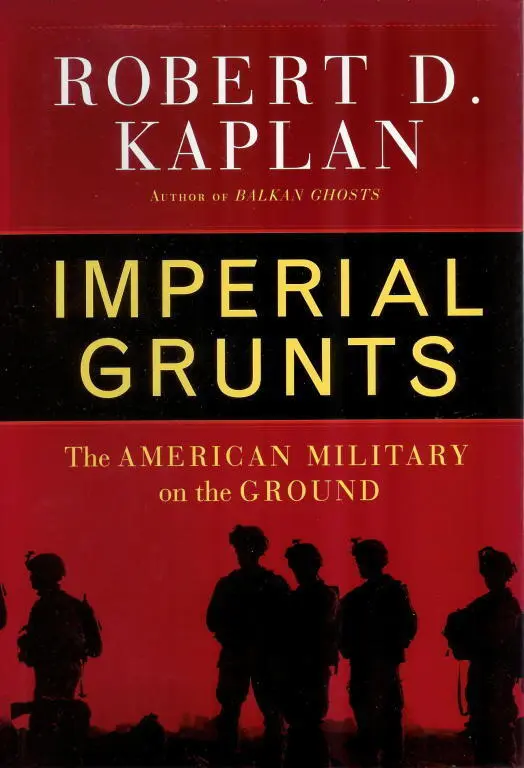
- Название:Imperial Grunts
- Автор:
- Издательство:Random House
- Жанр:
- Год:2005
- Город:New York
- ISBN:978-0-307-27850-0
- Рейтинг книги:5 / 5. Голосов: 1
-
Избранное:Добавить в избранное
- Отзывы:
-
Ваша оценка:
Imperial Grunts: краткое содержание, описание и аннотация
Предлагаем к чтению аннотацию, описание, краткое содержание или предисловие (зависит от того, что написал сам автор книги «Imperial Grunts»). Если вы не нашли необходимую информацию о книге — напишите в комментариях, мы постараемся отыскать её.
Imperial Grunts — читать онлайн бесплатно полную книгу (весь текст) целиком
Ниже представлен текст книги, разбитый по страницам. Система сохранения места последней прочитанной страницы, позволяет с удобством читать онлайн бесплатно книгу «Imperial Grunts», без необходимости каждый раз заново искать на чём Вы остановились. Поставьте закладку, и сможете в любой момент перейти на страницу, на которой закончили чтение.
Интервал:
Закладка:
Special Forces officers teamed up with their counterparts in the Philippine army to question local chiefs and their constituents in the island’s forty barangays, or parishes. They conducted demographic studies helped by satellite imagery. They found that the Christian population was heaviest in the northern part of Basilan, particularly in the island capital of Isabela. Abu Sayyaf’s strongest support was in the south and east of the island, where government services were, not surprisingly, the weakest. The islanders’ biggest concerns were the lack of clean water, basic security, medical care, education, and good roads, in that order.
Democracy or self-rule was not especially critical for the Muslim population: There already had been elections, many of them, which had achieved little for the average person. The government was elected, but did not rule. Abu Sayyaf had shut the schools and hospitals, and kidnapped and executed teachers and nurses. The survey indicated that, just as I had seen in Colombia, the most basic human right is not freedom as people in the West conceive of it, but physical security.
Next, under the auspices of Operation Enduring Freedom—Philippines, the Zamboanga-based joint task force dispatched twelve Green Beret A-teams to Basilan, backed up by three administrative B-teams. Their mission was to train Philippine army units, which would then conduct military operations against Abu Sayyaf. Doing that meant digging water wells for American troops and building roads so that they could move around the countryside. The Americans also built piers and airstrips for their operations. The Green Berets knew that once they departed, all of this infrastructure would be left behind for the benefit of the civilian population, which was the whole point.
It was precisely in the Abu Sayyaf strongholds where the Green Beret detachments chose to be located. That, in itself, encouraged the guerrillas to scatter and leave the island without firing a shot. By guaranteeing security, the American military was able to lure international relief agencies to Basilan, as well as some of the teachers and doctors who had fled. The American firm Kellogg, Brown & Root, a subsidiary of Halliburton, built and repaired schools and water systems. Special Forces medics conducted medical and dental clinics, at which villagers casually volunteered information about the insurgents while their children were being treated for scabies, malaria, and meningitis, and having their teeth pulled.
The objective was always to further legitimize the Philippine military among the islanders. The Americans went nowhere and did nothing without Philippine troops present to take the credit. When ribbons were cut to open a new road or school, the Americans made sure not to be around.
With discretionary funds the Americans also built several small neighborhood mosques. “We hired locally, and bought locally,” a Special Forces officer explained, referring to the labor and materials for each project. The policy was deliberately carried out to the extreme. Repairing roads meant clearing boulders off them. When the Green Berets saw peasants chipping away at these boulders to make smaller rocks, they bought the small jagged rocks (called “aggregate”) from these peasants and used them to lay the new roads.
The ostensible mission was to help Philippine troops kill international terrorists. But that was accomplished by orchestrating a humanitarian assistance campaign, which severed the link between the terrorists and the rest of the Muslim population—exactly what successful middle-level American commanders had done in the Philippines a hundred years before. “We changed the way we were perceived,” one Green Beret told me. “When we arrived in Basilan, Muslim kids made throat-slashing gestures at us. By the time we left they were our friends. That led them to question everything the guerrillas had told them about Americans.”
The Green Berets saw no combat on Basilan. Operation Enduring Freedom—Philippines was an example of unconventional warfare, which, according to Special Forces Lt. Col. David Maxwell, is about “solving complex political-military problems through creative means.”
When I arrived in Basilan the Americans had been gone for almost a year. Were their accomplishments long-lasting?
The hospital in Isabela was a short drive from Col. Ramos’s headquarters. Prior to Enduring Freedom, there were twenty-five beds and most of the staff had fled to Zamboanga. Now there were 110 beds plus a women’s clinic. There was drinkable water and electricity, and the grounds were being landscaped. “Tell the American people that it is a miracle what took place here in 2002,” the hospital director, Dr. Nilo Barandino, told me. “What the American people gave to us we will do our best to maintain and build upon. But there is still a shortage of penicillin. We get little help from our own government in Manila.”
Dr. Barandino said that Basilan used to be a “paradise for kidnappers,” but since the American intervention, kidnapping stopped and the inhabitants of Isabela were going out at night again. A decade earlier he himself had been a kidnap victim.
“I was kidnapped along with my wife and children on November 27, 1992, and released December 24 after the ransom was paid. I’ll never forget those dates. All that we had worked and saved for was gone in a day. We were not molested, tied up, or beaten. The Muslim guerrillas were still in an infant state then, just local bandits. The cruelty, the rapes, and the beheadings were techniques they learned from al-Qaeda in Afghanistan later in the decade.”
From Isabela, the two American sergeants and I headed southwest in a Humvee loaned to us by Col. Ramos. Everywhere we saw bailey bridges and sections of new roads built under the auspices of Enduring Freedom. If there was an island paradise on earth that surpassed all others, it was here, I thought, with rubber tree plantations and pristine palm jungles adorned with breadfruit, mahogany, and mango trees under a glittering sun.
In Maluso, a predominantly Muslim area on Basilan’s southwestern tip, I met a water engineer, Salie Francisco. He jumped in the Humvee with us and took us deep into the jungle to follow the trail of a pipeline constructed by Kellogg, Brown & Root. It led to a new dam, water filtration plant, and school, built under the auspices of the United States Agency for International Development (USAID). The area used to be a lair of Abu Sayyaf. The terrorists were gone. But as Francisco told me, there was no tourism, no jobs, no communications facilities, and yet lots of expectations raised by the Americans.
I saw poor and remote villages of the kind that I had seen all over the world, liberated from fear, but with a new class of Westernized activists beginning to trickle in. “The Philippine military is less and less doing its job here,” Francisco said. “We are afraid that Abu Sayyaf will return. No one trusts the government to finish building the roads that the Americans started.” He went on: “The Americans were sincere. They did nothing wrong. We will always be grateful to their soldiers. But why did they leave? Please tell me. We are very disappointed that they did so.” His smiling, naive eyes cried out for what we in the West call colonialism.
We continued in the Humvee out of the bush and into the port of Maluso, a picturesque firetrap of a town without regular electricity. The aquamarine water was filled with bancas stabilized by bamboo outriggings; fishing was the only economy and it wasn’t much. A tattered assemblage of unemployed men in Muslim skullcaps milled about. Women wore black scarves. Out in the Sulu Sea I saw a seascape of small islands with beautiful beaches that were reportedly infested by pirates and Abu Sayyaf. A mosque dome shaped like an Ottoman turban caught my eye.
Читать дальшеИнтервал:
Закладка:
Похожие книги на «Imperial Grunts»
Представляем Вашему вниманию похожие книги на «Imperial Grunts» списком для выбора. Мы отобрали схожую по названию и смыслу литературу в надежде предоставить читателям больше вариантов отыскать новые, интересные, ещё непрочитанные произведения.








Обсуждение, отзывы о книге «Imperial Grunts» и просто собственные мнения читателей. Оставьте ваши комментарии, напишите, что Вы думаете о произведении, его смысле или главных героях. Укажите что конкретно понравилось, а что нет, и почему Вы так считаете.