Robert Kaplan - Imperial Grunts
Здесь есть возможность читать онлайн «Robert Kaplan - Imperial Grunts» весь текст электронной книги совершенно бесплатно (целиком полную версию без сокращений). В некоторых случаях можно слушать аудио, скачать через торрент в формате fb2 и присутствует краткое содержание. Город: New York, Год выпуска: 2005, ISBN: 2005, Издательство: Random House, Жанр: Публицистика, nonf_military, на английском языке. Описание произведения, (предисловие) а так же отзывы посетителей доступны на портале библиотеки ЛибКат.
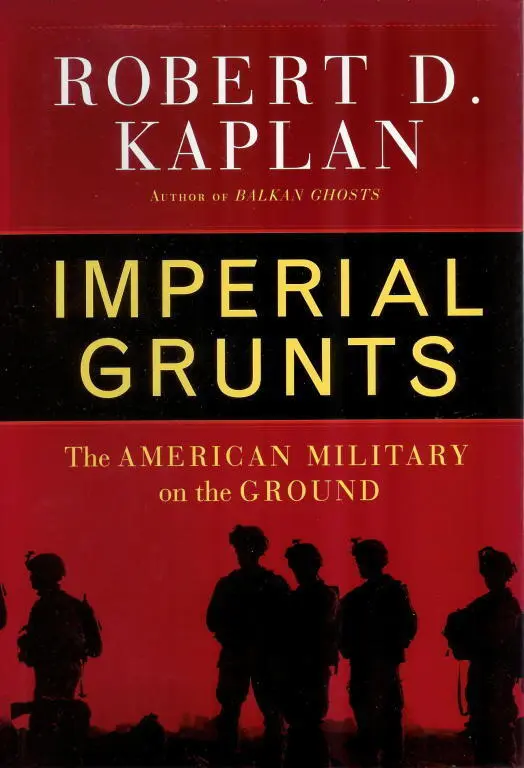
- Название:Imperial Grunts
- Автор:
- Издательство:Random House
- Жанр:
- Год:2005
- Город:New York
- ISBN:978-0-307-27850-0
- Рейтинг книги:5 / 5. Голосов: 1
-
Избранное:Добавить в избранное
- Отзывы:
-
Ваша оценка:
Imperial Grunts: краткое содержание, описание и аннотация
Предлагаем к чтению аннотацию, описание, краткое содержание или предисловие (зависит от того, что написал сам автор книги «Imperial Grunts»). Если вы не нашли необходимую информацию о книге — напишите в комментариях, мы постараемся отыскать её.
Imperial Grunts — читать онлайн бесплатно полную книгу (весь текст) целиком
Ниже представлен текст книги, разбитый по страницам. Система сохранения места последней прочитанной страницы, позволяет с удобством читать онлайн бесплатно книгу «Imperial Grunts», без необходимости каждый раз заново искать на чём Вы остановились. Поставьте закладку, и сможете в любой момент перейти на страницу, на которой закончили чтение.
Интервал:
Закладка:
Once again, the most prosperous and well-maintained part of the landscape was a military base, a large Swiss Family Robinson–style tree house of a complex, with fine prospects on the edge of town, inhabited by the 36th Philippine Army Special Forces Company, a combat dive unit trained by the Americans which patrolled the nearby coast. The Philippine base was decorated with inspirational sayings by famous American authors:
Beauty is altogether in the eye of the Beholder
—Gen. Lew WallaceDestiny is not a matter of chance, it is a matter of will
—William Jennings Bryan“I use the quotations to boost morale,” the commander, Capt. Peter Navarro, told me. He said that since assuming command he was concentrating on the beautification of his post. His company was composed overwhelmingly of Christians from Luzon. Like every other Philippine military encampment I had seen, this one was marked by overt Roman Catholic symbolism. Grace was said before meals. In Basilan, amid the helmet-shaped Muslim headscarves that determined the human landscape of the southern Philippines, Malaysia, and Indonesia, the Christian Philippine military seemed like an occupation force.
As I continued around the island over the next few days, especially in the Muslim region of Tipo-Tipo to the southeast, local officials were openly grateful to the U.S. military for the wells, schools, and clinics that had been built, yet critical of their own government in Manila for “corruption,” and for not providing funds for development. True or not, that was the perception.
In southern Basilan, the material intensity of Islamic culture became overpowering for the first time in my journey south. There was a profusion of head scarves, signs for halal food, and a large new mosque in Tipo-Tipo paid for by Arabian Gulf countries. Mindanao and the Zamboanga Peninsula had contained pockets of Islamic civilization, and were generally poorer than Luzon to the north. It was the same in northern Basilan. But it was only in Maluso and Tipo-Tipo where it became clear to the traveler that he had entered an Islamic continuum, in which the large Indonesian islands of Java, Borneo, and Sumatra seemed closer to him than Luzon.
While I would learn more about Operation Enduring Freedom—Philippines in the course of my travels, one thing was obvious: America could not change the vast forces of history and culture that had placed a poor Muslim region at the southern edge of a badly governed, Christian-run archipelago nation, just as America could not clap its hands and give governments in the mountains of Colombia and Yemen complete control over their lawless lowlands.
All America could do was insert its armed forces here and there, as unobtrusively as possible, to alleviate perceived threats to its own security when they became particularly acute. And because such insertions were often in fragile third world democracies, with difficult colonial pasts and prickly senses of national pride, American forces had to operate under very restricted rules of engagement.
Humanitarian assistance may not have been the weapon of choice for Pentagon hard-liners, who preferred to hunt down and kill “bad guys” through “direct action” rather than dig water wells and build schools—projects which, in any case, were likely unsustainable because of the lack of resolve of national governments like that of the Philippines to pick up where the U.S. had left off. But in a world where nineteenth-century-style colonialism was simply impractical and where the very spread of democracy for which America struggled meant that it could no longer operate with impunity, an approach that merged humanitarianism with intelligence gathering, in order to achieve low-cost partial victories, was what imperialism demanded in the early twenty-first century.
Even that was problematic, though, because any overt connection between humanitarian relief and intelligence gathering was illegal, and could put all Western relief charities under suspicion. But the key was not to get hung up in old-fashioned bureaucratic distinctions. There was nothing illegal or immoral about U.S. military officers simply keeping their eyes and ears open at the same time that they were engaged in civil affairs; it was part of what building normal relationships with the locals is all about. The best intelligence gathering is often done passively, not actively.
From Basilan I returned to the JSOTF in Zamboanga, then traveled on to Subic Bay in order to link up with another Green Beret A-team.
Subic Bay is separated from Manila Bay by the Bataan Peninsula. It was while briefly transiting Manila, en route to Subic Bay, that the full force of the poverty and underdevelopment in the Muslim south of the Philippines struck me. Following almost two weeks in Zamboanga and Basilan, I found the modernity and cleanliness of the domestic terminal in Manila simply stunning. The taxi journey from the airport to the ferry station took me past fancy car dealerships and luxurious malls with flashily dressed men and women. Here’s where all the money was, I realized, made in one street in Manila and spent in another. In the U.S., the capital and principal cities were wealthier than the countryside, but the countryside was still a seemly place to live, with basic services. In the Philippines there was garish luxury in Manila and its environs, and African-level underdevelopment in the Muslim south. In truth, the Philippines was only Luzon, with Mindanao, Sulu, and the other island groups mere offshore possessions, to greater and lesser extents.
Getting to Subic Bay required a ferry journey across Manila Bay to Orion on the Bataan Peninsula. On the dock at Orion I was met by Master Sgt. Mark Lopez, the former team sergeant for ODA-125, a combat dive squad, and his sidekick, Sgt. First Class Jim Irish. I was drenched in sweat just standing there. Looking up at the black-green, heavily jungled peaks of Bataan, I imagined what the Death March of April 1942 must have been like, in which as many as ten thousand American and Filipino troops died from disease, starvation, and the wanton brutality of the Japanese conquerors. 34The drive across the peninsula to Subic Bay took us along part of the route of the Death March, announced by historical markers.
Sgts. Lopez and Irish had just finished conducting a month-long exercise with a Philippine Special Forces unit, and were preparing to return to Okinawa. Mark Lopez was next slated to deploy with the South Korean special forces on a one-man mission. He had just been replaced a few days earlier as the ODA-125 team sergeant. Jim Irish planned to retire soon from the Army. Their Okinawa-based A-team had spent several months on Basilan the previous year.
With his deep tan, baritone voice, bulky muscularity, and beach attire, Lopez, a former surfer from California, fit the stereotypical image of a Special Forces scuba diver. He was self-consciously macho and authentically personable, picking up my train of thought on Manila’s colonial attitude toward the Muslim south with the following: “In the Philippines you see the legacy of Spain versus Ottoman Turkey. Luzon is Spanish Roman Catholic; it’s where all the Ford plants and other foreign factories are. Mindanao—all the way south to Indonesia—constitutes the Muslim world, influenced by Arab traders from the Ottoman Empire.”
Lopez had earned a political science degree from the University of Maryland in his spare time, but was perfectly happy as a noncommissioned officer and had no desire to go to Officer Candidate School. Jim Irish, a fair and towering guy from Pasadena, California, sporting a new tattoo, was the scuba team’s technical support sergeant, the equivalent of an auto mechanic for every piece of diving gear. The two drove me to a townhouse-style complex inside a Philippine naval base to meet the other members of ODA-125, who were planning an underwater combat insertion on an offshore island the following night.
Читать дальшеИнтервал:
Закладка:
Похожие книги на «Imperial Grunts»
Представляем Вашему вниманию похожие книги на «Imperial Grunts» списком для выбора. Мы отобрали схожую по названию и смыслу литературу в надежде предоставить читателям больше вариантов отыскать новые, интересные, ещё непрочитанные произведения.









Обсуждение, отзывы о книге «Imperial Grunts» и просто собственные мнения читателей. Оставьте ваши комментарии, напишите, что Вы думаете о произведении, его смысле или главных героях. Укажите что конкретно понравилось, а что нет, и почему Вы так считаете.