Robert Kaplan - Imperial Grunts
Здесь есть возможность читать онлайн «Robert Kaplan - Imperial Grunts» весь текст электронной книги совершенно бесплатно (целиком полную версию без сокращений). В некоторых случаях можно слушать аудио, скачать через торрент в формате fb2 и присутствует краткое содержание. Город: New York, Год выпуска: 2005, ISBN: 2005, Издательство: Random House, Жанр: Публицистика, nonf_military, на английском языке. Описание произведения, (предисловие) а так же отзывы посетителей доступны на портале библиотеки ЛибКат.
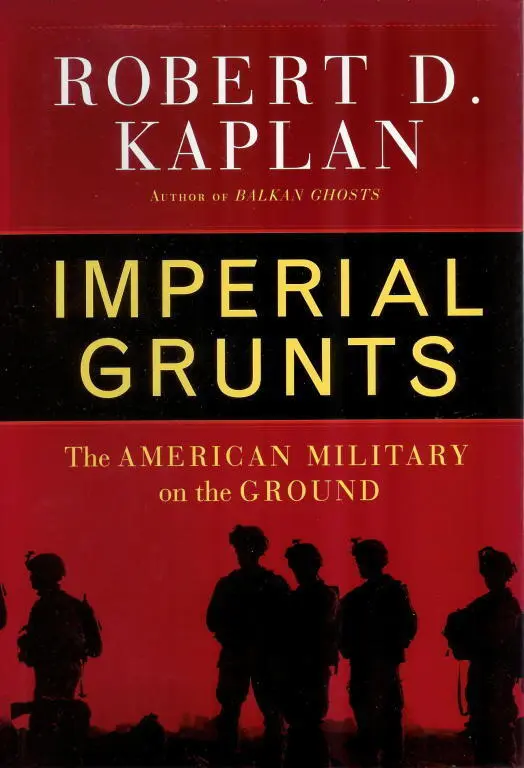
- Название:Imperial Grunts
- Автор:
- Издательство:Random House
- Жанр:
- Год:2005
- Город:New York
- ISBN:978-0-307-27850-0
- Рейтинг книги:5 / 5. Голосов: 1
-
Избранное:Добавить в избранное
- Отзывы:
-
Ваша оценка:
Imperial Grunts: краткое содержание, описание и аннотация
Предлагаем к чтению аннотацию, описание, краткое содержание или предисловие (зависит от того, что написал сам автор книги «Imperial Grunts»). Если вы не нашли необходимую информацию о книге — напишите в комментариях, мы постараемся отыскать её.
Imperial Grunts — читать онлайн бесплатно полную книгу (весь текст) целиком
Ниже представлен текст книги, разбитый по страницам. Система сохранения места последней прочитанной страницы, позволяет с удобством читать онлайн бесплатно книгу «Imperial Grunts», без необходимости каждый раз заново искать на чём Вы остановились. Поставьте закладку, и сможете в любой момент перейти на страницу, на которой закончили чтение.
Интервал:
Закладка:
The JSOTF concept was problematic, though. It indicated how forgetful the U.S. defense establishment could be about successful Cold War efficiencies, such as simply enlarging the ambassador’s country team inside the embassy, in order to handle periodic operations like Enduring Freedom. For example, Plan Colombia was run from within the U.S. Embassy in Bogotá without the need for a separate base elsewhere.
Everything inside the JSOTF, from the construction items to the soldiers and marines themselves, was maintained by a lifeline of C-130 cargo planes flying in from the American base at Okinawa. Few sights offered by imperial America were at once more mundane and stirring than the arrival of a C-130 with supplies and reinforcements for U.S. troops in officially hostile terrain. In the moments prior to landing, an MSE (Marine security element) in full kit drops down into the weeds and elephant grass, and secures a perimeter. Then the big bathtub toy of a plane lands and taxis to a halt, its massive propellers never stopping. The hatch opens in the rear and a K-loader quickly drives up to it. Ten-foot-high pallets of food, equipment, and personal belongings are slid off the plane upright. Next comes the long line of soldiers and marines, jogging out of the fuselage in single file and into waiting buses, men and women in BDUs and marine cammies, their expressions green, blank, expectant, nervous, and raceless in their varied ethnicities. Another line, with happier expressions, more comfortable in their surroundings, jogs into the plane, en route home. A John Deere forklift then brings over another assemblage of pallets to slide into the fuselage. The hatch closes and the plane taxis out for takeoff. The whole process takes ten minutes.
During the time I was at the JSOTF, both the commander and deputy commander happened to be Green Berets, Col. Al Walker of Salt Lake City, Utah, and Lt. Col. Dennis Downey from just south of Boston. Col. Walker was a quiet, self-effacing, gray-haired West Pointer; Lt. Col. Downey a delightfully talkative, moon-faced Irishman, a graduate of Norwich Military Academy in Vermont. Both got to the point quickly. There is a saying in the U.S. defense establishment, “Death by PowerPoint.” Well, Lt. Col. Downey put together a PowerPoint briefing for me that was anything but dull or insignificant. It was about how fed up he and Col. Walker were with elements of the Philippine military.
With the operation on the island of Basilan complete and high politics between Manila and Washington preventing future ones, the principal function of the JSOTF was ops/intel fusion. In plain English, that meant producing intelligence which led to American recommendations for specific battlefield operations, to be carried out by the Armed Forces of the Philippines against Islamic terrorists such as Abu Sayyaf. Like Colombia, the Philippines was a constitutional democracy that would not permit American troops to fight alongside its soldiers on its own soil. That was considered an infringement of national sovereignty. Thus, all Col. Walker and Lt. Col. Downey could do was advise the Filipinos. But even when real-time intelligence was handed to the Armed Forces of the Philippines on a silver platter, it rarely delivered.
Take the American-advised operation on Jolo Island in the Sulu chain in late December 2002, the subject of Lt. Col. Downey’s PowerPoint briefing. It occurred in the same part of Jolo where Capt. John Pershing had conducted successful operations in 1906 against the Moros. The Moros had attacked Pershing’s troops with bolos (machetes), Malay krises (wavy-edged swords), and poison darts fired from blowguns.
Downey, a Southeast Asian area expert, who had spent much of his career in the 1st Special Forces Group based out of Fort Lewis, Washington, warmed to his subject: “Jolo constituted the first time in American history that we fought Muslim insurgents. The Moros on Jolo are Tausug speakers, tough and mean-spirited, like the Chechens. When I tell you the details of what went wrong, have some sympathy for the common Filipino soldier—an eighteen-year-old kid paid the equivalent of $35 per month, with $2 extra for combat pay, and poorly led by generals sometimes making fortunes.”
After Operation Enduring Freedom—Philippines had ejected Abu Sayyaf from Basilan, five of the ten leading al-Qaeda–trained terrorists in Abu Sayyaf escaped to Jolo, where they conducted kidnap-for-ransom operations to raise money. Facing their tiny army were nine battalions of Philippine Marines and Army Scout Rangers, with helicopters and artillery batteries. On December 23, 2002, an American P-3 surveillance plane identified the terrorists arriving by boat at a Jolo port. The American and Philippine intelligence services tracked them into the interior of the island, to a point where they froze in position. The Americans put forward a plan that had Philippine Marines driving the terrorists into a pocket surrounded on three sides by Army Scout Rangers, thereby setting up a “kill box” without any villages nearby where the terrorists could hide. The Americans established a command operation center for the coming attack at Camp Navarro. But a key Philippine general did not show up. “He was not interested in getting out of bed,” Downey said bleakly.
Meanwhile, the Philippine army units designated to surround the terrorists did not move into their blocking positions, as their leaders had promised they would, even as the Philippine Marines began their part of the operation ahead of schedule. By the time the Army units arrived in position, eight hours late, the terrorists had slipped out of the kill box.
“The Filipino army and Marines just hate each other,” Downey explained. “There was total lack of synchronization. Their orders are communicated by text messages on cell phones, which are subsequently deleted, so there is no record, no paper trail, no accountability. The incentive for all kinds of corruption is great; nor is anyone punished for these kinds of screwups.”
Downey, whether aware of it or not, was describing a typical third world cultural failure, in which a functioning bureaucracy truly doesn’t exist, because there are no impersonal rules of behavior that take precedence over labyrinthine personal alliances and bribes. The Abu Sayyaf guerrillas on Jolo, such as Khadaffy Janjalani and Radullan Sahiron—men trained in the ideological hothouse of Afghanistan—had made an end run around their own culture’s weaknesses through indoctrination into a militant belief system, and by operating in small, tightly knit groups where no bureaucracy was required.
Still, Downey said that he had been encouraged by the ease in which the enemy could be targeted and Philippine troops mobilized, albeit not moved into position on time. Occasionally, this had led to success, as in June 2002 when Abu Sayyaf leader Abu Sabaya had been sighted on a banca off the Zamboanga Peninsula and killed. As in Colombia, despite all the failures, despite all the frustrations with the host country’s military, and the limitations on U.S. power, progress was possible, because the average “indig,” or native soldier, was brave and selfless.
You never gave up. You stayed engaged, no matter at how low a level, in order to keep enough pressure on the terrorists so that the threat did not escalate to a point requiring a much larger effort, an effort that would need to occur under a global media spotlight. A failed operation on Jolo was still better than no operation at all, since it kept the terrorists on the run. Such was the frustrating essence of imperial maintenance.
Sometimes imperial maintenance could be genuinely inspiring, like the MEDCAPS (medical civic action programs) that the JSOTF operated in the Zamboanga Peninsula to win “hearts and minds,” a phrase that officers like Col. Walker, who still chafed a bit at being harassed in New York City while on leave from West Point during the Vietnam War, never used cynically.
Читать дальшеИнтервал:
Закладка:
Похожие книги на «Imperial Grunts»
Представляем Вашему вниманию похожие книги на «Imperial Grunts» списком для выбора. Мы отобрали схожую по названию и смыслу литературу в надежде предоставить читателям больше вариантов отыскать новые, интересные, ещё непрочитанные произведения.







Обсуждение, отзывы о книге «Imperial Grunts» и просто собственные мнения читателей. Оставьте ваши комментарии, напишите, что Вы думаете о произведении, его смысле или главных героях. Укажите что конкретно понравилось, а что нет, и почему Вы так считаете.