Robert Kaplan - Imperial Grunts
Здесь есть возможность читать онлайн «Robert Kaplan - Imperial Grunts» весь текст электронной книги совершенно бесплатно (целиком полную версию без сокращений). В некоторых случаях можно слушать аудио, скачать через торрент в формате fb2 и присутствует краткое содержание. Город: New York, Год выпуска: 2005, ISBN: 2005, Издательство: Random House, Жанр: Публицистика, nonf_military, на английском языке. Описание произведения, (предисловие) а так же отзывы посетителей доступны на портале библиотеки ЛибКат.
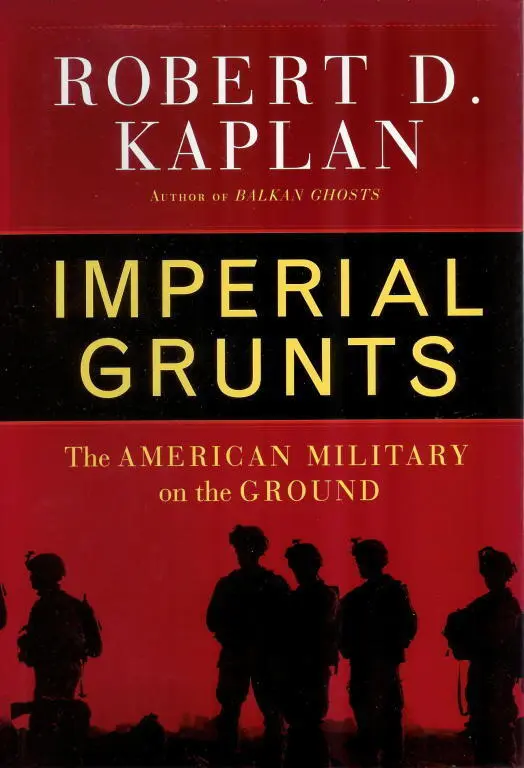
- Название:Imperial Grunts
- Автор:
- Издательство:Random House
- Жанр:
- Год:2005
- Город:New York
- ISBN:978-0-307-27850-0
- Рейтинг книги:5 / 5. Голосов: 1
-
Избранное:Добавить в избранное
- Отзывы:
-
Ваша оценка:
Imperial Grunts: краткое содержание, описание и аннотация
Предлагаем к чтению аннотацию, описание, краткое содержание или предисловие (зависит от того, что написал сам автор книги «Imperial Grunts»). Если вы не нашли необходимую информацию о книге — напишите в комментариях, мы постараемся отыскать её.
Imperial Grunts — читать онлайн бесплатно полную книгу (весь текст) целиком
Ниже представлен текст книги, разбитый по страницам. Система сохранения места последней прочитанной страницы, позволяет с удобством читать онлайн бесплатно книгу «Imperial Grunts», без необходимости каждый раз заново искать на чём Вы остановились. Поставьте закладку, и сможете в любой момент перейти на страницу, на которой закончили чтение.
Интервал:
Закладка:
I came to the Philippines to tell the story of what had taken place on Basilan, and to observe what was still going on.
I was met at the airport in Zamboanga by two U.S. soldiers in full kit and body armor, inside a van with darkened windows. They took me to Camp Navarro, a Philippine military base that was the headquarters of the American Joint Special Operations Task Force that had officially replaced the larger Joint Task Force 510, following the successful ejection of Abu Sayyaf from Basilan. The Americans treated all of Zamboanga outside of Camp Navarro as hostile, hence the guns and flak jackets. A large Muslim population coupled with an incompetent government police force of “Barney Fifes” made Zamboanga a perfect venue for the kind of terror attacks on American soldiers that would generate headlines around the world for a day or two. The local Chinese business community, the city’s only real middle class, had its own private security force.
From inside the van I found Zamboanga (Malay for “land of flowers”) a generic third world city: ratty, smoky with pollution, and jammed with trishaws, jeepneys, and mopeds. Roads were completely flooded from the monsoon rains; bright flowers sprouted like weeds. People were texting on cell phones while dodging water buffaloes in the streets. Vast, seemingly impenetrable mazes of wooden shacks led incongruously to a shopping mall similar to that in a middle-sized American town. With more than six hundred thousand inhabitants, Zamboanga was a somewhat less overwhelming version of many cities in India that I had seen, with the following distinctive features that I would get to know better:
• Much of the city was a warren of slums resting on stilts in the water, connected by narrow channels plied by wooden bancas, boats with bamboo outrigging. Out in the Basilan Strait sat houseboats inhabited by Samas, the Bedouin of the Sulu Sea and Moro Gulf. These fishermen moved back and forth between the southern Philippines and the Indonesian and Malaysian coasts of Borneo. They provided a convenient means for slipping terrorists in and out of the three countries.
• Zamboanga is located astride the fault line between Christianity and Islam. From inside the fungal black walls of Fort Pilar here, the Roman Catholic Spaniards had, for hundreds of years, governed the Muslims of Mindanao and the Sulu Islands. Three thousand Moros had stormed Fort Pilar in 1720. The Americans occupied it in 1898. It was taken by the Japanese in 1942, and liberated by the U.S. Army’s 41st Infantry Division in 1945. Fort Pilar now constituted an open-air Catholic church decorated by the Stations of the Cross and other overt Christian symbols. It was maintained in pristine fashion by the Philippine government, even as it overlooked one of the city’s poorest Muslim slums.
Just as Fort Pilar faced one Muslim slum, Camp Navarro faced another, this one with known Abu Sayyaf sympathizers. “Forget the crap about it ain’t being a culture war,” one American master sergeant told me; “in tactical, operational terms, we have no choice but to treat those people as the enemy.” That translated into clandestine infiltration on one hand and deliberately maintained paranoia on the other. People drove in and out of Camp Navarro in nondescript vans. A Special Forces A-team in civilian clothes roamed the port, nightclubs, and other hangouts, quietly developing local intelligence assets.
The first thing I noticed about Camp Navarro was how spacious and well maintained it was compared to the rest of Zamboanga, with meticulously cut hedgerows and parade grounds. In the third world, military bases often mean a step-up in economic well-being and social prestige, a refuge from the surrounding poverty and chaos. To wit, coups were a symptom of the early and middle stages of political development, in which the military offered the most organized and effective means of modernization. Because civilian governments in the two decades since Marcos’s overthrow were characterized by extremely high levels of corruption and incompetence, military coups remained a distinct possibility here.
Camp Navarro was headquarters for the Philippine military’s Southern Command, or SOUTHCOM. In standard colonial fashion, the Philippine armed forces had been organized on the model of the American one, with geographical areas of operational control. Advising Philippine SOUTHCOM in its war on terror was the American Joint Special Operations Task Force, or JSOTF (the acronym was pronounced “jah-SO-tef”). The JSOTF was a crowded jumble of prefabricated “cheeseboxes” and “blue gooses,” or modified shipping containers, each functioning as barracks for two soldiers. Because the monsoon tended to come at night, getting up to use the bathroom meant going from a freezing, air-conditioned shipping container to intense heat and pouring rain. The mess hall served institutional American food, inferior to the spicy seafood found at sidewalk stands all over Zamboanga. The fruit wasn’t even fresh. Because of hygienic rules set by American doctors, the fruit had to be flown in from the American base at Okinawa, Japan.
I didn’t like the JSOTF. It was claustrophobic, sterile, and impersonal, unlike the cool Green Beret hootches I had become accustomed to in Colombia, which interacted culturally through music and food with the local environment. As a joint command, the JSOTF had Army, Navy, and Air Force personnel, both men and women, often young and unsophisticated about the world outside Camp Navarro. They were guarded round-the-clock by U.S. Marines, distinguished by their high-and-tight haircuts and digital camouflage uniforms, a more complex design than the woodland camouflage of Army and Air Force BDUs.
“Thank God for the Marines,” muttered my roommate in the two-man cheesebox, a Green Beret master sergeant from Detroit. “Without them, this place would be a security nightmare. Few of the kids around here would know how to handle themselves outside the base perimeter. The Marines keep them locked up.” Though only a high school graduate, the master sergeant was a man of the world. He kept me awake the first night at the JSOTF talking about the execution of policemen in Nepal, ethnic problems in the Aceh region of Indonesia, the robbery of Russian soldiers returning from peacekeeping duties in Bosnia after they had crossed the border into Ukraine, and the old-fashioned esprit de corps of Australian commandos with whom he had trained.
Green Berets like my roommate disliked the unnecessarily big American footprint that the JSOTF represented. “It’s what happens when a Navy four-star and an Air Force one-star get to tell Army Special Forces what to do,” another Green Beret told me, referring to the PACOM and SOCPAC command structures. The Green Berets felt that the “Washington political correctness in favor of joint commands”—a reaction to the interservice rivalries of previous decades—had simply gone too far in the Pacific theater, and that in the jungly southern Philippines, the Navy and Air Force “aristocracies” were out of their depth.
In fairness to the Navy and Air Force top brass, the JSOTF had a large footprint because it was built and staffed with the assumption of a larger operation than the one which ultimately materialized. After the liberation of Basilan from Abu Sayyaf, PACOM expected the Philippine government to grant permission for U.S. forces to actively comb the other islands of the Sulu chain for remaining guerrillas. When electoral politics in the Philippines closed that option, the PACOM commander, Adm. Thomas Fargo, kept the JSOTF up and running in the hope, which seemed realistic at the time, of Manila’s decision being reversed.
In fact, with the closure of the two large and historic U.S. bases in the Philippines in the early 1990s—Clark Air Force Base and Subic Bay Naval Station—the JSOTF had succeeded as a political mechanism for getting an American base-of-sorts up and running, even as it earned the goodwill of the local population by providing free medical care in villages near Zamboanga. “Remember,” an Army colonel told me, in defense of the Navy and Air Force approach, “China is nearby and presence in the region is everything. The longer the JSOTF can stay here the better.”
Читать дальшеИнтервал:
Закладка:
Похожие книги на «Imperial Grunts»
Представляем Вашему вниманию похожие книги на «Imperial Grunts» списком для выбора. Мы отобрали схожую по названию и смыслу литературу в надежде предоставить читателям больше вариантов отыскать новые, интересные, ещё непрочитанные произведения.







Обсуждение, отзывы о книге «Imperial Grunts» и просто собственные мнения читателей. Оставьте ваши комментарии, напишите, что Вы думаете о произведении, его смысле или главных героях. Укажите что конкретно понравилось, а что нет, и почему Вы так считаете.