Robert Kaplan - Imperial Grunts
Здесь есть возможность читать онлайн «Robert Kaplan - Imperial Grunts» весь текст электронной книги совершенно бесплатно (целиком полную версию без сокращений). В некоторых случаях можно слушать аудио, скачать через торрент в формате fb2 и присутствует краткое содержание. Город: New York, Год выпуска: 2005, ISBN: 2005, Издательство: Random House, Жанр: Публицистика, nonf_military, на английском языке. Описание произведения, (предисловие) а так же отзывы посетителей доступны на портале библиотеки ЛибКат.
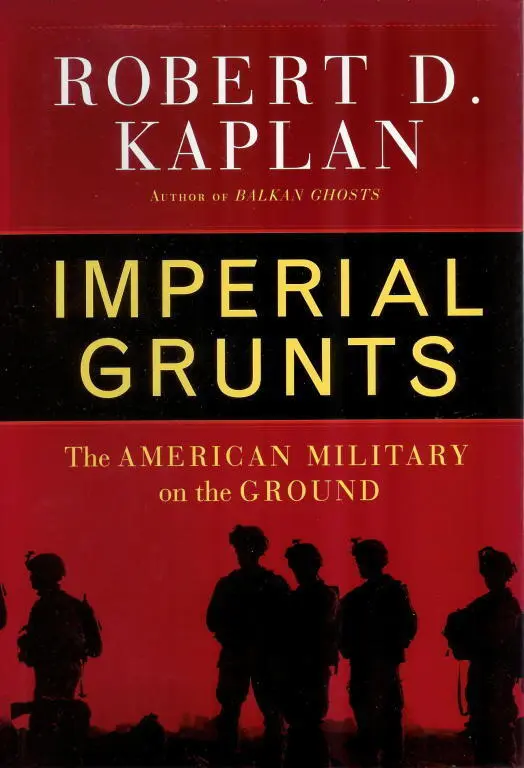
- Название:Imperial Grunts
- Автор:
- Издательство:Random House
- Жанр:
- Год:2005
- Город:New York
- ISBN:978-0-307-27850-0
- Рейтинг книги:5 / 5. Голосов: 1
-
Избранное:Добавить в избранное
- Отзывы:
-
Ваша оценка:
Imperial Grunts: краткое содержание, описание и аннотация
Предлагаем к чтению аннотацию, описание, краткое содержание или предисловие (зависит от того, что написал сам автор книги «Imperial Grunts»). Если вы не нашли необходимую информацию о книге — напишите в комментариях, мы постараемся отыскать её.
Imperial Grunts — читать онлайн бесплатно полную книгу (весь текст) целиком
Ниже представлен текст книги, разбитый по страницам. Система сохранения места последней прочитанной страницы, позволяет с удобством читать онлайн бесплатно книгу «Imperial Grunts», без необходимости каждый раз заново искать на чём Вы остановились. Поставьте закладку, и сможете в любой момент перейти на страницу, на которой закончили чтение.
Интервал:
Закладка:
After the Spanish were defeated, tensions mounted between the new Philippine government headed by a young ethnic Tagalog, Emilio Aguinaldo, and the American liberators, even as Aguinaldo was losing control over his own faction-ridden armed forces. By February 1899, Philippine anarchy and misplaced American idealism ignited into a full-scale war between American troops and a host of indigenous guerrilla armies.
The collapse of central authority led to the complete regionalization of the conflict, with various guerrilla leaders transforming themselves into local warlords. 10The American strategy was to pacify each region and turn it over to a civilian commission for reconstruction, to be headed by an Ohio judge, William Howard Taft, recently appointed by President McKinley. But it was this very civilizing strategy of the American occupiers that accounted for much of the war’s brutality, for it was a direct threat to the warlords’ authority over their own populations.
The American expeditionary force would peak at 69,000 Army, Navy, and Marines, commanded by Army Gen. Arthur MacArthur, a Congressional Medal of Honor winner from the Civil War. Most of Gen. MacArthur’s officers and troops were volunteers from states west of the Mississippi River, whose predominant military experience, if they had any, had been fighting the Indians. Of the thirty American generals in the Philippines, twenty-six had been in the Indian wars.
As with the Indian wars, in which tactics were somewhat different for each tribe, the American forces in the Philippines, scattered among four hundred isolated garrisons on different islands, fought many separate conflicts. Middle-level American officers in the Philippines at the end of the nineteenth century, lacking radios and helicopters, often had no possibility of following instructions from general headquarters. Thus, they became policymakers in their own patch of jungle, acquiring area expertise, and developing their own counterinsurgency campaigns specifically suited to the political, military, and cultural situation in each micro-region. They improvised by trial and error. By reporting their successes and failures to their superiors, they influenced policies up the command chain.
It became a war of company commanders impatient with paperwork and routine. William H. Taft told Secretary of War Elihu Root that “the pacification of the Islands seems to depend largely on the character of the military officer in charge of the particular district.” 11
That was the military the way it was supposed to be, with generals backing up decisions of subordinates who were closer to the action. Tom Wilhelm had told me much the same thing.
For example, in the extreme north of Luzon, Lt. Col. Robert L. Howze, a Texan who had won the Medal of Honor in the Indian wars, set up a school system and a local government, making the transition from a combat commander to a provincial governor. 12Yet it was Lt. Col. Howze’s very success, along with the paucity of troops at his disposal—there were only five companies confined to a few towns—that led the guerrillas to cut telegraph lines, attack convoys, and threaten civilians who cooperated with the Americans. Howze’s response was decisive. He organized aggressive patrols that ravaged the whole region, killing and surrounding the guerrillas, allowing them to die of hunger and disease, even as he offered amnesty to the simple villagers who had been coerced into helping the insurrectos.
In one instance, Howze told his commanders: “warn [civic officials] that the feeding, sheltering and harboring of the Insurrecto element must at once cease, or the vicinity will be laid to waste, even to the extent of destroying their crops.” 13Howze created a local intelligence service like the native scout units being set up by the British in India, even as he established village governing councils, which were the first rudimentary step toward self-rule.
The native intelligence services that the Americans established were “hard to beat,” in the words of Brig. Gen. Frederick Funston. 14A Kansas native with trekking experience in the Dakota badlands, Gen. Funston, the commander of a district in another part of Luzon, set up his own spy service, which he rewarded with large payments. When some of his spies were kidnapped, he would kidnap the family of a prominent guerrilla. He even organized a native strike force that he personally led into battle. “By conciliating powerful ethnic and social groups, using native auxiliaries, and conducting military operations which struck at the guerrillas but left the populace relatively untouched, he was able to destroy opposition in slightly more than a year,” Linn writes. 15
While in some parts of the archipelago the U.S. military was able to exploit ethnic divisions, in other parts it was foolish to try. In some parts a purely military strategy was called for; in others a civil affairs and humanitarian component was an absolute necessity. There was one constant, though: both military victory and social reform were possible only when, as Linn observes, “the Army could separate the guerrillas from civilians,” thus preventing the guerrillas from obstructing civic organizations. 16It was this overriding truth that would form the basis for the Army Special Forces plan to undermine international terrorism in the Philippines a century later.
On July 4, 1902, when President Theodore Roosevelt proclaimed the Philippine War over, 4,234 American soldiers had been killed in the conflict and 2,818 wounded. 17Overall, 200,000 people died, mainly Filipino civilians. 18Fighting in the Muslim south would go on for years. One could well argue that it was all unnecessary in the first place, a political blunder of the highest magnitude by the McKinley administration, in which America’s idealism and naÏveté led it on a path of destruction and brutality. But the strictly military part of the equation looked different. As Max Boot writes:
the success of the U.S. counterinsurgency effort was due not to committing atrocities—24,000 soldiers [in the field] could hardly hope to terrorize 7 million people into submission—but to paying attention to the rudiments of counterinsurgency strategy. In Vietnam… the army squandered its resources on fruitless search-and-destroy missions. In the Philippines, by contrast, it concentrated on cutting off the guerrillas from civilian assistance by garrisoning the countryside. While the men grumbled about the monotony of life in the boondocks (an Americanization of the Tagalog bundok, meaning “mountain”), their very isolation forced them to become well acquainted with their area and the people who lived there. 19
The military victory, however messy and brutal, was followed by decades of American rule that the journalist and historian Stanley Karnow calls “a model of enlightenment” compared to European colonialism. 20Samuel Tan, the Filipino historian who is critical of American policy in other respects, concurs, describing American rule as the historical engine that brought modernity to the Filipino masses. 21
The Americans forbade themselves to buy large tracts of land. They avoided schemes like opium monopolies. They redistributed land to peasants from wealthy church estates, and built roads, railways, ports, dams, and irrigation facilities. American expenditures on health and education led to a doubling of the Filipino population between 1900 and 1920, and a rise in literacy from 20 to 50 percent within a generation. 22
The Philippines, in turn, affected the destiny of twentieth-century America to a degree that few faraway countries have. Taft’s leadership of the Philippine Commission propelled him to the presidency of the United States. Capt. John “Black Jack” Pershing, who would head the expedition against Pancho Villa in Mexico and command American forces in World War I, was promoted to brigadier general over nine hundred other officers after his stellar performance in leading troops against Islamic insurgents in the southern Philippines. Douglas MacArthur, son of Gen. Arthur MacArthur, came to the Philippines to command an American brigade and returned for a second tour of duty as the indigenous government’s military advisor. One of Douglas MacArthur’s aides in Manila was a middle-aged major, Dwight D. Eisenhower, who honed his analytical skills for World War II by attempting to organize a Philippine national army. The Japanese victory over Gen. Douglas MacArthur’s forces on the Philippines, MacArthur’s last stand on Corregidor Island in Manila Bay before retreating to Australia, the subsequent Japanese atrocities committed against both American and Filipino prisoners of war during the Death March on the nearby Bataan Peninsula, and MacArthur’s triumphal return to the Philippines in the battle of Leyte Gulf, all became part of the Homeric legend of World War II that bound Americans to their military, and gave the American and Filipino peoples a common bond.
Читать дальшеИнтервал:
Закладка:
Похожие книги на «Imperial Grunts»
Представляем Вашему вниманию похожие книги на «Imperial Grunts» списком для выбора. Мы отобрали схожую по названию и смыслу литературу в надежде предоставить читателям больше вариантов отыскать новые, интересные, ещё непрочитанные произведения.



Обсуждение, отзывы о книге «Imperial Grunts» и просто собственные мнения читателей. Оставьте ваши комментарии, напишите, что Вы думаете о произведении, его смысле или главных героях. Укажите что конкретно понравилось, а что нет, и почему Вы так считаете.