Robert Kaplan - Imperial Grunts
Здесь есть возможность читать онлайн «Robert Kaplan - Imperial Grunts» весь текст электронной книги совершенно бесплатно (целиком полную версию без сокращений). В некоторых случаях можно слушать аудио, скачать через торрент в формате fb2 и присутствует краткое содержание. Город: New York, Год выпуска: 2005, ISBN: 2005, Издательство: Random House, Жанр: Публицистика, nonf_military, на английском языке. Описание произведения, (предисловие) а так же отзывы посетителей доступны на портале библиотеки ЛибКат.
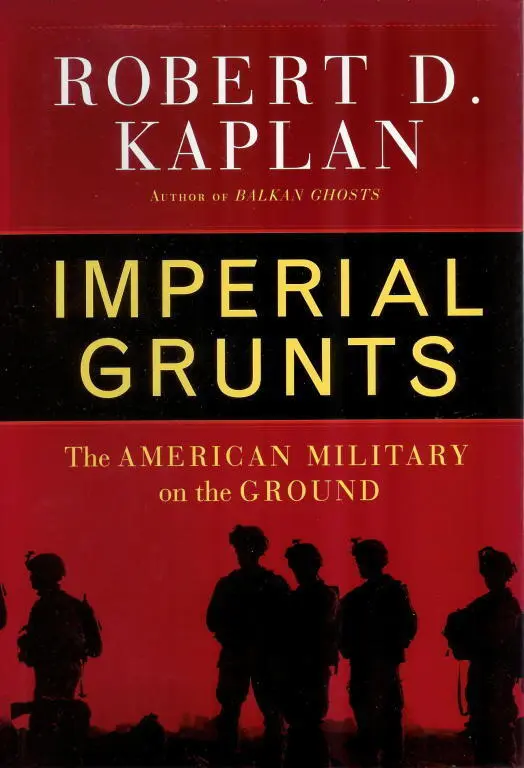
- Название:Imperial Grunts
- Автор:
- Издательство:Random House
- Жанр:
- Год:2005
- Город:New York
- ISBN:978-0-307-27850-0
- Рейтинг книги:5 / 5. Голосов: 1
-
Избранное:Добавить в избранное
- Отзывы:
-
Ваша оценка:
Imperial Grunts: краткое содержание, описание и аннотация
Предлагаем к чтению аннотацию, описание, краткое содержание или предисловие (зависит от того, что написал сам автор книги «Imperial Grunts»). Если вы не нашли необходимую информацию о книге — напишите в комментариях, мы постараемся отыскать её.
Imperial Grunts — читать онлайн бесплатно полную книгу (весь текст) целиком
Ниже представлен текст книги, разбитый по страницам. Система сохранения места последней прочитанной страницы, позволяет с удобством читать онлайн бесплатно книгу «Imperial Grunts», без необходимости каждый раз заново искать на чём Вы остановились. Поставьте закладку, и сможете в любой момент перейти на страницу, на которой закончили чтение.
Интервал:
Закладка:
Keep in mind that this was largely the Army’s perspective, and that of the Special Forces in particular. PACOM had other realities and points of view. The overriding fact of the Pacific theater was oceanic distance, which led to a reliance on the Navy and Air Force. Following the destruction of the Japanese navy and merchant fleet in World War II, critical SLOCS (sea lines of communication) had to be maintained for U.S. commerce and potential military operations against the Soviet Union. Though the Soviet threat became irrelevant, the sea lane threat from China continued to grow.
Thus, except for the Korean theater, the Army had always been the minor element in PACOM. The PACOM commander was traditionally a Navy admiral. The head of SOCPAC (Special Operations Command, Pacific), with operational control for Army Special Forces in the theater, was often an Air Force brigadier general. The Navy and Air Force thought more abstractly than the Army. They put more emphasis on fleet diplomacy in the Taiwan area and in the containment of North Korea than in unconventional wars in the Philippines and in collapsed states like East Timor. Indeed, because North Korea was still a major threat, PACOM remained somewhat in a Cold War mode of nuclear Armageddon. [32] Though the Korean Peninsula was technically under its own separate command from PACOM, it was the centerpiece of any regional strategy.
Finally, there was the pall of the Vietnam experience, which made PACOM particularly averse to land adventures in Asia. As one Army officer complained in mid-2003: “CENTCOM lives and breathes the unconventional post–Cold War world. So does EUCOM, with its peacekeeping and humanitarian rescue operations in the Balkans, Africa, and the Stans; while the biggest deal in SOUTHCOM is Special Forces in Colombia. But PACOM is twenty years behind the times, afraid of messy little wars and of a transparent humanitarian affairs role for SF. As for North Korea, it’s liable to melt down in the most unconventional of ways.”
September 11 eased PACOM out of its Cold War–era torpor. When President George W. Bush and his advisors scanned the world for places to get down and dirty with Islamic terrorism, the stark fact of the Philippines, a pathetically corrupt and heavily populated archipelago ridden with Islamic insurgents, became impossible to ignore. And that was a job for Special Operations Command.
In historical terms America had come full circle. It was in the Philippines where America’s epic experience in the Pacific had begun in earnest the century before, when President William McKinley dispatched a naval expedition to Manila Bay from Honolulu. The victory over Muslim insurgents in the Philippines at the start of the twentieth century—a corollary to the Spanish-American War of 1898—constituted the second milestone in the imperial progress of the United States, following the consolidation of the American West.
Throughout the nineteenth century, side by side with westward expansion, the United States Navy and Marines had been establishing, to quote Abraham Lincoln’s secretary of state, William Henry Seward, an “empire of the seas.” 4Built on trade and influence much more than on outright occupation, America’s mercantile, seaborne empire bore a certain resemblance to that of Venice. Driving it was the same pioneer optimism and bravado that had been expanding the borders of white settlement into the south and west of the continent, encouraged further by the economic dynamism that ensued from the industrial North’s victory in the Civil War.
U.S. sailors and marines staged repeated landings in Argentina, Peru, Nicaragua, Uruguay, Mexico, Chile, and Panama (then part of Colombia). The aggressive incursions in Latin America, designed to prop up and topple governments, and to protect American diplomats and the trading interests of an expanding nation, were replicated in the Caribbean, and also in the Pacific.
In 1887 the U.S. Navy gained exclusive access to Pearl Harbor, following the economic integration of Hawaii with post–Civil War America. The Navy also raided China, and great and small islands from Sumatra to the Marquesas. The United States opened Japan to American trade, purchased Alaska, charted and claimed the Midway Island group. And after a drawn-out series of sea engagements and negotiations, it acquired an island in the Samoas. 5
America’s entry into the Philippines began at dawn May 1, 1898, when Commodore George Dewey’s nine ships, having passed Corregidor Island off the Bataan Peninsula under cover of darkness, entered Manila Bay and destroyed a slightly larger Spanish flotilla. Like so many signal episodes in history, Dewey’s victory was both the culmination of vast political and economic forces and an accident of circumstance that might easily have not occurred, for it was not instigated by events in the Pacific at all, but by those in the Caribbean, where Spain’s repression of Cuba led President McKinley—urged on by expansionists including Assistant Secretary of the Navy Theodore Roosevelt—to declare war on the Spanish empire.
The invasion of the Philippines marked the first time that the U.S. had deliberately set out to conquer a large piece of territory overseas in order to occupy it. That would not happen again until the invasion of Iraq more than a century later. Though it began with Commodore Dewey’s glorious overture, the first major conflict for the United States outside its continental limits descended within a few months into a military nightmare, as well as a domestic trauma of a kind not to be seen again until Vietnam. 6The mistakes that the U.S. made in the Philippines, the varied experiences that the U.S. military had there, and the plethora of tactical lessons that American troops learned in the course of years of jungle warfare offered a far richer repository of information in terms of the war, peacekeeping, and nation-building challenges of the turn of the twenty-first century than the experiences of World Wars I and II combined. And had the U.S. military paid more attention to its successes and failures in the Philippines—what worked and what didn’t—it would have dealt with Vietnam better than it did.
The Philippine War was a gory, real-world experience writ large: the kind that both the American media and public, both then and now, could not and cannot bear. As a result, the military’s overall performance in the Philippines gained an undeservedly bad reputation. The instances of brutality committed by American troops, partly a response to the brutality of the Filipino insurgents, allowed a somewhat naive and muckraking press in the U.S. to smear the entire campaign. Thus, the painful military lessons gained in the Philippines were either ignored or forgotten by the same Army that would have to fight later in Vietnam, writes Brian McAllister Linn in The U.S. Army and Counterinsurgency in the Philippine War, 1899–1902 . 7Nevertheless, the larger truth, in the words of Max Boot, in The Savage Wars of Peace, is that U.S. actions in the Philippines constituted “one of the most successful counter-insurgencies waged by a Western army in modern times.” 8
Following Dewey’s successful entry into Manila Bay, the American military assisted Filipino insurgents in their takeover of the Spanish-run archipelago. But just as they would in Iraq and elsewhere, the Americans wrongly assumed that because local elements welcomed the ouster of a despotic regime, they would automatically remain friendly once the regime was toppled. Freedom was “understood in differing ways,” explains the Filipino historian Samuel K. Tan. The United States “pursued the quest of empire in the name of freedom to civilize the world,” while for Filipinos freedom had little to do with elected government and everything to do with a “mystical relationship between the people and the natural environment.” 9
Читать дальшеИнтервал:
Закладка:
Похожие книги на «Imperial Grunts»
Представляем Вашему вниманию похожие книги на «Imperial Grunts» списком для выбора. Мы отобрали схожую по названию и смыслу литературу в надежде предоставить читателям больше вариантов отыскать новые, интересные, ещё непрочитанные произведения.




Обсуждение, отзывы о книге «Imperial Grunts» и просто собственные мнения читателей. Оставьте ваши комментарии, напишите, что Вы думаете о произведении, его смысле или главных героях. Укажите что конкретно понравилось, а что нет, и почему Вы так считаете.