Robert Kaplan - Imperial Grunts
Здесь есть возможность читать онлайн «Robert Kaplan - Imperial Grunts» весь текст электронной книги совершенно бесплатно (целиком полную версию без сокращений). В некоторых случаях можно слушать аудио, скачать через торрент в формате fb2 и присутствует краткое содержание. Город: New York, Год выпуска: 2005, ISBN: 2005, Издательство: Random House, Жанр: Публицистика, nonf_military, на английском языке. Описание произведения, (предисловие) а так же отзывы посетителей доступны на портале библиотеки ЛибКат.
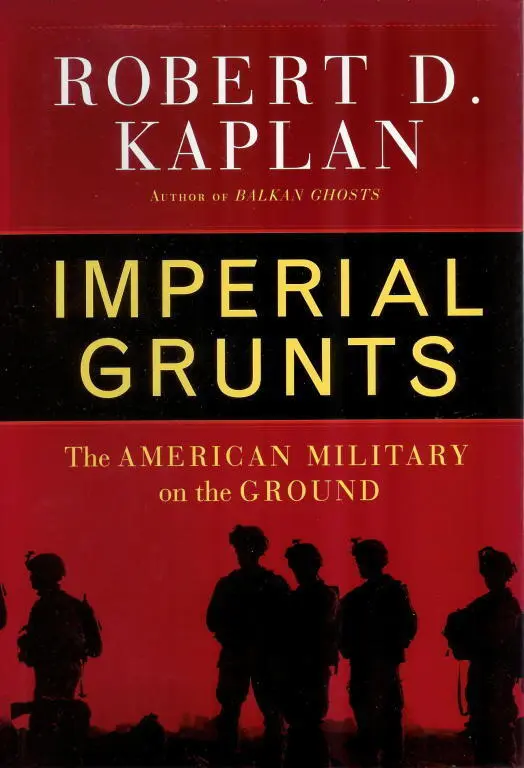
- Название:Imperial Grunts
- Автор:
- Издательство:Random House
- Жанр:
- Год:2005
- Город:New York
- ISBN:978-0-307-27850-0
- Рейтинг книги:5 / 5. Голосов: 1
-
Избранное:Добавить в избранное
- Отзывы:
-
Ваша оценка:
Imperial Grunts: краткое содержание, описание и аннотация
Предлагаем к чтению аннотацию, описание, краткое содержание или предисловие (зависит от того, что написал сам автор книги «Imperial Grunts»). Если вы не нашли необходимую информацию о книге — напишите в комментариях, мы постараемся отыскать её.
Imperial Grunts — читать онлайн бесплатно полную книгу (весь текст) целиком
Ниже представлен текст книги, разбитый по страницам. Система сохранения места последней прочитанной страницы, позволяет с удобством читать онлайн бесплатно книгу «Imperial Grunts», без необходимости каждый раз заново искать на чём Вы остановились. Поставьте закладку, и сможете в любой момент перейти на страницу, на которой закончили чтение.
Интервал:
Закладка:
Few vistas are as laden with fateful patriotic memory as the one seen from the grounds of Camp H. M. Smith outside Honolulu, Hawaii, home of U.S. Pacific Command (PACOM). [29] Marine Maj. Gen. Holland McTyeire (“Howling Mad”) Smith is the father of amphibious training of the U.S. armed forces. Before the outbreak of World War II, the Alabama-born general foresaw the need for U.S. soldiers and marines to land on enemy beaches in the face of hostile fire. See Robert Sherrod’s Tarawa: The Story of a Battle (New York: Duell, Sloan and Pearce, 1944), pp. 133–34.
From the cluster of yellow World War II buildings that served as PACOM headquarters until 2004, when a new building opened on the site, I saw in one sweep the whole tragic landscape of December 7, 1941.
From left to right I gazed down upon Hickam Field; Pearl Harbor, with the U.S.S. Arizona Memorial off Ford Island—a mass grave for 1,177 sailors and marines; the shadowy lava peaks of the Waianae Range, behind which Japanese bombers hid in the moments prior to their assault; Wheeler Air Force Base; and Schofield Barracks, the forward post of the 25th Infantry Division, memorialized by James Jones in From Here to Eternity.
The Hawaiian island of Oahu, like the Deep South and the Great Plains, screamed military. Uniformed Americans were ever-present, so different from the Northeast where I lived. There, with the exception of Fort Drum in northern New York State, home of the Army’s 10th Mountain Division, the major bases had been closed and scaled back decades before. It was one of the lesser noted causes of the Northeast’s anti-militarism, in comparison to the rest of the country. [30] The Northeast certainly has military facilities—the Hanscom Air Force Base in Portsmouth, New Hampshire; the Soldier Systems Center in Natick, Massachusetts; the U.S. Military Academy at West Point, New York; the Naval War College in Newport, Rhode Island; and so on. Nevertheless, no military facility in the Northeast serves as the home of thousands of uniformed troops and their families, and none has generated a retirement community of former military men and women, as bases in the heartland and in the South have.
I had stopped at PACOM for briefings en route to the Philippines. While in Mongolia, I received a message from Maj. Gen. Geoff Lambert at Fort Bragg, asking if I wanted to be embedded with Army Special Forces in the Philippine islands of Mindanao and Luzon. It was an easy call. While the media was focused on Afghanistan and Iraq, the southern Philippines had quietly become a laboratory for drying up an Islamic insurgency, as well as for small-scale nation-building.
As the majestic view from its headquarters indicated, PACOM enjoyed all the grandeur that poor little SOUTHCOM lacked. PACOM had its roots in America’s old Pacific Army, which existed from the 1899–1902 Philippine War to World War II. The Pacific Army had arisen from the ashes of the Indian fighting force of frontier days. It was as close to a British colonial institution as the U.S. had ever produced. Its snappy uniforms were made by Chinese tailors, and were worn by men who talked of jungle marches, of the treacherous Moros of Mindanao and the Sulu Islands, and of the headhunters of Luzon. America’s Pacific soldiers of the early twentieth century belonged “to the Bamboo or Carabao or Pineapple armies” of the Philippines and Hawaii. They had their own marching songs like “The Monkeys Have No Tails in Zamboanga.” Their officers played polo with the local Pacific island elites, while the lower ranks kept exotic village maidens as mistresses. When their ships docked in Honolulu the troops were serenaded by regimental bands and decked with flower leis. 1
The character and ambience of this colonial-style army was brutally captured for posterity in Jones’s From Here to Eternity, a saga of thirty-year lifers rather than of citizen soldiers, for whom the military is simply “The Profession.” Robert E. Lee Prewitt, Jones’s main protagonist, is inspired to join the Army out of Harlan County, Kentucky, not because of the stories he heard from older men about World War I, but because of the ones they told him about fighting the “Goddam” Muslim Moros in the Philippine insurrection. 2
The surviving remnants of that world were visible in the open-porched quadrangles at Schofield Barracks and the line of wood-framed, hip-roofed houses at nearby Fort Shafter, with their mint green facades and screened porches, encased in a graceful clutter of flowering trees and venerable palms. Through the early twenty-first century, Army general officers assigned to PACOM in Oahu were still living in these elegant termite-infested structures, listed on the National Historic Register.
America’s Pacific troops still accounted for the bulk of its overseas soldiery, just as they had a hundred years before. Whereas SOUTHCOM had a paltry 1,271 dedicated troops, CENTCOM 22,046, EUCOM 112,000, and NORTHCOM 133,407, PACOM had a whopping 280,840 troops in addition to 75 warships, 35 submarines, and 1,679 combat aircraft. 3CENTCOM fought wars in Iraq and Afghanistan with troops borrowed from PACOM.
History and current reality accounted for the extreme imbalance among the area commands. [31] Defense Secretary Donald Rumsfeld considered this imbalance irrelevant, arguing that troops everywhere belonged to him and the President, to be moved around as they saw fit. But outside Washington, the proprietary attitude with which the various area commands referred to their troops was striking. Also, Rumsfeld’s argument presupposed a powerful defense secretary as well as a president focused constantly on military matters. As the 1990s showed, a less forceful defense secretary coupled with a distracted president allowed some area commanders to become barons in their own theaters.
The Pacific, specifically the Philippines, had been the setting of America’s first great overseas war. The Pacific theater had been one of the two great components of World War II. Afterwards, the only large-scale and sustained conflicts in which Americans fought and died were in the Pacific—Korea and Vietnam. The very size of the Pacific Ocean meant PACOM bore responsibility for 51 percent of the earth’s surface. India, the two Koreas, China, and the numerous archipelagoes of the South Seas, including Indonesia—the most populous Muslim nation—also meant that PACOM’s area included 60 percent of the world’s people. And these were mainly highly educated, high-technology populations with expanding militaries, difficult relations with each other, and increasing dependence on imported oil.
Moreover, America did a third of its trade with the Far East. The Strait of Malacca between the Malay Peninsula and the Indonesian island of Sumatra was the busiest waterway in the world. There were nuclear standoffs on the Korean Peninsula and the Indian subcontinent. Islamic fundamentalism infected the bigger archipelagoes, while some of the smaller ones were failed states like the Solomon Islands. Looming over all of this was the rising power of China. The Pacific theater could make a grand strategist’s head spin.
The briefings at PACOM packed the following theme, even if the briefers themselves did not fully spell it out. Forget central governments and national sovereignty. The Philippines, Malaysia, and Indonesia constituted one vast, interconnected archipelago, whose innumerable remote islands made it a crossroads for international terrorism. Terrorists used these poor, shantyish, unpoliceable islands as hideouts for training and rest and rehabilitation. Combating Islamic terrorism in this region carried a secondary benefit for the United States: it positioned the U.S. for the future containment of nearby China.
Читать дальшеИнтервал:
Закладка:
Похожие книги на «Imperial Grunts»
Представляем Вашему вниманию похожие книги на «Imperial Grunts» списком для выбора. Мы отобрали схожую по названию и смыслу литературу в надежде предоставить читателям больше вариантов отыскать новые, интересные, ещё непрочитанные произведения.






Обсуждение, отзывы о книге «Imperial Grunts» и просто собственные мнения читателей. Оставьте ваши комментарии, напишите, что Вы думаете о произведении, его смысле или главных героях. Укажите что конкретно понравилось, а что нет, и почему Вы так считаете.