Robert Kaplan - Imperial Grunts
Здесь есть возможность читать онлайн «Robert Kaplan - Imperial Grunts» весь текст электронной книги совершенно бесплатно (целиком полную версию без сокращений). В некоторых случаях можно слушать аудио, скачать через торрент в формате fb2 и присутствует краткое содержание. Город: New York, Год выпуска: 2005, ISBN: 2005, Издательство: Random House, Жанр: Публицистика, nonf_military, на английском языке. Описание произведения, (предисловие) а так же отзывы посетителей доступны на портале библиотеки ЛибКат.
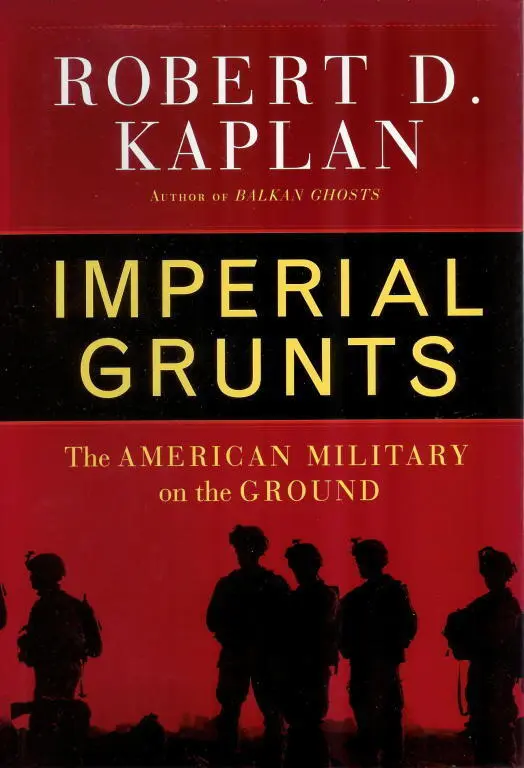
- Название:Imperial Grunts
- Автор:
- Издательство:Random House
- Жанр:
- Год:2005
- Город:New York
- ISBN:978-0-307-27850-0
- Рейтинг книги:5 / 5. Голосов: 1
-
Избранное:Добавить в избранное
- Отзывы:
-
Ваша оценка:
Imperial Grunts: краткое содержание, описание и аннотация
Предлагаем к чтению аннотацию, описание, краткое содержание или предисловие (зависит от того, что написал сам автор книги «Imperial Grunts»). Если вы не нашли необходимую информацию о книге — напишите в комментариях, мы постараемся отыскать её.
Imperial Grunts — читать онлайн бесплатно полную книгу (весь текст) целиком
Ниже представлен текст книги, разбитый по страницам. Система сохранения места последней прочитанной страницы, позволяет с удобством читать онлайн бесплатно книгу «Imperial Grunts», без необходимости каждый раз заново искать на чём Вы остановились. Поставьте закладку, и сможете в любой момент перейти на страницу, на которой закончили чтение.
Интервал:
Закладка:
“The values the Mongols have are those of our pioneer forebears 150 years ago, when they settled the frontier. They were full of optimism and busy with chores, emptying the wash pail, getting the fire started in the morning. What a tough life it was—freezing in a wagon train threatened by Indians. Yet few regretted it. Anything could happen and it was all good—that was the central tenet of the pioneer spirit.” Wilhelm’s parting gift to Col. Battsengel was a lavish coffee table volume of Frederic Remington’s paintings of the nineteenth-century American West.
Battsengel introduced us to Col. Kh. Ranjinnyam, a bearish, scruffy, and friendly-looking man who would be our guide on a northeasterly journey along the Chinese border, into an area where Mongolia sticks out into Manchuria. Col. Ranjinnyam’s UAZ followed ours until we had driven a few miles beyond Zamyn-Uud. Then we got out and, in the midst of the desert, toasted farewell to Col. Battsengel with a few glasses of Absolut, the only high-quality vodka we had on the journey.
Following final farewells, we transferred to Col. Ranjinnyam’s UAZ and set out over a tableland of sagebrush and tumbleweed, stopping after twenty miles at a zastaf. I was freezing despite my long underwear. The outhouse was an eighth of a mile away in the ceaseless wind. This zastaf had the same spartan minimalism as the one we had seen the day before, with the floors painted a lovely autumnal yellow, and the smell of fresh bread and drying jerky on the roof, a bit of which a petite girl in a blue smock put in our soup along with horse meat. Horse meat, I had decided, tasted as good as beef.
Another twenty miles brought us to another border post and another line of soldiers in fur hats and greatcoats holding ancient AK-47s and standing at attention alongside women and children in the bleating wind on a knife-carved steppe. Here Wilhelm gave yet another short speech of thanks, on behalf of the people of the United States of America.
It turned out that the meal at the previous zastaf was only a pre-lunch snack. Here we were brought veritable masses of food. Eyeing the beds beside the eating table, Col. Ranjinnyam announced that it was time for a nap. Within a moment he was snoring loudly. Wilhelm, Maj. Altankhuu, and I followed suit. When I awoke Col. Ranjinnyam was already sitting up in bed, his hair and uniform in disarray and pouring himself another glass of vodka, like a character out of a Russian short story. “It’s time to go,” he announced.
More zastafs and lonely soldiers looking like throwbacks to the czarist army. The landscape of the Gobi kept shifting: small glaciers and glinting streams that wove through gravel fields beside volcanic slag heaps, followed by horizonless uplands of igneous rock engulfed in late-afternoon shadow. Then came vast dirt expanses that gradually shed their stubble, so that by dusk there was nothing in sight but empty sand, with the desert unfurling like a long, haunting echo, a warbling note held at the back of the throat until eternity. I thought of the sound of a morin khuur, the traditional Mongolian fiddle capable of the most astonishing sounds with only two horsehairs.
We stopped for the night at Ulaan-Uul (Red Rock), a regiment-sized encampment for the border force. Wilhelm and I shared a small icy room where he continued his reminiscences of Bosnia. I didn’t ask questions. I just let him talk. Homer must have been a middle-ranking officer like Wilhelm, I thought, a great oral historian.
“The Russians were in Uglevik, Republike Srpske, to patrol a sector in the U.S.-led area of operations,” Wilhelm said. “They had American brigades on either side of them. They had their own JMCs [joint military commands] to set up. Again, there was no doctrine for this. Daily patrols were the guts of the Dayton agreement, and I went on many patrols with the Russians, enduring their combat rations of tinned fish and buckwheat. Their BTR-80s [Bronetransporter, the Russian armored personnel carrier] dispelled the myth of cramped and clunky Red Army fighting vehicles. They were quite comfortable and user-friendly, with plenty of room for a squad in full kit to prep equipment and swap positions.
“We went to one village where the church had been destroyed,” Wilhelm went on, “and the Serbs had their headquarters on the wrong side of the street. They had had twenty days to move it to the right side of the street, as stipulated by Dayton, and they hadn’t. I took out the copy of Dayton that I carried around with me and read it out loud. The Russian lieutenant with me repeated it to the Serbs. I told the Serbs we would bomb their headquarters with an Apache if they didn’t move it. I called in an Apache to do a flyover. The Serbs were in disbelief that they couldn’t drive a wedge between us and the Russians. ‘Let’s go now,’ my Russian companion told me. ‘Let’s give them their own space to absorb the bad news.’ An American would have stayed and drunk tea with the Serbs. But the Russians live more in an ambiguous world of negotiations without rules, especially because of their experience with civil wars in the Caucasus and Central Asia. They have a better sense of these things.
“My Russian lieutenant and I seized weapons that were hidden in haystacks,” Wilhelm continued. “We destroyed anti-aircraft guns mounted on trucks. We called in Apache missions. That’s when I started to be called ‘Mean Mr. Tom,’ because I kept threatening both the Muslims and Serbs with Apaches if they didn’t abide by Dayton by disarming and dismantling their checkpoints.
“I’ve logged more hours in a Russian ACV [armored combat vehicle] than in an American one over my lifetime,” Wilhelm said. “I was taken in and accepted by a brotherhood that had seen exceptional combat in Chechnya and Afghanistan, and listened to them bitch about lousy chains of command and problems in Russia. Many national armies in Europe wouldn’t fight when push comes to shove. I’ve seen them corrupted by too much U.N. work and not enough real combat. But hell, the Russians would fight! Nothing about the American military in Bosnia impressed the Russians so much as our own sergeants whipping out GPS devices, which the Russians didn’t have, and calling in Apache strikes. Through us, the Russians learned the real power of technology, not the false power of it.”
The real power of technology, Wilhelm went on, is that it provides an objectivity even an enemy trusts. It has a calming effect. Because of the GPS devices, there were no arguments about whether this or that outpost was on the wrong side of the cease-fire line. “The false power of technology,” Wilhelm believed, was exemplified by the nuclear chains of command, which were elaborate theoretical constructs never meant for actual use. “The Cold War wrought a whole bureaucratic culture that had no battlefield reality. The Cold War armies were not great armies because all the decisions were made by generals and politicians. In great armies the job of generals is to back up their sergeants. That’s just my opinion, but I know I’m right.”
That was the other thing about American sergeants whipping out GPS devices in Bosnia which had impressed the Russians. Even if they had GPS equipment, in the Russian military calling in an air strike would be a decision only a colonel would make. Yet the Russians, in Wilhelm’s opinion, had middle-level officers almost as good as those in the U.S. military, the result of combat experience in complex environments like Transdniestria, Ossetia, Abkhazia, and Tajikistan, not to mention Chechnya and Afghanistan. And because their empire was collapsing, the Russian military found itself frequently in combat situations that, in turn, were encouraging reform at the lower and middle levels. “I would have followed Col. [Alexander] Lentsov into combat anywhere,” said Wilhelm, referring to his Russian commander in Bosnia. “On a tactical level, we have more in common with the Russians than with many of our allies.”
Читать дальшеИнтервал:
Закладка:
Похожие книги на «Imperial Grunts»
Представляем Вашему вниманию похожие книги на «Imperial Grunts» списком для выбора. Мы отобрали схожую по названию и смыслу литературу в надежде предоставить читателям больше вариантов отыскать новые, интересные, ещё непрочитанные произведения.







Обсуждение, отзывы о книге «Imperial Grunts» и просто собственные мнения читателей. Оставьте ваши комментарии, напишите, что Вы думаете о произведении, его смысле или главных героях. Укажите что конкретно понравилось, а что нет, и почему Вы так считаете.