Robert Kaplan - Imperial Grunts
Здесь есть возможность читать онлайн «Robert Kaplan - Imperial Grunts» весь текст электронной книги совершенно бесплатно (целиком полную версию без сокращений). В некоторых случаях можно слушать аудио, скачать через торрент в формате fb2 и присутствует краткое содержание. Город: New York, Год выпуска: 2005, ISBN: 2005, Издательство: Random House, Жанр: Публицистика, nonf_military, на английском языке. Описание произведения, (предисловие) а так же отзывы посетителей доступны на портале библиотеки ЛибКат.
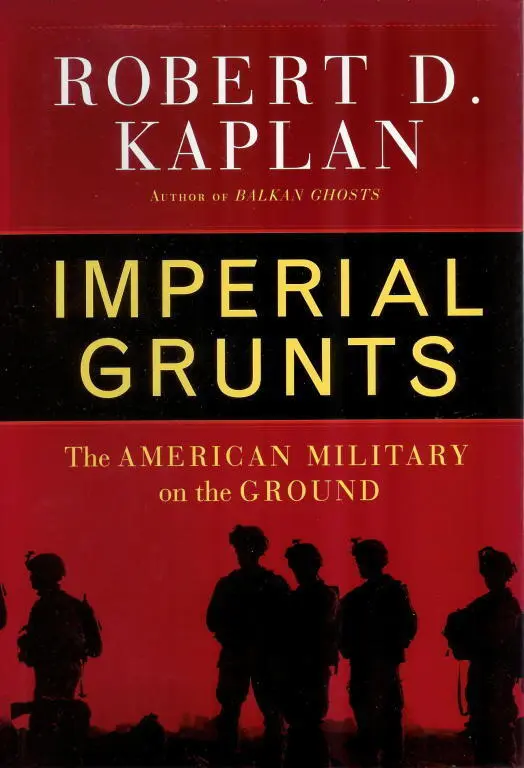
- Название:Imperial Grunts
- Автор:
- Издательство:Random House
- Жанр:
- Год:2005
- Город:New York
- ISBN:978-0-307-27850-0
- Рейтинг книги:5 / 5. Голосов: 1
-
Избранное:Добавить в избранное
- Отзывы:
-
Ваша оценка:
Imperial Grunts: краткое содержание, описание и аннотация
Предлагаем к чтению аннотацию, описание, краткое содержание или предисловие (зависит от того, что написал сам автор книги «Imperial Grunts»). Если вы не нашли необходимую информацию о книге — напишите в комментариях, мы постараемся отыскать её.
Imperial Grunts — читать онлайн бесплатно полную книгу (весь текст) целиком
Ниже представлен текст книги, разбитый по страницам. Система сохранения места последней прочитанной страницы, позволяет с удобством читать онлайн бесплатно книгу «Imperial Grunts», без необходимости каждый раз заново искать на чём Вы остановились. Поставьте закладку, и сможете в любой момент перейти на страницу, на которой закончили чтение.
Интервал:
Закладка:
Wilhelm next had to get the stuff into the countryside. “I got no intel out of the capital. The only useful intel came from the Russian troops nearest to the latest shoot-out.” He found himself writing battle doctrine for humanitarian convoys that needed to be escorted by Russian Hind helicopter gunships through terrain so rugged distances were more vertical than horizontal: from canyon floors to high mountain passes. (The last helicopter Wilhelm would pilot in his career was a Russian Mi-8 in Tajikistan, in order to survey the autonomous region of Gorno-Badakhshan.) “If your relief convoy is escorted by local militia and someone attempts to rob one of your trucks, do you ask the militiamen to shoot? At what point does a threat to a humanitarian convoy necessitate losing lives in a firefight?” he asked himself.
This was a question for which the Ranger Handbook provided no guidance. The Ranger Handbook is about combat: how to kill and avoid being killed. “Nobody much spoke about ROEs until the humanitarian and peacekeeping operations of the 1990s,” Wilhelm explained, “since during the Cold War we were either in an armed conflict or we weren’t. Now we needed subtle rules for subtle situations.”
That summer of 1992 saw fighting in Yugoslavia spread from Croatia to Bosnia, while the Caucasus, Moldova, Transdniestria, and Tajikistan all erupted in civil wars and rebellions. For untold millions across the southern swath of a former communist imperium, it was among the bloodiest and saddest times in history, even as many Americans turned away from the world in semi-isolationist ignorance.
Yet a pivotal drama had begun to unfold for both the Russian and American militaries. The collapse of the Soviet Union was causing civil conflict on the communist empire’s periphery. Throughout its history, the Soviet army had been a top-down institution in the most extreme sense. Because of the totalitarian nature of Soviet society, the lower ranks did little more than follow orders. That tendency was reinforced by the terms of the bipolar nuclear standoff, which necessitated that all key decisions be made at the highest levels in Moscow. But what had begun in Afghanistan now spread to the Caucasus and Tajikistan, places where the Soviet military found itself in the midst of dirty little wars. Consequently, in Wilhelm’s words, “The generals in Moscow had to rely on their twenty-six-year-olds in the field to figure out what to do.”
Figuring out what to do meant that these young Russian officers and noncoms had to overcome an iron law of Russian bureaucracy, initsiyativa vsegda nakazevema (initiative is always punished).
Wilhelm bonded with these young Russians, because he was in a similar position himself, writing a new rule book for what a Cold War American military, with its fixation on Armageddon in Germany’s Fulda Gap, had not prepared him for. It would be in the Balkans where that learning process would continue for him, and for the American military.
Following several months in Tajikistan, Wilhelm, now a major, was suddenly pulled back to Rhein-Main to lead more weapons inspections in the former East Bloc. Flying on a C-130 transport from one country to another, he watched the noses of MiG fighter jets cut off and steel wrecking balls destroy tanks. But his career was in danger. He had had too much education and not enough infantry experience. He became a “major non-select for the CGSC,” meaning he was not among the majority of middle-ranking officers selected to study at the Command and General Staff College at Fort Leavenworth, Kansas, which automatically put him in the bottom 20 percent of all majors slated for future promotion. The U.S. Army, still in its Cold War mode, was not impressed by his hybrid soldier-diplomatic-academic–relief worker career pattern.
To balance out his résumé, Wilhelm was assigned to the 3rd Battalion of the 12th Infantry Division, stationed in Baumholder, Germany. As the executive assistant to the commander, he worked long hours, seven days a week. “Like Ranger school, it was another meet-yourself experience. I loved it.” He kept the job for three years, during which time he continued to develop doctrine, based on his experience in Tajikistan, for MOOTWA—military operations other than war.
Then, in 1995, his unit was assigned to the United Nations peacekeeping force in Macedonia.
The next morning in Zamyn-Uud we woke to rain and freezing weather. The day before we had driven on well-worn desert tracks made by other UAZs. Now we headed out on a longer excursion southwest along the border and left the dirt tracks entirely. Here the Gobi only appeared flat; the vast ocean of stubble fields was so bumpy my head was constantly banging against the roof. After an hour we came to a zastaf (border fort), a few single-story barracks with distempered white walls and leaden green roofs. Before alighting, we drove on a little further to pay homage at an ovoo, a shamanistic cairn for making offerings to the gods.
Wilhelm, I, Maj. Altankhuu, and the other Mongolian soldiers with us walked around the ovoo three times, clockwise, throwing stones at it, in the traditional manner. Then we sprinkled camel’s milk on it—a truly sacred gift—and placed the juniper incense, tea bricks, candies, and small vodka bottles that we had brought into the ovoo ’s crevices, just as other worshippers were doing. Finally, we lined up in single file to tie khatags (ceremonial scarves) around the uppermost stones. “It’s a pretty good ovoo, ” Wilhelm said, nodding like a connoisseur.
A fat Mongol woman in a black del and orange sash was on her hands and knees in supplication. This ovoo had been a stop on the Silk Road long before the Mongolian-Chinese border existed. Destroyed by the communists, it had been rebuilt in 1990. Ovoo s were pre-Buddhist. They represented the purest and ultimate form of worship, signifying less superstition than a stark and simple submission to larger forces. Now that we had paid it the proper respect, we would be welcomed at the zastaf.
A young soldier wearing a fur hat and greatcoat, with frostbite on his cheeks, saluted smartly as we entered. Then came the dress parade, with a dozen or so troops, a few officers and their wives and children, and the post dog all standing at attention for review. It was like a frontier fort of the Old West. This was not merely a military base but a small community in the wilderness, something that Wilhelm truly admired. Protecting a remote border was seen in Mongolia as a vocation, a way of life. Such an outpost would not be considered complete without at least some women and children.
In a bare and freezing room, the officers’ wives served us tea mixed with salt, mutton fat, and camel’s milk. The women were thin, wore tight blouses, and were quite attractive. While we shivered inside our heavy jackets, they looked comfortable in shirtsleeves. Wilhelm took notes as the zastaf officers complained about how the cold weather shortened battery life for their Kenwood walkie-talkies, about the shortages of spare parts and diesel fuel, and how their solar panels didn’t work in bad weather. Wilhelm said he would try to get them new FM radios. In place of solar panels, he suggested wind generators.
The neat and frigid barracks were lined with maps and shamanistic designs. The border guards used old-model Kalashnikovs, with wooden stocks rather than collapsible metal ones. Outside, several dozen horses stood stoically in a freezing drizzle; the afternoon desert sky looked as dark and dreary as coal. A network of concrete trenches and pillboxes indicated the closeness of the Chinese border. Gen. Purev Dash, the deputy commander of the border patrol service, whom I had met in Ulaanbaatar, told me that his men used camels and horses for patrols “not because we are poor and primitive, but because such animals offered the surest means to scout the desert.” Wilhelm’s plan was for a mobile patrol force mixing fast ponies and Bactrian camels with light, high-tech communication gear.
Читать дальшеИнтервал:
Закладка:
Похожие книги на «Imperial Grunts»
Представляем Вашему вниманию похожие книги на «Imperial Grunts» списком для выбора. Мы отобрали схожую по названию и смыслу литературу в надежде предоставить читателям больше вариантов отыскать новые, интересные, ещё непрочитанные произведения.






Обсуждение, отзывы о книге «Imperial Grunts» и просто собственные мнения читателей. Оставьте ваши комментарии, напишите, что Вы думаете о произведении, его смысле или главных героях. Укажите что конкретно понравилось, а что нет, и почему Вы так считаете.