Robert Kaplan - Imperial Grunts
Здесь есть возможность читать онлайн «Robert Kaplan - Imperial Grunts» весь текст электронной книги совершенно бесплатно (целиком полную версию без сокращений). В некоторых случаях можно слушать аудио, скачать через торрент в формате fb2 и присутствует краткое содержание. Город: New York, Год выпуска: 2005, ISBN: 2005, Издательство: Random House, Жанр: Публицистика, nonf_military, на английском языке. Описание произведения, (предисловие) а так же отзывы посетителей доступны на портале библиотеки ЛибКат.
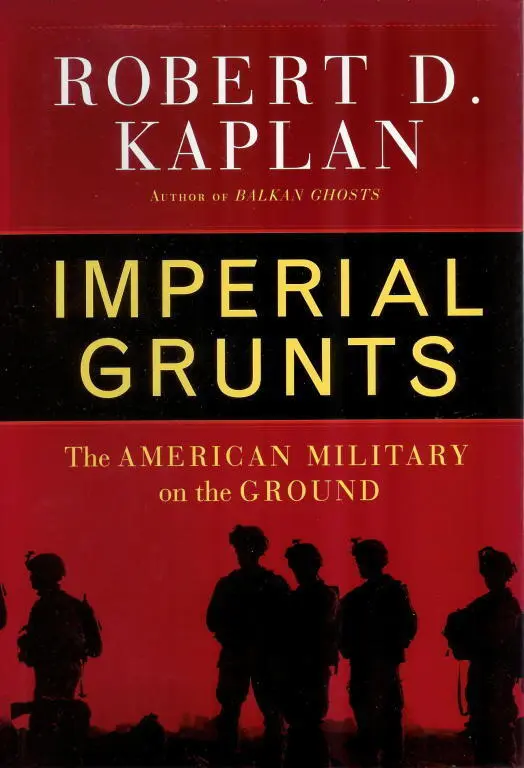
- Название:Imperial Grunts
- Автор:
- Издательство:Random House
- Жанр:
- Год:2005
- Город:New York
- ISBN:978-0-307-27850-0
- Рейтинг книги:5 / 5. Голосов: 1
-
Избранное:Добавить в избранное
- Отзывы:
-
Ваша оценка:
Imperial Grunts: краткое содержание, описание и аннотация
Предлагаем к чтению аннотацию, описание, краткое содержание или предисловие (зависит от того, что написал сам автор книги «Imperial Grunts»). Если вы не нашли необходимую информацию о книге — напишите в комментариях, мы постараемся отыскать её.
Imperial Grunts — читать онлайн бесплатно полную книгу (весь текст) целиком
Ниже представлен текст книги, разбитый по страницам. Система сохранения места последней прочитанной страницы, позволяет с удобством читать онлайн бесплатно книгу «Imperial Grunts», без необходимости каждый раз заново искать на чём Вы остановились. Поставьте закладку, и сможете в любой момент перейти на страницу, на которой закончили чтение.
Интервал:
Закладка:
“West Point’s official motto is ‘Duty, Honor, Country,’ but the everyday mantra is ‘You Must!’ Electives at other colleges are required subjects here. You take a full load of engineering, math, science, history, psychology, philosophy, foreign languages, and other hard courses besides the military training that continues through the summer. For me that included airborne training and jungle warfare school in Panama. If you flunk just one class, you get a bus ticket home the same day. You don’t even get to spend the night in your dorm room. It was certainly an experience, but it was only a moment. As soon as you’re commissioned you’re just another second lieutenant in the U.S. Army. The only information that appears on your uniform is your last name, WILHELM. You never mention that you went to West Point. The Army hates elitists.”
After West Point came something harder still: Ranger school at Fort Benning, Georgia. The Army Rangers hark back to Rogers’s Rangers, organized in 1756 by the New Hampshire native Maj. Robert Rogers, who recruited nine companies of American colonists to fight for the British during the French and Indian War. Rogers was the first to incorporate the guerrilla fighting methods of the frontier into an organized military doctrine, the nucleus of today’s Ranger Handbook.
“At Ranger school you learn what you’re capable of,” Wilhelm continued. “It’s where you meet yourself, stripped of illusions. When we’d run up a hill in full kit a school bus would follow beside us, to pick up stragglers, who got shipped out immediately—without even a chance to wash off the sweat and dust. You swam rushing rivers in winter with a full pack, boots, and rifle. The Ranger Handbook has been my bible ever since. In the Army infantry, without that Ranger patch on your BDU, you’re suspect.”
Having become an Army Ranger, Wilhelm was appointed a platoon leader of an air assault infantry unit of the 101st Airborne Division, stationed in Fort Campbell, Kentucky. It was the early 1980s, the last years, it would turn out, of the old Vietnam War Army. Robbery and drugs were still rife in the barracks. Disciplining soldiers was a big part of his job. “That was all gonna change. I’ll get to that later.” In 1983 he was sent to helicopter flight school at Fort Rucker, Alabama, and afterwards assigned to the 172nd Infantry Brigade, based in Fairbanks, Alaska.
After a tour as an Army bush pilot, Wilhelm commanded an arctic infantry company, patrolling the Aleutian Islands with Eskimo scouts, occasionally spotting signs of SPETSNAZ (Soviet special forces) units which operated in remote parts of Alaska, a little-known aspect of the Cold War. Fighting in the Arctic demanded a unique set of infantry skills. “When the temperature is forty below,” Wilhelm explained, “you can’t afford to break a sweat, because once you stop sweating you’ll turn into a Popsicle. You’ve got to stay dry, even when you’re pulling a sled loaded down with gear. Therefore, everything has to be planned and carried out far more methodically than in temperate climates. It was the best job of my life.” But that’s what he said about all the jobs he had in the Army.
In 1985 he was sent to the Canadian Land Forces Command and Staff College at Kingston, Ontario, a bastion of British colonial tradition where you wore a tie after six and were given your own napkin ring at mess. “There was a lot of esprit. Everything was deliberate, meticulous, with a fierce sense of a warrior ethic, despite the lack of opportunities Canada had to prove it. I never worked harder writing op orders. The Canadians didn’t blink; they just kept demanding more detail. I get angry whenever someone belittles the Canadian military.”
About this time Wilhelm decided to become a foreign area officer (FAO) for the Soviet Union and its environs. Henceforth he would be a soldier-diplomat, a risky career choice given that the regular Army’s main mission was fighting wars, not diplomacy. Total immersion in Russian at the Defense Language Institute in Monterey, California, and graduate school in Russian and Eastern European studies at the University of Kansas followed in quick succession. Then, on his own initiative, and with his own money—with a wink and a nod from the U.S. Army—Wilhelm applied and got accepted to Leningrad State University. “I’ve built my career in the gray areas,” he explained.
He slept in the dorms with Soviet students and queued at neighborhood buffets for sticky rice, black bread, and sour milk. “But the ice cream made it worth it. Russian vanilla ice cream is the best vanilla ice cream in the world!” he exclaimed. Like everyone else in Leningrad, he learned to chase down rumors about consignments of fresh fruit. Waiting in line once in a rainstorm for bananas, he saw the heavyset woman in front of him turn completely naked as the cheap cotton slip she was wearing stuck to her body and became transparent. She laughed along with everyone around her.
It was a life spent learning specific skills—the Russian language, arctic survival, helicopter piloting—rather than theoretical constructs. And there was no letup. At the Russian Institute in Garmisch-Partenkirchen, Germany, Wilhelm studied Soviet mapmaking and Soviet arms control mathematics, which he soon learned had nothing to do with mathematics.
“The Cold War was a sequence of tactical responses,” he explained. “Each side developed a new weapons system to negate the other side’s. The Soviets had reduced the whole process to various math equations. Then I learned about ‘Coefficient K,’ which stipulated that the Politburo always had the power to revise all the other math.” For example, toward the end of the Cold War the Soviets came out with the T-80 tank, which they touted as superior to its American counterparts. In that case, responded the Americans, the Soviets would have to reduce their forces in Europe to compensate for the imbalance created by the new tank. The Politburo then revised the math data and indicated that maybe the T-80 wasn’t such a breakthrough after all. “This was my first hard lesson in the politization of warfighting,” he said.
Wilhelm was thirty years old and an Army captain when the Berlin Wall fell, an event that would change his life. At first he was made a leader of an on-site inspection team for policing arms control agreements between the U.S. and the Soviet Union that had been accelerated by the wall’s collapse. The following decade would take him all over the former East Bloc, and to war-torn Tajikistan, Macedonia, Bosnia, and back to Tajikistan. His knowledge of Russian and other Slavic languages would get him repeatedly into war zones, something the Cold War likely never would have.
I went to sleep in the dark and rattling train compartment amidst smells of cheese, lignite, and dirty socks, remembering the China scholar Owen Lattimore’s phrase about the melancholy of travel: “a winelike melancholy, tenuous but soft, like the delicate, plangent, muted syllables of Verlaine, fortuitously remembered in a Mongolian sunset.” 28I awoke to a full moon at dawn, with snow like powdered sugar glinting on the wrinkled face of the desert. We were now in the real Gobi (Mongolian for “gravel-covered plain”). A Bactrian camel, hairy from the long winter, stood silhouetted at a lonely station platform. Wilhelm, playing with his orange prayer beads and adjusting his ball cap after a few hours of sleep, said, “Now where would you rather be: here, or stuck in traffic, staring at the car ahead of you on I-395 going to work at the Pentagon?”
The train pulled into Zamyn-Uud. Scanning the compartment one last time, Wilhelm, quoting the next-to-last page of the Ranger Handbook with Maj. Rogers’s own standing orders, declared, “Don’t forget nothing.”
Читать дальшеИнтервал:
Закладка:
Похожие книги на «Imperial Grunts»
Представляем Вашему вниманию похожие книги на «Imperial Grunts» списком для выбора. Мы отобрали схожую по названию и смыслу литературу в надежде предоставить читателям больше вариантов отыскать новые, интересные, ещё непрочитанные произведения.




Обсуждение, отзывы о книге «Imperial Grunts» и просто собственные мнения читателей. Оставьте ваши комментарии, напишите, что Вы думаете о произведении, его смысле или главных героях. Укажите что конкретно понравилось, а что нет, и почему Вы так считаете.