Robert Kaplan - Imperial Grunts
Здесь есть возможность читать онлайн «Robert Kaplan - Imperial Grunts» весь текст электронной книги совершенно бесплатно (целиком полную версию без сокращений). В некоторых случаях можно слушать аудио, скачать через торрент в формате fb2 и присутствует краткое содержание. Город: New York, Год выпуска: 2005, ISBN: 2005, Издательство: Random House, Жанр: Публицистика, nonf_military, на английском языке. Описание произведения, (предисловие) а так же отзывы посетителей доступны на портале библиотеки ЛибКат.
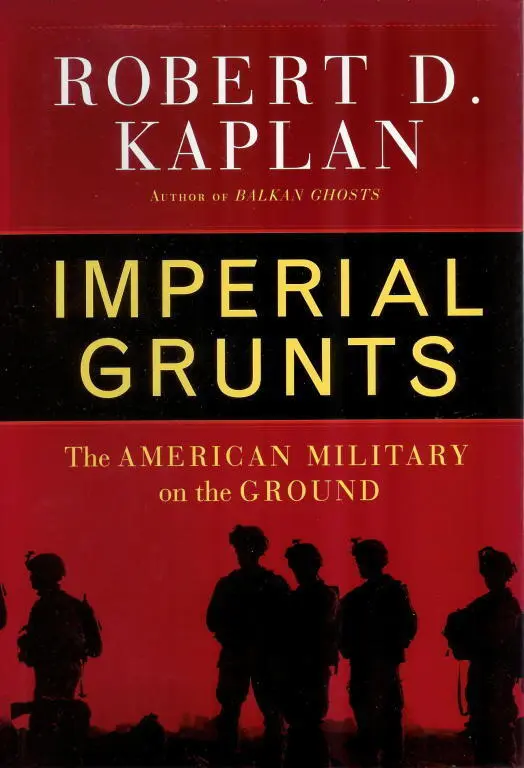
- Название:Imperial Grunts
- Автор:
- Издательство:Random House
- Жанр:
- Год:2005
- Город:New York
- ISBN:978-0-307-27850-0
- Рейтинг книги:5 / 5. Голосов: 1
-
Избранное:Добавить в избранное
- Отзывы:
-
Ваша оценка:
Imperial Grunts: краткое содержание, описание и аннотация
Предлагаем к чтению аннотацию, описание, краткое содержание или предисловие (зависит от того, что написал сам автор книги «Imperial Grunts»). Если вы не нашли необходимую информацию о книге — напишите в комментариях, мы постараемся отыскать её.
Imperial Grunts — читать онлайн бесплатно полную книгу (весь текст) целиком
Ниже представлен текст книги, разбитый по страницам. Система сохранения места последней прочитанной страницы, позволяет с удобством читать онлайн бесплатно книгу «Imperial Grunts», без необходимости каждый раз заново искать на чём Вы остановились. Поставьте закладку, и сможете в любой момент перейти на страницу, на которой закончили чтение.
Интервал:
Закладка:
As with other American officers and noncoms I had met, for Tom Wilhelm the mission was everything. Not to take bureaucratic risks—or to shade the truth for the sake of a diplomatic or career advantage—was in his eyes unmanly, the worst of offenses. “I’m the guy who gutted the DOD’s [Department of Defense’s] environmental program for Mongolia, because it was unimplementable, and I didn’t see what we were getting out of it,” he told me as soon as we had met in Ulaanbaatar, just after he had been promoted to a full bird colonel. “Gutting the environmental program was the first policy step towards getting Mongolian peacekeepers on the yellow brick road to Baghdad.”
When Wilhelm had arrived in Mongolia in 2001, there was no focus to defense relations, only a hodgepodge of unrelated aid and training programs that had not been staffed out in detail in either Washington or Ulaanbaatar. Nor did Mongolia’s post-communist military have a realistic vision of its own future. It wanted a modern air force, but it was unclear just what such an air force would do, even as there was no expertise to maintain and sustain transport planes or fighter jets.
Wilhelm, with the active support of Ambassador John Dinger (like Colombia, this was another example of interagency cooperation), implemented a “three pillars” strategy for Mongolia, to which he convinced the Mongolian military to sign on.
• Secure Mongolia’s borders not against a conventional military threat from China, which was impossible to do, but against illegal border incursions including Chinese migration and transnational terrorism—for example, the Turkic Uighurs of western China. Aided by the Chechen mafia and al-Qaeda, the oppressed Muslim Uighurs conceivably represented the future of terrorism in Central Asia.
• Prepare the Mongolian military to play an active role in international peacekeeping, in order to raise its profile in global forums and thus provide it diplomatic protection from its large, rapacious neighbors. The planned dispatch of Mongolian troops to post-Saddam Iraq elicited shrill cries of annoyance from Russia and China, which had opposed the U.S. invasion. But it was the first building block of this pillar.
• Improve Mongolia’s own capacity to respond to internal disasters.
To achieve these goals, Wilhelm scrapped existing aid programs and added new ones that would support the three pillars, such as a humanitarian dental project in a key Mongolian-Chinese border area. Even as a lieutenant colonel, Tom Wilhelm was a policymaker by another name.
But there was another reason that I traveled to Mongolia to meet Wilhelm. Tom Wilhelm—known as “Mean Mr. Tom” to warlords in Bosnia, and “Aga Tom” to aficionados of the civil war in Tajikistan—had witnessed the messy collapse of communism in Eurasia on the ground in several theaters, where his very presence indicated the consequent rise of American power. Fluent in Russian, he was the ultimate area expert for the former Soviet empire and its shadow zones, from Yugoslavia to Mongolia.
Ulaanbaatar, where Wilhelm and I met, was a composite of any number of ex-communist capitals that I had seen in the Balkans, the Caucasus, and Central Asia, with an added touch of bone-chilling Anatolian-like bleakness. Dominated by gray cement and brown dirt, it had barely a tree in sight. The apartment blocks resembled penitentiaries. The stench of lignite lasted deep into spring. Yaks fed on weeds in garbage-strewn lots on the city’s outskirts, where people inhabited traditional gers (circular felt tents). Underground utility pipes housed the homeless and shipping containers functioned as kiosks. Because of the SARS epidemic, people went about with white masks over their mouths and noses, adding a strange, futuristic element to the cityscape. [23] SARS, severe acute respiratory syndrome, caused panic in Asia in the spring of 2003. The Centers for Disease Control and Prevention in Atlanta said that the masks were of only minimal help, yet the Mongolian authorities insisted that everyone wear them.
Ulaanbaatar was a far cry from the town founded in the mid-seventeenth century as a trading post at the junction of several caravan routes, known as Urga. Roy Chapman Andrews, observing Mongol horsemen mingling with camel drivers from Turkestan in Urga’s dusty streets, compared it to “an American frontier outpost of the Indian fighting days.” 22
The American Indian analogy went far in Mongolia, for the Plains Indians were descendants of the very peoples who had migrated from this part of North-Central Asia across the Bering Strait and down into North America. Gen. Joseph Stilwell, the American commander in China during World War II, remarked that the “sturdy, dirty, hard-bitten” Mongols all had “faces like Sitting Bull.” 23The Mongolian long-song took you back to the chants of the Sioux and Apaches. Helping matters were the cowboy hats that Mongolians wore along with their traditional robes. As Wilhelm never stopped saying, “Mongolia is real Injun Country.”
There was other romance, too. Ulaanbaatar was once the Sacred City of the Living Buddha. The Buddhist lamaseries of Gandantegchinlen Khiid and Daschoilon Khiid, revived since the fall of communism, were cavernous, dusky red and leafy gold worlds of chanting, saffron-robed monks and hammered brass prayer wheels. Sculptures of frightening servant deities sat in dilapidated wooden cases sanctified by dust, reminiscent of faded black-and-white photos in an antiquarian’s library. The seventy-five-foot-tall gilded gold statue of Buddha at Gandantegchinlen Khiid, built to replace the one destroyed by the communists, was a loud, happy spirit of beauty and wonderment. It was a welcome contrast to the bone gray steppe, apartment blocks, and statues of local communist bosses that had curiously not been torn down, and which people passed by in silence.
The American Embassy in Ulaanbaatar was different from the American embassies in Sana’a and Bogotá. It was a small building, with less imposing security, befitting the threat assessment. Mongolia had been under the Soviet jackboot for seventy years, a generation longer than the satellite states of Eastern Europe, so public opinion was particularly pro-American. There were no anti-war demonstrations at the time of the invasion of Iraq. On the walls of the embassy’s corridors were splendid old photographs of Chapman Andrews’s expeditions in the Gobi in the 1920s, with the Stars and Stripes snapping in the breeze above Fulton trucks.
Newly promoted Col. Tom Wilhelm greeted me in a gray suit, white shirt, tie, and suspenders. His jobs included defense attaché, Office of Defense Cooperation chief, and liaison for Pacific Command. Actually, he was an Army FAO (foreign area officer), part of a cadre of U.S. military experts in local cultures that blended the role of soldier and diplomat.
The morning I arrived, Col. Wilhelm was busy with a number of tasks. He had to personally thank the parents of a Mongolian-born U.S. Marine fighting in Basra, Iraq, and plan for the visit of the chief of the Mongolian military, Maj. Gen. Tsevegsuran Togoo, to Washington, and the visit of fourteen American brigadier generals to Mongolia. Also due to arrive here was the Third Marine Expeditionary Force commander, Lt. Gen. Wallace Gregson. That last visit was the most important. If there were ever a land invasion of Asia, in the Korean Peninsula for example, III MEF would play a role just as prominent as I MEF had played in Iraq.
The majority of Mongolia’s foreign military training and assistance came from the U.S., and Wilhelm was only one of three full-time defense attachés here. The other two were Russian and Chinese, and they rarely left the capital. Americans were uncomfortable with the idea of empire, even as the responsibility was thrust upon them in places like this.
Читать дальшеИнтервал:
Закладка:
Похожие книги на «Imperial Grunts»
Представляем Вашему вниманию похожие книги на «Imperial Grunts» списком для выбора. Мы отобрали схожую по названию и смыслу литературу в надежде предоставить читателям больше вариантов отыскать новые, интересные, ещё непрочитанные произведения.




Обсуждение, отзывы о книге «Imperial Grunts» и просто собственные мнения читателей. Оставьте ваши комментарии, напишите, что Вы думаете о произведении, его смысле или главных героях. Укажите что конкретно понравилось, а что нет, и почему Вы так считаете.