Robert Kaplan - Imperial Grunts
Здесь есть возможность читать онлайн «Robert Kaplan - Imperial Grunts» весь текст электронной книги совершенно бесплатно (целиком полную версию без сокращений). В некоторых случаях можно слушать аудио, скачать через торрент в формате fb2 и присутствует краткое содержание. Город: New York, Год выпуска: 2005, ISBN: 2005, Издательство: Random House, Жанр: Публицистика, nonf_military, на английском языке. Описание произведения, (предисловие) а так же отзывы посетителей доступны на портале библиотеки ЛибКат.
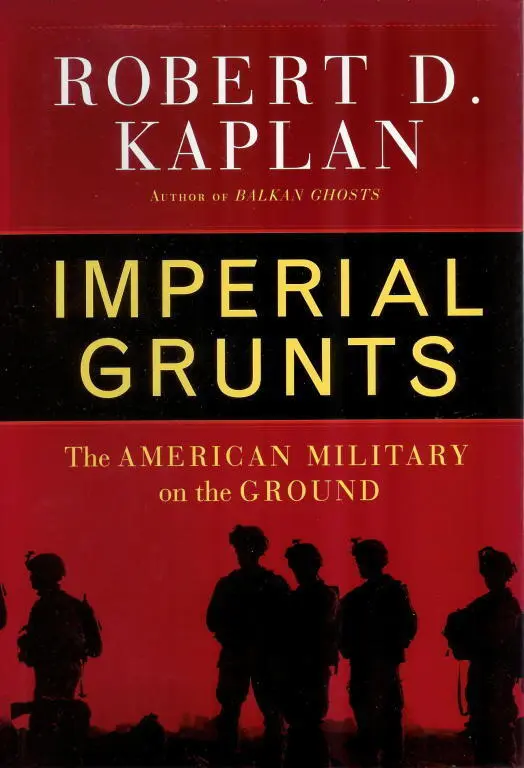
- Название:Imperial Grunts
- Автор:
- Издательство:Random House
- Жанр:
- Год:2005
- Город:New York
- ISBN:978-0-307-27850-0
- Рейтинг книги:5 / 5. Голосов: 1
-
Избранное:Добавить в избранное
- Отзывы:
-
Ваша оценка:
Imperial Grunts: краткое содержание, описание и аннотация
Предлагаем к чтению аннотацию, описание, краткое содержание или предисловие (зависит от того, что написал сам автор книги «Imperial Grunts»). Если вы не нашли необходимую информацию о книге — напишите в комментариях, мы постараемся отыскать её.
Imperial Grunts — читать онлайн бесплатно полную книгу (весь текст) целиком
Ниже представлен текст книги, разбитый по страницам. Система сохранения места последней прочитанной страницы, позволяет с удобством читать онлайн бесплатно книгу «Imperial Grunts», без необходимости каждый раз заново искать на чём Вы остановились. Поставьте закладку, и сможете в любой момент перейти на страницу, на которой закончили чтение.
Интервал:
Закладка:
But while the public at the time identified America’s imperium with an expeditionary force of several hundred thousand troops in Iraq, more often than not this empire was being created and maintained elsewhere by just a few individuals here and there. Mongolia, whose obscurity did not render it unimportant, was the best example of that.
As I MEF and the 3rd Infantry, assisted by Special Operations Forces, tried to consolidate their hold over Iraq following the collapse of Saddam Hussein’s despotic regime, a small event went unnoticed. A contingent of 175 Mongolian soldiers made plans to deploy to Iraq, to assist American troops in policing that conquered country. It constituted the first entry of Mongol troops into Mesopotamia since 1258, when Hulagu Khan, a grandson of Genghis Khan, exterminated most of the population of Baghdad, the capital of the Abbasid caliphate.
Hulagu also destroyed the irrigation system, reducing Mesopotamia to a malarial swamp from which it never quite recovered. Tamerlane, another Turkic-Mongol, reconquered it in 1400. Mesopotamia next became a battleground for Sunni Turks and Shiite Persians, with the Turks eventually consolidating it as a backwater of the Ottoman Empire. The collapse of the Ottoman sultanate at the end of World War I led to a British-created state that threw Kurds together with Sunni and Shiite Arabs. Following the British departure, one Iraqi ruler violently toppled another. Only the most ruthless of dictators could contain Iraq’s sectarian passions, hence Saddam.
The arrival in Mesopotamia of America’s liberal world empire was an attempt to reverse that doleful historical pattern. The fact that America did, in fact, constitute a world empire was best demonstrated by distant Mongolia’s inclusion in it. “Mongolia is a vast country completely surrounded by two anti-American empires, Russia and China,” S. Galsanjamts, a member of Mongolia’s National Security Council, told me. “It is therefore a symbol of the kind of independence America wants to encourage in the world.”
Before seeing how one good man encouraged that independence, it is necessary to set the stage with some history.
For nearly a millennium, from before the collapse of Rome to the dawn of the Renaissance, Inner Asia—Mongolia in particular—was the source of much of the destruction and epochal change wrought upon Europe and the Middle East. Pouring out of a desolate steppe prone to extreme temperatures and hemmed in by the Altai, Pamir, and other mountain ranges, Turko-Mongol nomads recurrently descended upon sedentary peoples lying to the south and west. Between the fourth and twelfth centuries, Huns, Avars, and Magyars, as well as Khazar, Petcheneg, and Cuman Turks, all beat similar paths out of North-Central Asia into southern Russia, the Great Hungarian Plain, and the Balkans. 1China, too, which lies to the southeast of Mongolia, suffered the whirlwind onslaughts. The Great Wall was less a defense against men than against their horses, without which the nomads were powerless. 2
But the barbarians of Asia’s interior tableland were shrewd, making a pact with one Chinese faction against the other, or siding with an exiled pretender. In his definitive tome, The Empire of the Steppes: A History of Central Asia, the French scholar René Grousset writes that the “periodic descents by the hordes of the steppe… became one of the geographic laws of history.” 3
There was an opposing law, too, which brought about the “slow absorption of the nomad invaders by ancient civilized lands.” 4To wit, the Moghul Empire in northern India, with its sensuous fusion of Persian-Turkic architecture, was the by-product of stationary anthills of civilization being invigorated, rather than ravished, by steppeland nomads, founded as the Moghul Empire was by Muhammad Babur, an early-sixteenth-century Mongol king and descendant of Tamerlane. History in Eurasia had always been determined by large-scale migrations. And that was something the United States had to keep in mind, given that as the earth’s largest landmass Eurasia was still the heart of geopolitics.
Of all the Turkic and proto-Turkic multitudes that washed out of the high plateau of North-Central Asia, the most notable came from just north of the Gobi Desert: the thirteenth-century Mongols led by Genghis Khan who, as Grousset writes, “integrated the steppe… and became the steppe incarnate, from Peking to Kiev.” 5It was Genghis—the “Great Khan” and “Lord of the Earth”—who replaced clan-based battle units with mixed squads of ten, which allowed for a monolithic cavalry that crossed tribal lines and represented all the peoples of Central Asia. 6
Following his imperial election in 1206, Genghis (a Persianized spelling, actually; he is called “Chingis” by Mongols) required only twenty years to unify the steppe and begin his conquest of sedentary China and Iran. By the middle of the thirteenth century, the conquering squadrons of his descendants would cover 90 degrees of longitude across the swath of Asia, a quarter of the earth’s circumference. 7
The descriptions of the thirteenth-century Mongols by the Chinese annalists and the medieval French traveler William of Rubruquis are, in fact, strikingly similar to those of the fourth-century Huns written by the Roman historian Ammianus Marcellinus: they were short and stocky, with broad faces, leathery skins, straight black hair, flat noses, and eyes like thin crevices. History may record nothing so terrifying as the sight of a Mongol cavalry, in all its stench and ugliness, girdling the horizon, and advancing “at a jog trot in an awe-inspiring silence,” before charging with “diabolical shrieks and yells.” 8Tuluy Khan, the most brutal of Genghis’s sons, in 1221 killed several times more people in Merv, in Turkestan, with swords and axes than the 225,000 killed in Hiroshima and Nagasaki. 9Up to 30 percent of the population of Central Asia and adjacent areas was decimated by this Mongol war machine.
Still, the great civilizations of northern India would never have come into being without these Turko-Mongol incursions. It was the Mongols who unified Cathay and Mangi, respectively the northern and southern empires of China. Kublai Khan, another of Genghis’s grandsons, established China’s Yuan dynasty, with Beijing as its capital. In 1267 he began to construct a new complex of palaces to the northeast of Beijing, known as the “City of the Khan,” Khanbaligh, the Cambuluc of Western travelers to Kublai’s court, whose luxury was celebrated by Marco Polo.
The late-eighteenth-century English historian Edward Gibbon, who considered these Central Asian hordes the “remote authors of the fall of the Roman empire,” writes thus in defense of the Mongols:
The Catholic inquisitors of Europe, who defended nonsense by cruelty, might have been confounded by the example of a barbarian, who anticipated the lessons of philosophy, and established by his laws a system of pure theism and perfect toleration. 10
Under Kublai Khan’s reign in China, Gibbon continues, “letters and commerce, peace and justice, were restored,” and “the great canal of five hundred miles was opened.” 11Kublai’s Chinese khanate lasted no more than a century, though, as the Mongols lost their old nomadic hardiness and slipped into the decadence of sedentary life. They were subsequently toppled by their Chinese subjects, even as China’s civilization had been revitalized by the steppeland occupiers. “Conquering a country while mounted is easy,” Genghis had said, anticipating the problem with China, “dismounting and building a nation is difficult.” 12It was something the U.S. would learn in Iraq eight hundred years later.
Following Genghis’s conquests, the process of dismounting and nation-building was truly begun by Ogodai Khan, the most intelligent of Genghis’s offspring. Ogodai, who completed the Mongol conquest of northern China, Iran, and southern Russia, settled in the city of Karakorum in the center of present-day Mongolia (the region where the Hsiung-nu, or Huns of antiquity, had their capital), and in 1235 surrounded it with a defensive wall. 13Gibbon observes that a “change of manners is implied in the removal… from a tent to a house.” 14In Karakorum, the sterile immensity of the plateau and forest was tempered by painting, sculpture, silverware, and the mosques and Nestorian churches of foreign traders.
Читать дальшеИнтервал:
Закладка:
Похожие книги на «Imperial Grunts»
Представляем Вашему вниманию похожие книги на «Imperial Grunts» списком для выбора. Мы отобрали схожую по названию и смыслу литературу в надежде предоставить читателям больше вариантов отыскать новые, интересные, ещё непрочитанные произведения.




Обсуждение, отзывы о книге «Imperial Grunts» и просто собственные мнения читателей. Оставьте ваши комментарии, напишите, что Вы думаете о произведении, его смысле или главных героях. Укажите что конкретно понравилось, а что нет, и почему Вы так считаете.