Robert Kaplan - Imperial Grunts
Здесь есть возможность читать онлайн «Robert Kaplan - Imperial Grunts» весь текст электронной книги совершенно бесплатно (целиком полную версию без сокращений). В некоторых случаях можно слушать аудио, скачать через торрент в формате fb2 и присутствует краткое содержание. Город: New York, Год выпуска: 2005, ISBN: 2005, Издательство: Random House, Жанр: Публицистика, nonf_military, на английском языке. Описание произведения, (предисловие) а так же отзывы посетителей доступны на портале библиотеки ЛибКат.
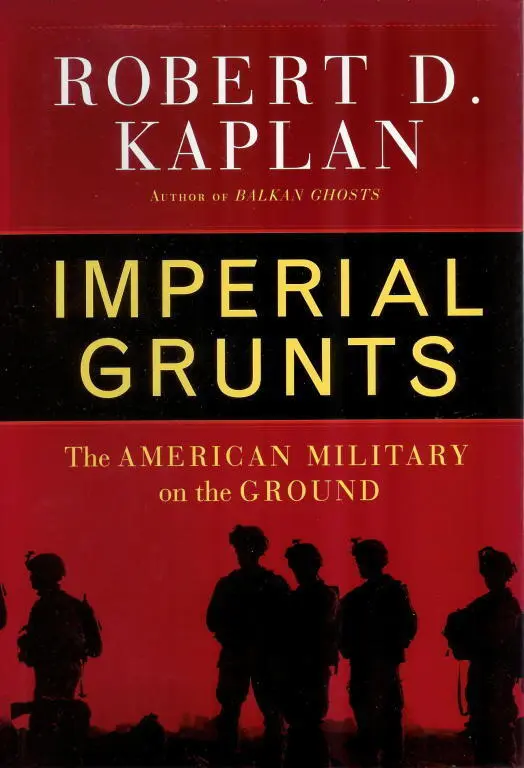
- Название:Imperial Grunts
- Автор:
- Издательство:Random House
- Жанр:
- Год:2005
- Город:New York
- ISBN:978-0-307-27850-0
- Рейтинг книги:5 / 5. Голосов: 1
-
Избранное:Добавить в избранное
- Отзывы:
-
Ваша оценка:
Imperial Grunts: краткое содержание, описание и аннотация
Предлагаем к чтению аннотацию, описание, краткое содержание или предисловие (зависит от того, что написал сам автор книги «Imperial Grunts»). Если вы не нашли необходимую информацию о книге — напишите в комментариях, мы постараемся отыскать её.
Imperial Grunts — читать онлайн бесплатно полную книгу (весь текст) целиком
Ниже представлен текст книги, разбитый по страницам. Система сохранения места последней прочитанной страницы, позволяет с удобством читать онлайн бесплатно книгу «Imperial Grunts», без необходимости каждый раз заново искать на чём Вы остановились. Поставьте закладку, и сможете в любой момент перейти на страницу, на которой закончили чтение.
Интервал:
Закладка:
“I chose to come here, and not to work on the JSTAFF [joint staff] at the Pentagon, because in Mongolia I knew that I could make a difference,” Wilhelm told me as we packed for a nine-day trip along the Mongolian-Chinese border. “Mongolians are the only optimistic people in post-Soviet Central Asia,” he went on. “In the Stans they’re all cynical.”
The Stans —Turkmenistan, Uzbekistan, and so forth—were an assemblage of dysfunctional one-man dictatorships, in which Brezhnevian-era central committeemen were behaving like medieval khans, searching for a glorious past that eluded them because of artificial borders drawn by Stalin, which had resulted in ethnically divided populations. In Mongolia, by contrast, a place with few ethnic tensions, the greatest of the true khans, Genghis, had been reborn as a unifying national hero following the Soviet collapse. Genghis, unlike Hitler or Stalin, was not burdened by any racist or utopian ideology. He was simply a conqueror, albeit among history’s bloodiest, so given enough centuries he could metamorphose into a useful and benign symbol.
The Soviets detested the legacy of Genghis Khan’s thirteenth-century Mongols. It was their destructive onslaughts that had orientalized Russia, denying Russia the experience of the European Enlightenment. Because the Communists had banned all public displays of veneration for Genghis, after the Soviet Union’s collapse he became a luminary instantly. His visage now appeared on carpets, altars, the currency, and beer and vodka bottles. Because his presence overshadowed that of every politician in this fledgling democracy, it discouraged any of them from trying to become big shots, or dictators; thus was democracy strengthened here.
For that and other odd reasons, Mongolia seemed full of promise. So was our mood as Wilhelm donned his baseball cap, suspenders, and cargo pants in the style of an Austrian mountaineer, and slipped oriental prayer beads into one of his pockets for good luck. Next he stuffed his BDU (battle dress utility) into his Army kit bag, in order to wear it at upcoming meetings with Mongolian officers at the Chinese border.
Like any good policymaker—for that was what, in essence, he was—Wilhelm relied on a vivid ground-level sensibility regarding the country in question. Such ground-level sensibility was not a matter of squeezing a large number of meetings into a day or two of travel outside the capital. The keenest insights could never be had by efficient management of time. You refined your instincts about places like Mongolia—or Colombia or Yemen, for that matter—by, in effect, wasting a lot of time. You needed to be able to forget about the capital and slip into the bizarre and tedious inefficiencies of the countryside, with its monotonous travel and meetings that often didn’t go anywhere, in order to have a better understanding of what you were dealing with. That is what Wilhelm meant to do on this trip, though he never put it that way.
Ulaanbaatar’s train station was a poured-concrete neoclassical pile that for a third world train station was surprisingly quiet and well organized. Our Russian-built train reeked of lignite as a shapely female conductor, wearing a white mask against SARS, had the stove already going for tea. Joining us in the compartment was Maj. Dabarch Altankhuu (Golden Sun), our translator. Mongolians, like American Indians, had naturalistic names. Maj. Altankhuu, dressed in jeans and a work shirt, was a young, stocky, and clean-cut officer who had learned English at the Defense Language Institute in San Antonio, Texas.
As the train slipped out of Ulaanbaatar, Wilhelm, wearing a little boy’s smile, declared: “I just love train travel.” Being dinnertime, he whipped out from his rucksack a bottle of red wine, black Russian caviar, soft-boiled eggs, cheese, and pickles, and we had ourselves a feast. Then he proceeded to pump Maj. Altankhuu for information on the up-and-comers in the Mongolian military. I looked out the window at bark-brown and tungsten-hued ridges streaked with snow beyond the last of Ulaanbaatar’s scrap metal junkyards.
Mongolia constituted a vast spectacular emptiness: Mars except with oxygen to breathe. Only 2.5 million people lived in this country two and a quarter times the size of Texas, and close to a million of them were in Ulaanbaatar. For Peter Fleming, that most intrepid of early-twentieth-century British travelers, Mongolia was a barren tableland of “little horses and great frosts.” 24Here geology mattered more than civilization. Unfolding like a streamer before my eyes was a steppe of gaunt and grumbling hills. Not a tree or piece of scrub was in sight, not even a ger. One of the pretty conductors brought tea.
Deep inside East-Central Asia, Mongolia is dominated by a “basin-like plateau,” much of which lies from three thousand to five thousand feet above sea level. 25Looming to the north are the Khangai and Altai ranges, rising to fourteen thousand feet. The climate is among the world’s most extreme, with temperatures in Ulaanbaatar varying from 100 degrees in summer to -43 degrees in winter. “It was a desolate country,” writes Roy Chapman Andrews, “for every wave in this vast land-sea was cut and slashed by the knives of wind and frost and rain, and lay in a chaotic mass of gaping wounds—canyons, ravines, and gullies, painted in rainbow colors, crossing and cutting one another at fantastic angles as far as the eye could see.” 26
Today’s Mongolia, the former Outer Mongolia, has the elongated shape of a sheepskin. We were headed southeast—and downhill—from Ulaanbaatar, into the warmer lowlands of the Gobi Desert, as far as Zamyn-Uud on the Chinese border. This was close to where Marco Polo had passed en route to China in the thirteenth century.
For much of history, the overwhelming majority of Mongolia’s inhabitants were nomadic herdsmen. The Khalka tribe formed the majority in an ethnic mosaic that included Kazakhs, Uzbeks, Buriats, and Torgots. The Chinese began settling here in the early eighteenth century by order of the Manchu emperors. The current hostility between the Mongolians and the Chinese dates from this time. While the Mongolian was at home on the back of his pony, the Chinese infiltrated through agriculture. As Chapman Andrews writes,
The Great Wall was built to keep the Mongols out, and by the same token it should have kept the Chinese in. But the rolling, grassy sea of the vast plateau was too strong a temptation for the Chinese farmer. Encouraged by his own government, which knows the value of just such peaceful penetration, he pushes forward the line of cultivation a dozen miles or so every year. 27
At sunset we saw a signature image of Mongolia’s nomadic spirit: galloping across the hard, baked steppe and keeping up with the train was a lone horseman, standing upright in his unpadded wooden saddle, wearing a pointed fur cap. “It’s like the Great Plains 150 years ago,” Wilhelm exclaimed. After two years here his enthusiasm hadn’t abated. When darkness reduced the world to the rumbling sound of the train, he began to tell me his life story.
Tom Wilhelm was born in 1959 in Evansville, Indiana. His father worked for Martin Marietta, a defense contractor. His job brought him to Orlando, Florida, soon after Tom’s birth. “I grew up in Orlando, B. M.—Before the Mouse,” he said, referring to Disney World. “It was a quiet little town back then, with a lot of veterans always talking about World War II. The military was an important part of our lives. I was a nationally ranked backstroker and class president with good grades. You know,” he continued, sounding embarrassed, “the typical high achiever, and got into West Point. When I got there I found out I was Joe Average.
Читать дальшеИнтервал:
Закладка:
Похожие книги на «Imperial Grunts»
Представляем Вашему вниманию похожие книги на «Imperial Grunts» списком для выбора. Мы отобрали схожую по названию и смыслу литературу в надежде предоставить читателям больше вариантов отыскать новые, интересные, ещё непрочитанные произведения.





Обсуждение, отзывы о книге «Imperial Grunts» и просто собственные мнения читателей. Оставьте ваши комментарии, напишите, что Вы думаете о произведении, его смысле или главных героях. Укажите что конкретно понравилось, а что нет, и почему Вы так считаете.