Robert Kaplan - Imperial Grunts
Здесь есть возможность читать онлайн «Robert Kaplan - Imperial Grunts» весь текст электронной книги совершенно бесплатно (целиком полную версию без сокращений). В некоторых случаях можно слушать аудио, скачать через торрент в формате fb2 и присутствует краткое содержание. Город: New York, Год выпуска: 2005, ISBN: 2005, Издательство: Random House, Жанр: Публицистика, nonf_military, на английском языке. Описание произведения, (предисловие) а так же отзывы посетителей доступны на портале библиотеки ЛибКат.
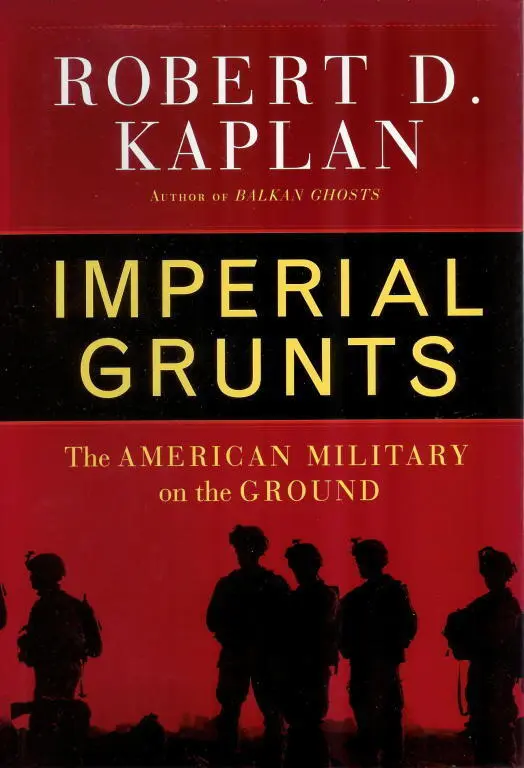
- Название:Imperial Grunts
- Автор:
- Издательство:Random House
- Жанр:
- Год:2005
- Город:New York
- ISBN:978-0-307-27850-0
- Рейтинг книги:5 / 5. Голосов: 1
-
Избранное:Добавить в избранное
- Отзывы:
-
Ваша оценка:
Imperial Grunts: краткое содержание, описание и аннотация
Предлагаем к чтению аннотацию, описание, краткое содержание или предисловие (зависит от того, что написал сам автор книги «Imperial Grunts»). Если вы не нашли необходимую информацию о книге — напишите в комментариях, мы постараемся отыскать её.
Imperial Grunts — читать онлайн бесплатно полную книгу (весь текст) целиком
Ниже представлен текст книги, разбитый по страницам. Система сохранения места последней прочитанной страницы, позволяет с удобством читать онлайн бесплатно книгу «Imperial Grunts», без необходимости каждый раз заново искать на чём Вы остановились. Поставьте закладку, и сможете в любой момент перейти на страницу, на которой закончили чтение.
Интервал:
Закладка:
Sgt. Elliot briefed Col. Wilhelm. First he introduced the other members of the team, who nodded as they were busy with patients: Dr. Mark Uyehara, an Air Force lieutenant colonel from Honolulu; Dr. Charles F. Craft, a captain in the U.S. Public Health Service from Lincoln, Nebraska; and Air Force Tech. Sgt. Lorrin Savage from Newport News, Virginia.
“The goal here, sir,” Sgt. Elliot told Col. Wilhelm, “is load-light, low-tech, small footprint.” He meant that here in the Gobi more good could be done by traveling with minimal equipment, using the most basic technology least compromised by power outages, and keeping the mission as unobtrusive as possible. Slip in, slip out, take five minutes to set up and pack up, spend the rest of your time and energy with your patients. “We stay low-key and crank out patients, sir.”
Sgt. Elliot pointed out the cheap hardware store lamps for illuminating patients’ mouths and the locally purchased gas burners for hot water sterilization. The dental chairs came from nearby shops and offices. The team had advertised its mission to the community through the local radio station. All the equipment fit into six small trunks, including presents for the kids treated along the way. It was like battlefield surgery. The American military was most impressive when it knew how to be low-tech, the same way as guerrilla fighters.
In Colombia, high-tech items were less significant than training on basic tactics like peel-back retreats and direct charges into ambushes with old-fashioned grenades and assault rifles. Each war, each training mission, brought with it new lessons that had little to do with technology. Because America, under all its post–Cold War presidents, was active militarily overseas, its armed services were improving tactically by leaps and bounds.
Wilhelm complimented Sgt. Elliot and the rest of the team on the good work. As we were leaving, Elliot said, “Drink some of that camel’s milk, sir. It’s what keeps people’s teeth here so healthy.” With his fair face, unblinking eyes, and organizational skills, Sgt. Elliot was another example of America’s superb cadre of noncommissioned officers.
Later, at Col. Battsengel’s office, we were plied with camel’s milk, greasy mutton, and horse meat for lunch. There was a portrait of Genghis Khan, but none of our beloved leader, as in all the other Central Asian countries I had visited that venerate the current dictator. Mongolia, miraculously, still comprised a traditional culture that remained undiluted and uncompromised by communism or globalization. The diet, even at the upper levels of the military, was still a purely nomadic one: meat and milk products with no fruits or vegetables, for nomads lived off their animals and did not stay long enough in any place to cultivate the land. The only foreign cultural import was vodka.
After lunch we piled into the UAZ and headed southwest along the border from Zamyn-Uud. This part of the Gobi, inside no-man’s-land, was flat, featureless, and gravel strewn, utterly disorientating. No matter what direction I fixed my eyes, it all looked the same. Here I got my first intimation of how the Gobi abounded with wildlife, more so than anyplace I had seen in sub-Saharan Africa. There were swarms of finches, ruddy drakes, and black-tailed gazelles (Asiatic antelopes), the last of which we used the UAZ to chase down, barely catching them at forty-five miles per hour, exactly as Roy Chapman Andrews had described doing in his book Across Mongolian Plains. The horizons were so far you intuited the curvature of the earth. On a one-foot rise, the only landscape feature in this flat emptiness, stood a golden eagle about two feet tall. Next we came upon herds of goats, horses, and Bactrian camels guarded by a few border police. The goats, enclosed in a corral of sheep dung, were a source of food; the horses and camels were used for patrolling.
The Bactrian camels, with their cartoon-like faces and thick winter coats that they shed in blanket-like masses, appeared almost prehistoric. They were far more imposing than the single-humped, smooth-skinned dromedaries of the North African and Middle Eastern deserts. These homely queens of the desert, with heads like floor mops, got their name from the ancient kingdom of Bactria, between the Oxus and the Hindu Kush, that was easily subdued by Alexander the Great. Mongolia and the Gobi in particular contained most of the world’s surviving Bactrians.
Near the corral was a ger inhabited by a family of nomads. They invited us inside for camel’s milk and homemade vodka. The ger, ubiquitous throughout Mongolia, is a large, round felt tent. Everywhere else in Central Asia it is known by its Turkic equivalent, yurt. We were careful not to step on the door board as we entered; that brings bad luck and was a crime punishable by death in Genghis’s time. Continuing with the prescribed etiquette, we walked to the left, or clockwise, around the side of the tent to the back, the place for honored guests. This made sense as the kitchen—a few pots on a stove fueled by dried dung—lay off to the right of the door. The center of the sloping roof was open to the sky. From there hung the ceremonial blue scarf, or khatag, which blessed the ger. The spokes of the roof frame, or toono, represented the wheel of life. The altar behind us, fragrant with juniper incense, included a small carpet with a portrait of Genghis. There was a clean pagan simplicity to it all.
“I’m culturally at home,” Wilhelm announced to the gathering, as he sprinkled vodka in the air three times in Mongolian fashion before swallowing a small glassful. “I’m in the Gobi, among Mongolians, and among soldiers.” The statement, like so many others he made, endeared him to the locals. It demonstrated, too, how imperialism can entail the aesthetic appropriation of a foreign landscape. The tradition of British literary travel writing would have been impossible without the British Empire. Tom Wilhelm was a man of empire here in Mongolia. He was a more grounded, less mystical version of Francis Younghusband, the early-twentieth-century British army officer and Central Asian explorer who had led a military expedition to Tibet as a preventative to Russian infiltration there.
Heading back to Zamyn-Uud for the night, Wilhelm continued telling me about his life.
His arms inspection team had worked out of a “cheesebox” on Rhein-Main air base in Germany, on call for surprise inspections in recently liberated East Bloc countries. Then in the summer of 1992 came Provide Hope, a humanitarian program for giving away excess military supplies (pallets of winter clothes, blankets, tea, etc.) to the victims of the civil war in Tajikistan, a war which would result in more casualties proportionate to the population than any other civil war in the second half of the twentieth century. 31Wilhelm, as a Russian foreign area officer, was dispatched immediately to Dushanbe, the Tajik capital in the midst of a descent into anarchy, where he would link up with CARE International. 32
Now a captain, the only order he got from his superiors was “Don’t get yourself killed.” The rest he had to figure out on his own.
Capt. Wilhelm now found himself the leader of a different sort of team, one of young and inexperienced civilian relief workers pining for discipline and organization. “I had to figure out who needed to be bribed in order to get our relief supplies out of the railway station in Dushanbe and into secure warehouses.” Without a functioning government, and with thousands of ethnic Russians fleeing the country, the railway station was a place of chaos. “Over tea and vodka with the stationmaster, I realized that my team had something he could use. The SeaLand containers holding the humanitarian supplies were exactly what the Russians needed to get their possessions out. Because I controlled the market on storage, we struck a deal.”
Читать дальшеИнтервал:
Закладка:
Похожие книги на «Imperial Grunts»
Представляем Вашему вниманию похожие книги на «Imperial Grunts» списком для выбора. Мы отобрали схожую по названию и смыслу литературу в надежде предоставить читателям больше вариантов отыскать новые, интересные, ещё непрочитанные произведения.








Обсуждение, отзывы о книге «Imperial Grunts» и просто собственные мнения читателей. Оставьте ваши комментарии, напишите, что Вы думаете о произведении, его смысле или главных героях. Укажите что конкретно понравилось, а что нет, и почему Вы так считаете.