Robert Kaplan - Imperial Grunts
Здесь есть возможность читать онлайн «Robert Kaplan - Imperial Grunts» весь текст электронной книги совершенно бесплатно (целиком полную версию без сокращений). В некоторых случаях можно слушать аудио, скачать через торрент в формате fb2 и присутствует краткое содержание. Город: New York, Год выпуска: 2005, ISBN: 2005, Издательство: Random House, Жанр: Публицистика, nonf_military, на английском языке. Описание произведения, (предисловие) а так же отзывы посетителей доступны на портале библиотеки ЛибКат.
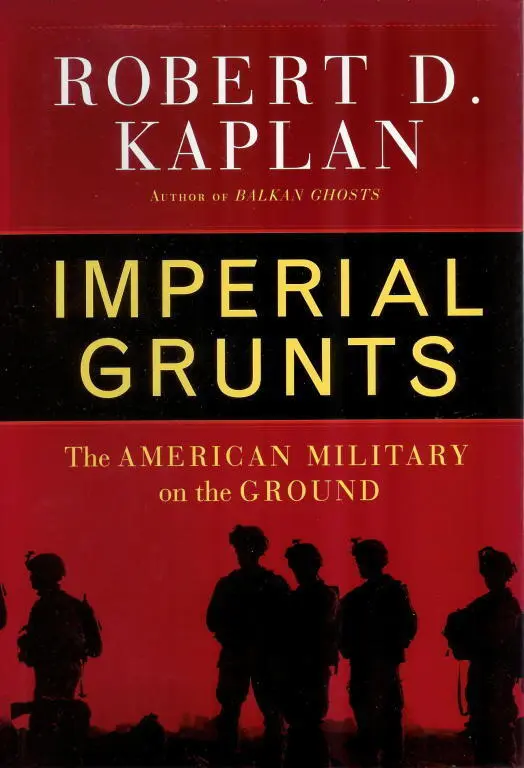
- Название:Imperial Grunts
- Автор:
- Издательство:Random House
- Жанр:
- Год:2005
- Город:New York
- ISBN:978-0-307-27850-0
- Рейтинг книги:5 / 5. Голосов: 1
-
Избранное:Добавить в избранное
- Отзывы:
-
Ваша оценка:
Imperial Grunts: краткое содержание, описание и аннотация
Предлагаем к чтению аннотацию, описание, краткое содержание или предисловие (зависит от того, что написал сам автор книги «Imperial Grunts»). Если вы не нашли необходимую информацию о книге — напишите в комментариях, мы постараемся отыскать её.
Imperial Grunts — читать онлайн бесплатно полную книгу (весь текст) целиком
Ниже представлен текст книги, разбитый по страницам. Система сохранения места последней прочитанной страницы, позволяет с удобством читать онлайн бесплатно книгу «Imperial Grunts», без необходимости каждый раз заново искать на чём Вы остановились. Поставьте закладку, и сможете в любой момент перейти на страницу, на которой закончили чтение.
Интервал:
Закладка:
“You arrived with the rain, that is a blessing,” Lt. B. Altanzul (Golden Flame), a lively and inquisitive fellow, told us after several vodka toasts. We were tired and a bit drunk, so we just let the conversation flow. Owen Lattimore writes that “nothing shuts off the speech of simple men like the suspicion that they are being pumped for information; while if they get over the feeling of strangeness they will yarn as they do among themselves,” revealing “the rich rough ore of what they themselves accept as the truth about their lives and beliefs.” 33Lt. Altanzul was not a simple man, yet after we sat and got a little drunk with him, without directly asking him a political question, he began to talk about the U.S. and Iraq, the issue of the moment.
“I saw the demonstrations against the war on television,” he remarked suddenly, “yet America acted anyway. As a military man, that impressed me.” When another officer asked us if the U.S. would defend Mongolia, as it had Kuwait in 1991, Wilhelm replied bluntly, “Probably not. The U.S. can only help Mongolia defend itself. That’s the reality.” Wilhelm loved Mongolia, but his primary concern was U.S. interests, and he was honest about that.
Driving back to Zamyn-Uud, Wilhelm talked about northeastern Macedonia, where U.S. and combined-Nordic battalions were patrolling the border with Serbia in the early 1990s.
“I was a major; my bosses called me an ‘iron major,’ no damn joke, the deputy commanding officer on the ground. ‘This is great,’ we all told ourselves, ‘we’re in a war zone,’ what all soldiers live for. There were American generals saying the Balkans were a waste of time, that we should have been doing Bradley fighting vehicle exercises in Germany instead. What a bunch of crap! Finally, we’re actually using our training, and these Cold War dinosaur generals want us to train for a war that would never happen. I’ll bet you the reenlistment rate for the soldiers who served in the Balkans was greater than that of those who stayed in Germany. The Balkan deployments were the best thing for the morale of U.S. soldiers at the time. They paved the way for how we fight now.”
Wilhelm’s men monitored the smuggling of fuel across the unmarked Serbian-Macedonian border. They tracked Serb patrols. They learned to integrate themselves with the Finns, who were part of the Nordic battalion but not part of NATO. They patrolled in full kit several times a day. “The Scandinavians started patrolling without weapons because the atmosphere seemed peaceful. Not us. Our sergeants, who didn’t have poli-sci degrees, were smart enough to insist that we lock-and-load all the time. We were defining real peacekeeping, which is like war-making, since you monopolize the use of force in a given area.
“Macedonia,” he went on, “was the dictionary definition of exotic: dark-eyed women, little teahouses, intoxicating music, and no laws or rules. It was paradise after Germany. Somalia was over. Bosnia for us hadn’t started yet. Macedonia was the only game in town. Majors and master sergeants were defining national policy at the fingertip level. It was really in the post–Cold War years that you started hearing the term ‘iron major.’”
The full flowering of the middle ranks had its roots in the social transformation of the American military which, according to Wilhelm, happened a decade earlier, when the rise of Christian evangelicalism helped stop the indiscipline of the Vietnam-era Army. “This zeal reformed behavior, empowered junior leaders, and demanded better recruits,” he said. “For one thing, drinking stopped, and that killed off the officers’ clubs, which, in turn, broke down barriers between officers and noncommissioned officers and changed the recipe for junior leader development. Our noncoms gained the confidence to do the jobs that those of higher rank and experience had previously done. Our majors do the job of colonels in other armies; our sergeants perform like captains. The moral fundamentalism,” continued Wilhelm, a liberal who voted for Al Gore in 2000, “was the hidden hand that changed the military for the better. But you try to get someone to admit it! We never could have pulled off Macedonia or Bosnia with the old Vietnam Army. It lacked the discipline and talent to abide by the restrictive ROEs and complex political-military battlefield.
“In Macedonia,” Wilhelm said, “I brought the broom back to the Wizard of Oz. The Army demanded I get experience as a field grade officer. Well, I did.”
On December 14, 1995, Wilhelm, who hadn’t seen his family for the better part of a year, was on leave in Peoria, Illinois. He had just finished cutting down a Christmas tree with his father-in-law when he saw on television that the Dayton Peace Accords had been signed. He was summoned the next day to the Balkans by Maj. Gen. William Nash, who was about to assume command of Task Force Eagle, with responsibility for the northeast sector of Bosnia.
In Macedonia, Wilhelm had learned the evolving, unwritten doctrine of insertion of forces in a zone of separation. In Bosnia he built on that. He established joint military commands in these zones between the Serbs and the Bosnian Muslims.
Establishing a joint military command, Wilhelm explained, meant “finding the top thug in each village and his counterpart on the other side of the ethnic divide, then finding a secure, neutral place for them to meet, and putting in place the force protection so that each of these local warlords could get to the meeting without being assassinated. The real purpose of the first meeting,” he went on, “was not to talk, but to show the thugs who was the boss—and it was us, not them. It was to teach them that unless something was facilitated by us, it wasn’t going to get done.
“ ‘We’re the foremen,’ I’d say to each local warlord, ‘and you’re the workers. Without all of our hands on the wheelbarrow, it ain’t going to move.’ Once they realized the fighting was over, they began making demands on us for water and electricity, which was exactly what we wanted.
“We’re still in 1995 now,” he continued. “Bosnia was a cold, muddy place, and the people were cold and muddy, too. There wasn’t much brotherly love. They had just shot the shit out of each other and were living in the rubble they made for themselves. They seemed tired, though. Their morale was low. That was all good news. Those were things we could exploit.”
Wilhelm got wind that the diplomats had worked out a deal for the Russians to join the peacekeeping force. The Russians would be subordinate to Maj. Gen. Nash, who assigned Wilhelm the role of integrating them with the other NATO peacekeepers. “The reason you’re here, corporal,” Gen. Nash told then-Maj. Wilhelm, “is to keep the Russians out of trouble.” Nash had meant the word “corporal” as a generic term for lower- and middle-ranking officers. “Nash had given me a one-sentence mission, which implied that he trusted me to figure the rest out. He knew that I knew that the Russians were professional and well disciplined, and would work well within the brigade. My job was to incorporate them into this complex, fast-moving machine of ours, and to protect them from our own media that was constantly looking for mistakes.”
Wilhelm broke off talking as the UAZ pulled into Zamyn-Uud. It was dark and we had another meal of meat and camel’s milk and vodka toasting to endure. Peter Fleming had been continuously hungry during his trip across China to India in 1935. That seemed easier to endure than being force-fed meat and alcohol all the time.
The next morning Wilhelm and I went for a walk. Zamyn-Uud’s clapboard houses, with their uneven sidings and dumb ornamentation fronting the dust-blown desert, reminded us of the bad construction that each of us had seen throughout the ex–Soviet Union and its former communist satellites. “It’s like everything in sight was put together by a high school shop class,” Wilhelm remarked. But then his zest returned, as he fingered his prayer beads.
Читать дальшеИнтервал:
Закладка:
Похожие книги на «Imperial Grunts»
Представляем Вашему вниманию похожие книги на «Imperial Grunts» списком для выбора. Мы отобрали схожую по названию и смыслу литературу в надежде предоставить читателям больше вариантов отыскать новые, интересные, ещё непрочитанные произведения.






Обсуждение, отзывы о книге «Imperial Grunts» и просто собственные мнения читателей. Оставьте ваши комментарии, напишите, что Вы думаете о произведении, его смысле или главных героях. Укажите что конкретно понравилось, а что нет, и почему Вы так считаете.